AQA · GCSE · Physics
Course version: 8463 · Version from Sept 2016
The electrons are arranged at different distances from the nucleus…
Full specification wording
The structure of an atom: The electrons are arranged at different distances from the nucleus (different energy levels).
Electrons are not scattered at random around the nucleus.
Checked against the AQA 8463 specification (opens in a new tab) on .
- Point 3 of 4
- 4 key terms
Study notes
From the checked teaching notes for this specification point.
The idea
Electrons are not scattered at random around the nucleus. They occupy particular distances from it, drawn as shells and described as energy levels. The level closest to the nucleus is the lowest in energy and fills first, taking up to two electrons; the next levels each take up to eight for the first twenty elements. So sodium, with eleven electrons, is written 2,8,1. An electron further from the nucleus is in a higher energy level, because energy has to be supplied to move it out against the attraction of the positive nucleus. The outermost electrons are held least tightly, which is why they are the ones lost when an atom becomes a positive ion.
What earns the marks
- Electrons occupying particular distances from the nucleus, called energy levels or shells.
- Stating that an electron further from the nucleus is at a higher energy level.
- Stating that the lowest energy level fills first.
- A correct electron arrangement written or drawn, such as 2,8,1 for sodium.
Common mistakes and how to put them right
Drawing electrons scattered randomly in the space around the nucleus.
Placing more than two electrons in the first energy level.
Saying the outermost electrons are at the lowest energy level.
Treating the shells as orbits that can take any radius at all.
Exam tips
- Draw each shell as a neat circle and space the electrons around it; crowded dots lose marks on diagrams.
- Count the electrons against the atomic number before you fill the levels.
- Use the phrase energy level as well as shell, because the specification wording uses both.
Try the lesson
The start of the The structure of an atom: The electrons are arranged at different distances from the nucleus (different energy levels). lesson, made from checked teaching notes for this specification point.
Have a go first
In an atom, how are the electrons arranged around the nucleus?
Listen
Electrons are not scattered at random around the nucleus. They occupy particular distances from it, drawn as shells and described as energy levels. The level closest to the nucleus is the lowest in energy and fills first, taking up to two electrons; the next levels each take up to eight for the first twenty elements. So sodium, with eleven electrons, is written 2,8,1. An electron further from the nucleus is in a higher energy level, because energy has to be supplied to move it out against the attraction of the positive nucleus. The outermost electrons are held least tightly, which is why they are the ones lost when an atom becomes a positive ion. A strong answer earns marks for these points. electrons occupying particular distances from the nucleus, called energy levels or shells. stating that an electron further from the nucleus is at a higher energy level. stating that the lowest energy level fills first. a correct electron arrangement written or drawn, such as 2,8,1 for sodium. Exam tip: Draw each shell as a neat circle and space the electrons around it; crowded dots lose marks on diagrams.
See it
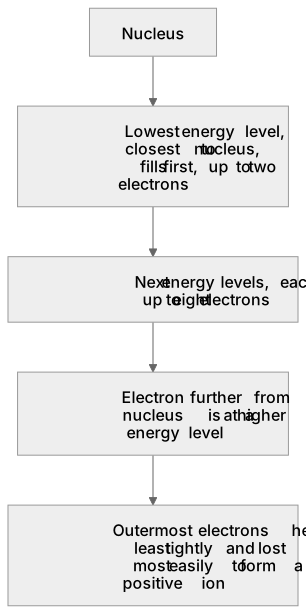
Put it in order
Put these steps in the order they happen.
- 1. Lowest energy level, closest to nucleus, fills first, up to two electrons
- 2. Next energy levels, each up to eight electrons
- 3. Nucleus
- 4. Outermost electrons held least tightly and lost most easily to form a positive ion
- 5. Electron further from nucleus is at a higher energy level
Key words
Say what each word means before you turn the card.
energy levels
Try answering aloud or in your head before turning the card.
electron shells
Try answering aloud or in your head before turning the card.
electron arrangement
Try answering aloud or in your head before turning the card.
outer electrons
Try answering aloud or in your head before turning the card.
See every definition
- energy levels
- The different distances from the nucleus at which electrons are arranged, with the level closest to the nucleus being the lowest in energy.
- electron shells
- The particular distances from the nucleus that electrons occupy, drawn as shells and described as energy levels.
- electron arrangement
- The way electrons are arranged at different distances from the nucleus, filling the lowest energy level first, such as 2,8,1 for sodium.
- outer electrons
- The electrons held least tightly, which are the ones lost when an atom becomes a positive ion.
Label the diagram
Some boxes have lost their names. Pick the right name for each number.
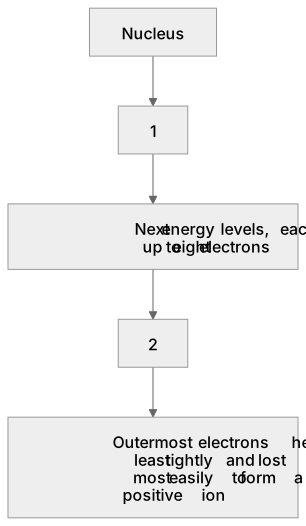
1Box 1
2Box 2
There is more to this lesson
The full lesson goes on to check your understanding and help you earn the marks. Create a free account to carry on, with your progress saved.
A week of Premium from your first lesson · Then the free plan continues · No card, no charge
Test your understanding of The structure of an atom: The electrons are arranged at different distances from the nucleus (different energy levels).
Active recall beats re-reading. Take an instant quiz now to test what you’ve learned and lock it into long-term memory.
A week of Premium from your first lesson · Then the free plan continues · No card, no charge