AQA · GCSE · Physics
Course version: 8463 · Version from Sept 2016
Students should be able to describe the difference between longitudinal…
Full specification wording
Transverse and longitudinal waves: Students should be able to describe the difference between longitudinal and transverse waves.
The difference between the two wave types is always stated with reference to the direction of energy transfer, never to the page or to the ground.
Checked against the AQA 8463 specification (opens in a new tab) on .
- Point 5 of 6
- 2 key terms
Study notes
From the checked teaching notes for this specification point.
The idea
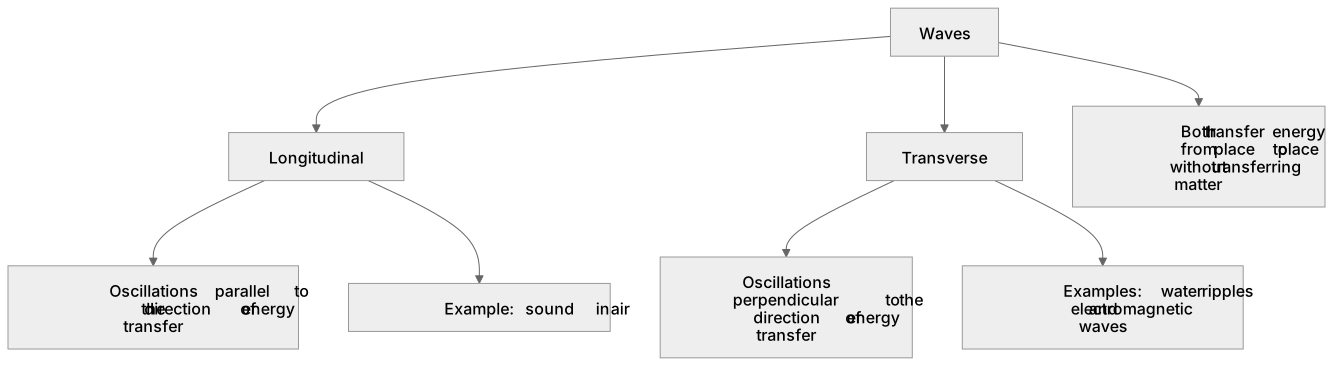
The difference between the two wave types is always stated with reference to the direction of energy transfer, never to the page or to the ground. In a longitudinal wave the oscillations or vibrations are parallel to the direction of energy transfer; in a transverse wave they are perpendicular to it. That single contrast explains the rest. Transverse waves are drawn with crests and troughs; longitudinal waves are drawn as compressions and rarefactions along the line of travel. Sound in air is longitudinal, while water ripples and every electromagnetic wave are transverse. Both types transfer energy from place to place without transferring any matter with it. Where two marks are offered, give both the parallel and the perpendicular statements; a pair of examples alone will not reach full marks.
What earns the marks
- Longitudinal waves having oscillations parallel to the direction of energy transfer.
- Transverse waves having oscillations perpendicular to the direction of energy transfer.
- A named example of each type.
- The shared property that both transfer energy and not matter.
Common mistakes and how to put them right
Answering about only one of the two wave types, so the comparison is incomplete.
Saying transverse waves move 'up and down' without stating what they are perpendicular to.
Claiming transverse waves are always faster than longitudinal waves.
Saying only longitudinal waves need a medium, when water ripples need water.
Exam tips
- Write the answer as two matched sentences so the contrast is obvious to the examiner.
- Use 'direction of energy transfer', though 'direction of wave travel' is usually accepted too.
- Add an example to each sentence; it costs one extra clause and often secures the mark.
Try the lesson
The start of the Transverse and longitudinal waves: Students should be able to describe the difference between longitudinal and transverse waves. lesson, made from checked teaching notes for this specification point.
Have a go first
Which statement describes how the particles of the medium move in a transverse wave?
Listen
The difference between the two wave types is always stated with reference to the direction of energy transfer, never to the page or to the ground. In a longitudinal wave the oscillations or vibrations are parallel to the direction of energy transfer; in a transverse wave they are perpendicular to it. That single contrast explains the rest. Transverse waves are drawn with crests and troughs; longitudinal waves are drawn as compressions and rarefactions along the line of travel. Sound in air is longitudinal, while water ripples and every electromagnetic wave are transverse. Both types transfer energy from place to place without transferring any matter with it. Where two marks are offered, give both the parallel and the perpendicular statements; a pair of examples alone will not reach full marks. A strong answer earns marks for these points. longitudinal waves having oscillations parallel to the direction of energy transfer. transverse waves having oscillations perpendicular to the direction of energy transfer. a named example of each type. the shared property that both transfer energy and not matter. Exam tip: Write the answer as two matched sentences so the contrast is obvious to the examiner.
See it
Key words
Say what each word means before you turn the card.
longitudinal wave
Try answering aloud or in your head before turning the card.
transverse wave
Try answering aloud or in your head before turning the card.
See every definition
- longitudinal wave
- A wave in which the oscillations or vibrations are parallel to the direction of energy transfer.
- transverse wave
- A wave in which the oscillations or vibrations are perpendicular to the direction of energy transfer.
Label the diagram
Some boxes have lost their names. Pick the right name for each number.
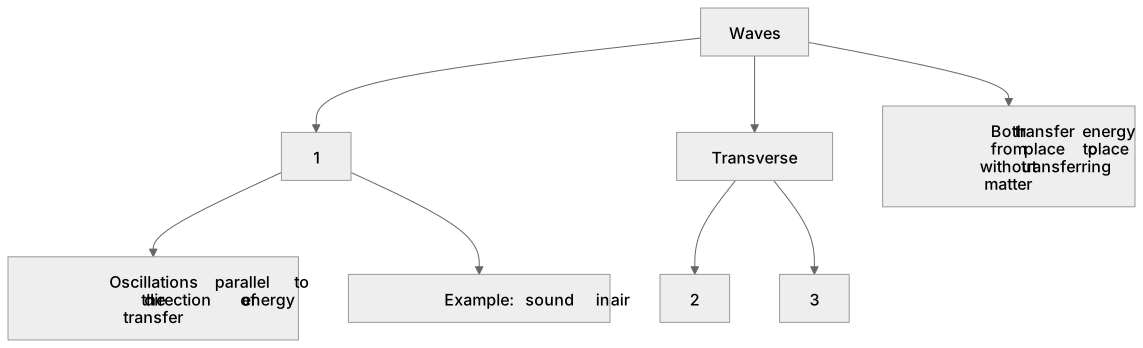
1Box 1
2Box 2
3Box 3
There is more to this lesson
The full lesson goes on to check your understanding and help you earn the marks. Create a free account to carry on, with your progress saved.
A week of Premium from your first lesson · Then the free plan continues · No card, no charge
Test your understanding of Transverse and longitudinal waves: Students should be able to describe the difference between longitudinal and transverse waves.
Active recall beats re-reading. Take an instant quiz now to test what you’ve learned and lock it into long-term memory.
A week of Premium from your first lesson · Then the free plan continues · No card, no charge