AQA · GCSE · Physics
Course version: 8463 · Version from Sept 2016
Waves may be either transverse or longitudinal.
Full specification wording
Transverse and longitudinal waves: Waves may be either transverse or longitudinal.
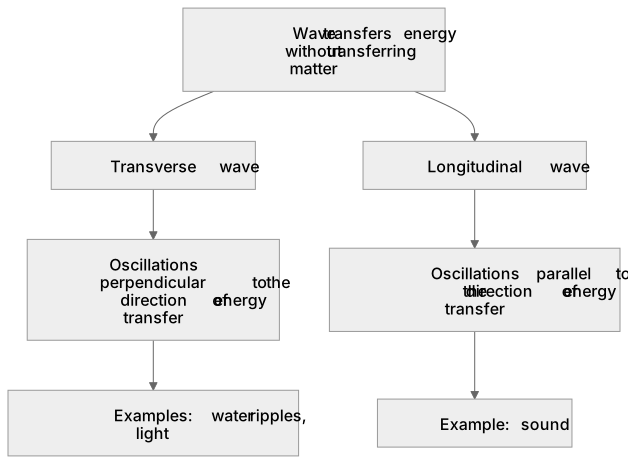
Every wave transfers energy without transferring matter, and each one is either transverse or longitudinal.
Checked against the AQA 8463 specification (opens in a new tab) on .
- Point 1 of 6
- 4 key terms
Study notes
From the checked teaching notes for this specification point.
The idea
Every wave transfers energy without transferring matter, and each one is either transverse or longitudinal. In a transverse wave the oscillations are perpendicular to the direction of energy transfer, which is why a rope shaken up and down sends a wave along its length, and why water ripples and all electromagnetic waves are drawn with crests and troughs. In a longitudinal wave the oscillations are parallel to the direction of energy transfer, so the medium is squeezed and stretched along the line the wave travels, giving compressions and rarefactions; sound is the standard example. Sound is mechanical and needs a medium; light is electromagnetic and crosses a vacuum. Both types can be reflected, refracted and diffracted, which is why they share so many properties despite the different oscillation directions.
What earns the marks
- Transverse waves having oscillations perpendicular to the direction of energy transfer.
- Longitudinal waves having oscillations parallel to the direction of energy transfer.
- A correct example of each, such as water ripples or light, and sound.
- Stating that both types transfer energy without transferring matter.
Common mistakes and how to put them right
Saying a transverse wave 'moves up and down' without saying what that is perpendicular to.
Describing longitudinal waves as going side to side rather than along the direction of travel.
Calling sound transverse because an oscilloscope displays it as a wavy line.
Claiming electromagnetic waves need a medium to travel through.
Exam tips
- Always finish the comparison with the phrase 'direction of energy transfer', which mark schemes look for.
- Give one example of each type even when the question does not ask for one.
- Keep the comparison balanced: one sentence on transverse, one on longitudinal.
Try the lesson
The start of the Transverse and longitudinal waves: Waves may be either transverse or longitudinal. lesson, made from checked teaching notes for this specification point.
Have a go first
Which statement correctly describes the difference between transverse and longitudinal waves?
Listen
Every wave transfers energy without transferring matter, and each one is either transverse or longitudinal. In a transverse wave the oscillations are perpendicular to the direction of energy transfer, which is why a rope shaken up and down sends a wave along its length, and why water ripples and all electromagnetic waves are drawn with crests and troughs. In a longitudinal wave the oscillations are parallel to the direction of energy transfer, so the medium is squeezed and stretched along the line the wave travels, giving compressions and rarefactions; sound is the standard example. Sound is mechanical and needs a medium; light is electromagnetic and crosses a vacuum. Both types can be reflected, refracted and diffracted, which is why they share so many properties despite the different oscillation directions. A strong answer earns marks for these points. transverse waves having oscillations perpendicular to the direction of energy transfer. longitudinal waves having oscillations parallel to the direction of energy transfer. a correct example of each, such as water ripples or light, and sound. stating that both types transfer energy without transferring matter. Exam tip: Always finish the comparison with the phrase 'direction of energy transfer', which mark schemes look for.
See it
Key words
Say what each word means before you turn the card.
transverse waves
Try answering aloud or in your head before turning the card.
longitudinal waves
Try answering aloud or in your head before turning the card.
direction of energy transfer
Try answering aloud or in your head before turning the card.
energy not matter
Try answering aloud or in your head before turning the card.
See every definition
- transverse waves
- Waves in which the oscillations are perpendicular to the direction of energy transfer.
- longitudinal waves
- Waves in which the oscillations are parallel to the direction of energy transfer, giving compressions and rarefactions.
- direction of energy transfer
- The line along which a wave carries energy, to which transverse oscillations are perpendicular and longitudinal oscillations are parallel.
- energy not matter
- Both types of wave transfer energy without transferring matter.
Label the diagram
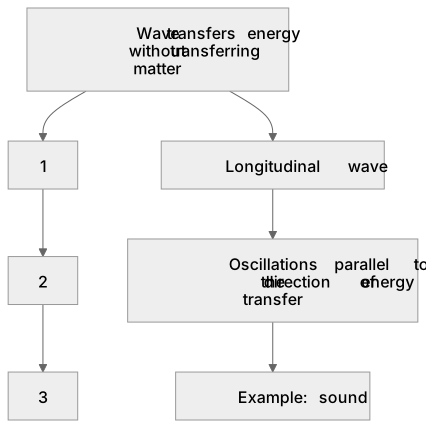
Some boxes have lost their names. Pick the right name for each number.
1Box 1
2Box 2
3Box 3
There is more to this lesson
The full lesson goes on to check your understanding and help you earn the marks. Create a free account to carry on, with your progress saved.
A week of Premium from your first lesson · Then the free plan continues · No card, no charge
Test your understanding of Transverse and longitudinal waves: Waves may be either transverse or longitudinal.
Active recall beats re-reading. Take an instant quiz now to test what you’ve learned and lock it into long-term memory.
A week of Premium from your first lesson · Then the free plan continues · No card, no charge