AQA · GCSE · Physics
Course version: 8463 · Version from Sept 2016
Students should be able to: explain how the generator effect is used in an…
Full specification wording
Uses of the generator effect (HT only): Students should be able to: explain how the generator effect is used in an alternator to generate ac and in a dynamo to generate dc draw/interpret graphs of potential difference generated in the coil against time.
A generator's output is never steady, because the rate at which the sides of the coil cut field lines changes as the coil turns.
Checked against the AQA 8463 specification (opens in a new tab) on .
- Point 2 of 2
- 4 key terms
Study notes
From the checked teaching notes for this specification point.
The idea
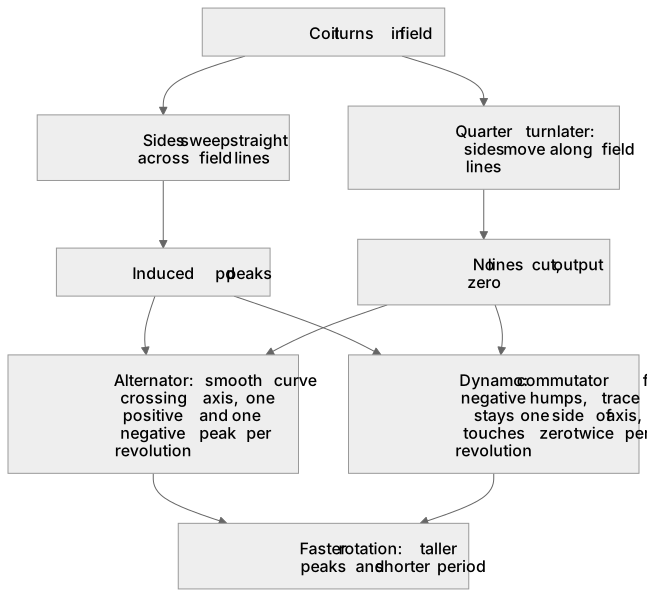
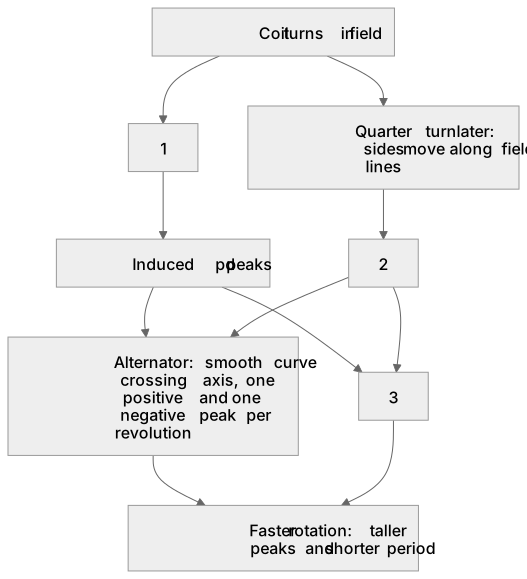
A generator's output is never steady, because the rate at which the sides of the coil cut field lines changes as the coil turns. When the coil lies along the field its sides sweep straight across the field lines and the induced potential difference peaks; a quarter turn later those sides are moving along the lines, cutting none, and the output is zero. An alternator therefore traces a smooth curve that crosses the time axis twice per revolution, with one peak above the axis and one below. A dynamo traces the same humps, but the commutator flips the negative ones over, so every hump sits on the same side of the axis and the trace touches zero twice per revolution without crossing. Spin either faster and the peaks grow taller while the period gets shorter.
What earns the marks
- A smooth curve rather than straight lines or a square wave.
- The alternator trace crossing the axis, with one positive and one negative peak per revolution.
- The dynamo trace staying on one side of the axis and touching zero twice per revolution.
- A faster rotation drawn as both taller peaks and a shorter period.
- Linking the zero output to the moment the coil sides move along the field lines rather than across them.
Common mistakes and how to put them right
Drawing a dynamo output as a flat horizontal line, as though it were a battery.
Drawing taller peaks for a faster rotation but keeping the period the same.
Drawing a square wave, which suggests the potential difference switches instantly.
Putting the peaks where the coil is at right angles to the field, which is where the output is zero.
Giving the alternator an output that never goes below the axis.
Exam tips
- Mark the revolutions on the time axis first, so that you draw the right number of peaks.
- Sketch means a labelled shape rather than plotted points, but it must still start and finish in the right places.
- If the question doubles the speed, change two things on the graph, the height and the period.
Try the lesson
The start of the Uses of the generator effect (HT only): Students should be able to: explain how the generator effect is used in an alternator to generate ac and in a dynamo to generate dc draw/interpret graphs of potential difference generated in the coil against time. lesson, made from checked teaching notes for this specification point.
Have a go first
A graph shows the potential difference from a generator plotted against time. The trace is a wave that rises above the time axis, returns to zero, then falls below the time axis before returning to zero. What does this trace show?
Listen
A generator's output is never steady, because the rate at which the sides of the coil cut field lines changes as the coil turns. When the coil lies along the field its sides sweep straight across the field lines and the induced potential difference peaks; a quarter turn later those sides are moving along the lines, cutting none, and the output is zero. An alternator therefore traces a smooth curve that crosses the time axis twice per revolution, with one peak above the axis and one below. A dynamo traces the same humps, but the commutator flips the negative ones over, so every hump sits on the same side of the axis and the trace touches zero twice per revolution without crossing. Spin either faster and the peaks grow taller while the period gets shorter. A strong answer earns marks for these points. a smooth curve rather than straight lines or a square wave. the alternator trace crossing the axis, with one positive and one negative peak per revolution. the dynamo trace staying on one side of the axis and touching zero twice per revolution. a faster rotation drawn as both taller peaks and a shorter period. Exam tip: Mark the revolutions on the time axis first, so that you draw the right number of peaks.
See it
Key words
Say what each word means before you turn the card.
smooth curve
Try answering aloud or in your head before turning the card.
period and peak value
Try answering aloud or in your head before turning the card.
alternator against dynamo
Try answering aloud or in your head before turning the card.
output against time graphs
Try answering aloud or in your head before turning the card.
See every definition
- smooth curve
- The shape of the trace drawn for a generator's output, rather than straight lines or a square wave.
- period and peak value
- Two features of a generator's output graph; spinning faster makes the peaks grow taller while the period gets shorter.
- alternator against dynamo
- The alternator trace crosses the time axis with one positive and one negative peak per revolution, while the dynamo trace stays on one side of the axis and touches zero twice per revolution.
- output against time graphs
- Graphs of the potential difference generated in the coil plotted against time, which students should be able to draw and interpret.
Label the diagram
Some boxes have lost their names. Pick the right name for each number.
1Box 1
2Box 2
3Box 3
There is more to this lesson
The full lesson goes on to check your understanding and help you earn the marks. Create a free account to carry on, with your progress saved.
A week of Premium from your first lesson · Then the free plan continues · No card, no charge
Test your understanding of Uses of the generator effect (HT only): Students should be able to: explain how the generator effect is used in an alternator to generate ac and in a dynamo to generate dc draw/interpret graphs of potential difference generated in the coil against time.
Active recall beats re-reading. Take an instant quiz now to test what you’ve learned and lock it into long-term memory.
A week of Premium from your first lesson · Then the free plan continues · No card, no charge