AQA · GCSE · Physics
Course version: 8463 · Version from Sept 2016
Students should be able to explain: how the colour of an object is related…
Full specification wording
Visible light (physics only): Students should be able to explain: how the colour of an object is related to the differential absorption, transmission and reflection of different wavelengths of light by the object the effect of viewing objects through filters or the effect on light of passing through filters why an opaque object has a particular colour.
Questions on this content chain several steps together, so work through them in order: what light leaves the source, what the filter transmits and absorbs, what the surface reflects and absorbs,…
Checked against the AQA 8463 specification (opens in a new tab) on .
- Point 9 of 9
Study notes
From the checked teaching notes for this specification point.
The idea
Questions on this content chain several steps together, so work through them in order: what light leaves the source, what the filter transmits and absorbs, what the surface reflects and absorbs, and what finally reaches the eye. Colourless glass transmits all of the white light, so nothing changes. Blue glass transmits only the blue and absorbs the other colours, so anything seen through it is lit by blue light alone. A red book viewed through a blue filter then looks black, because the only light reaching it is blue and the red surface absorbs blue. Each transmitted colour and each absorbed colour is credited separately, so name both rather than describing the result as the light changing colour.
What earns the marks
- Stating that colourless glass transmits the white light unchanged.
- Stating that blue glass transmits only the blue light.
- Stating that all the other colours, wavelengths or frequencies are absorbed.
- Chaining the filter and the surface together to predict the final appearance of an object.
Common mistakes and how to put them right
Describing only the colour that gets through and never naming what is absorbed.
Saying the filter reflects the missing colours back towards the source.
Treating an object's colour as fixed, independent of the light actually reaching it.
Writing that the light 'turns blue' as it passes through the glass.
Exam tips
- Work through source, filter, object, eye in that order and write one sentence for each stage.
- Two answer boxes mean two separate answers; do not use one to cover both materials.
- Stick to the vocabulary transmitted, absorbed and reflected throughout.
Try the lesson
The start of the Visible light (physics only): Students should be able to explain: how the colour of an object is related to the differential absorption, transmission and reflection of different wavelengths of light by the object the effect of viewing objects through filters or the effect on light of passing through filters why an opaque object has a particular colour. lesson, made from checked teaching notes for this specification point.
Have a go first
A red apple is viewed in white light. Which statement explains why the apple appears red?
Listen
Questions on this content chain several steps together, so work through them in order: what light leaves the source, what the filter transmits and absorbs, what the surface reflects and absorbs, and what finally reaches the eye. Colourless glass transmits all of the white light, so nothing changes. Blue glass transmits only the blue and absorbs the other colours, so anything seen through it is lit by blue light alone. A red book viewed through a blue filter then looks black, because the only light reaching it is blue and the red surface absorbs blue. Each transmitted colour and each absorbed colour is credited separately, so name both rather than describing the result as the light changing colour. A strong answer earns marks for these points. stating that colourless glass transmits the white light unchanged. stating that blue glass transmits only the blue light. stating that all the other colours, wavelengths or frequencies are absorbed. chaining the filter and the surface together to predict the final appearance of an object. Exam tip: Work through source, filter, object, eye in that order and write one sentence for each stage.
See it
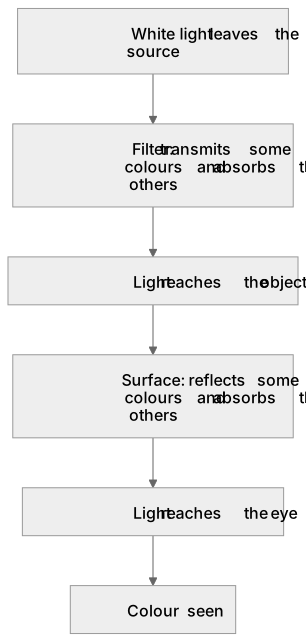
Put it in order
Put these steps in the order they happen.
- 1. Light reaches the object
- 2. Filter: transmits some colours and absorbs the others
- 3. White light leaves the source
- 4. Colour seen
- 5. Light reaches the eye
- 6. Surface: reflects some colours and absorbs the others
Label the diagram
Some boxes have lost their names. Pick the right name for each number.
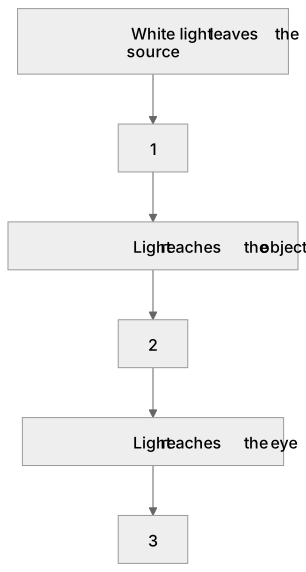
1Box 1
2Box 2
3Box 3
There is more to this lesson
The full lesson goes on to check your understanding and help you earn the marks. Create a free account to carry on, with your progress saved.
A week of Premium from your first lesson · Then the free plan continues · No card, no charge
Test your understanding of Visible light (physics only): Students should be able to explain: how the colour of an object is related to the differential absorption, transmission and reflection of different wavelengths of light by the object the effect of viewing objects through filters or the effect on light of passing through filters why an opaque object has a particular colour.
Active recall beats re-reading. Take an instant quiz now to test what you’ve learned and lock it into long-term memory.
A week of Premium from your first lesson · Then the free plan continues · No card, no charge