AQA · GCSE · Physics
Course version: 8463 · Version from Sept 2016
Wavelengths that are not reflected are absorbed.
Full specification wording
Visible light (physics only): Wavelengths that are not reflected are absorbed.
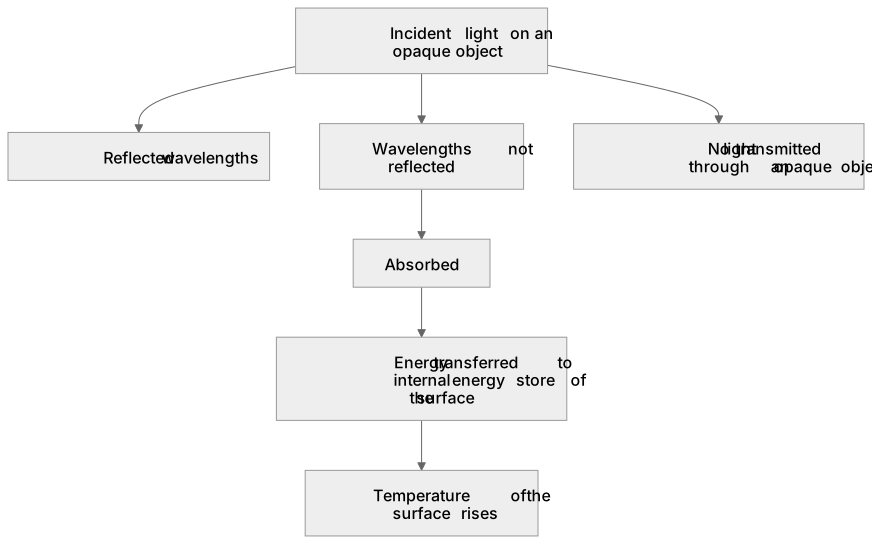
For an opaque object the incident light has only two possible fates: it is reflected or it is absorbed, because none is transmitted through.
Checked against the AQA 8463 specification (opens in a new tab) on .
- Point 5 of 9
- 3 key terms
Study notes
From the checked teaching notes for this specification point.
The idea
For an opaque object the incident light has only two possible fates: it is reflected or it is absorbed, because none is transmitted through. The two shares add up to all of the incident light, so once you know which wavelengths are reflected you also know that everything else has been absorbed. A green leaf reflects the middle of the spectrum and absorbs the red and blue. Absorbed light is not destroyed; its energy is transferred to the internal energy store of the surface, which is why a black car roof in sunlight becomes far hotter than a white one. That same idea carries straight over into the infrared work: a matt black cube absorbs the most and shows the largest temperature rise.
What earns the marks
- Stating that any wavelength not reflected by an opaque surface is absorbed.
- Naming the colours absorbed by a given object, such as a green leaf absorbing red and blue.
- Stating that no light is transmitted through an opaque object.
- Linking absorption to an increase in the internal energy, and so the temperature, of the surface.
Common mistakes and how to put them right
Saying the light that is not reflected simply disappears or is destroyed.
Saying the unreflected light passes through an object described as opaque.
Describing absorption as reflection that happens inside the object.
Forgetting that absorbed light warms the surface, so missing the energy mark.
Exam tips
- Answer in two parts: what is reflected, then what is absorbed.
- Bring in the temperature rise when a question mentions sunlight or heating.
- Use 'absorbed' rather than 'taken in' or 'soaked up' to match the mark scheme.
Try the lesson
The start of the Visible light (physics only): Wavelengths that are not reflected are absorbed. lesson, made from checked teaching notes for this specification point.
Have a go first
A red apple is placed in white light. Which wavelengths of visible light does the apple absorb?
Listen
For an opaque object the incident light has only two possible fates: it is reflected or it is absorbed, because none is transmitted through. The two shares add up to all of the incident light, so once you know which wavelengths are reflected you also know that everything else has been absorbed. A green leaf reflects the middle of the spectrum and absorbs the red and blue. Absorbed light is not destroyed; its energy is transferred to the internal energy store of the surface, which is why a black car roof in sunlight becomes far hotter than a white one. That same idea carries straight over into the infrared work: a matt black cube absorbs the most and shows the largest temperature rise. A strong answer earns marks for these points. stating that any wavelength not reflected by an opaque surface is absorbed. naming the colours absorbed by a given object, such as a green leaf absorbing red and blue. stating that no light is transmitted through an opaque object. linking absorption to an increase in the internal energy, and so the temperature, of the surface. Exam tip: Answer in two parts: what is reflected, then what is absorbed.
See it
Key words
Say what each word means before you turn the card.
absorption
Try answering aloud or in your head before turning the card.
opaque surfaces
Try answering aloud or in your head before turning the card.
heating by absorbed light
Try answering aloud or in your head before turning the card.
See every definition
- absorption
- Wavelengths that are not reflected are absorbed, and the energy of absorbed light is transferred to the internal energy store of the surface.
- opaque surfaces
- For an opaque object the incident light has only two possible fates: it is reflected or it is absorbed, because none is transmitted through.
- heating by absorbed light
- Absorbed light is not destroyed; its energy is transferred to the internal energy store of the surface, so the surface becomes hotter.
Label the diagram
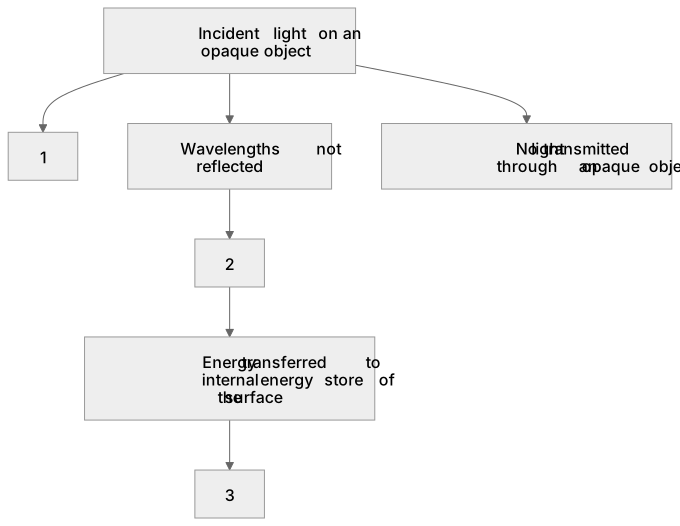
Some boxes have lost their names. Pick the right name for each number.
1Box 1
2Box 2
3Box 3
There is more to this lesson
The full lesson goes on to check your understanding and help you earn the marks. Create a free account to carry on, with your progress saved.
A week of Premium from your first lesson · Then the free plan continues · No card, no charge
Test your understanding of Visible light (physics only): Wavelengths that are not reflected are absorbed.
Active recall beats re-reading. Take an instant quiz now to test what you’ve learned and lock it into long-term memory.
A week of Premium from your first lesson · Then the free plan continues · No card, no charge