AQA · GCSE · Physics
Course version: 8463 · Version from Sept 2016
Students should be aware that the study of seismic waves provided new…
Full specification wording
Waves for detection and exploration (physics only) (HT only): Students should be aware that the study of seismic waves provided new evidence that led to discoveries about parts of the Earth which are not directly observable.
This statement is about how science works, not only about the Earth.
Checked against the AQA 8463 specification (opens in a new tab) on .
- Point 12 of 12
- 4 key terms
Study notes
From the checked teaching notes for this specification point.
The idea
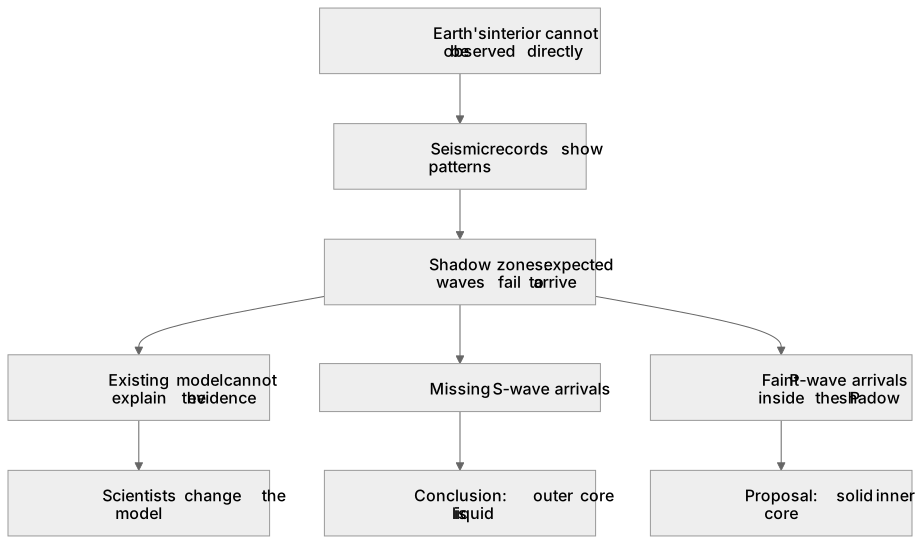
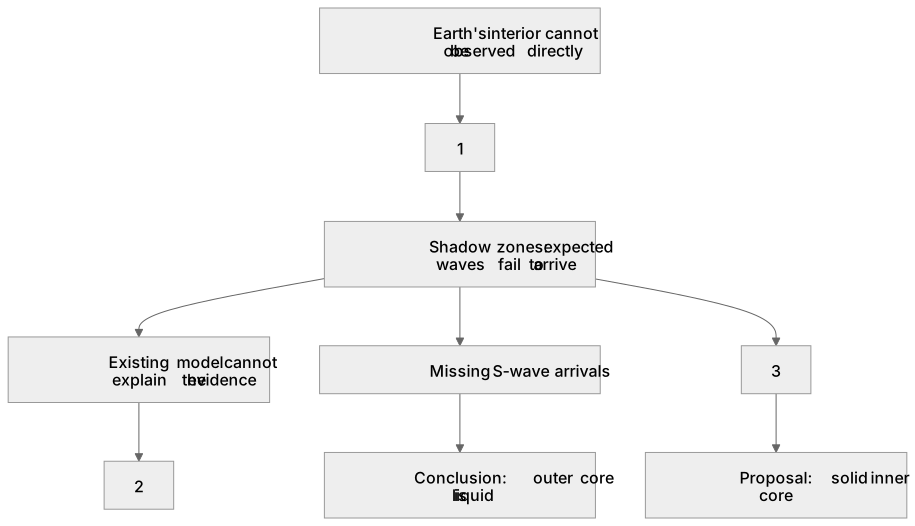
This statement is about how science works, not only about the Earth. Nobody has ever seen the core; the model of a layered Earth was built because seismic records contained patterns the earlier models could not explain, in particular shadow zones where expected waves failed to arrive. When new evidence appears that the current model cannot account for, scientists change the model. That is what happened when the S-wave shadow forced the conclusion that the outer core is liquid, and again when faint P-wave arrivals inside the P shadow led to a solid inner core being proposed. Exam questions usually ask why scientists change a theory, and the expected answer is that new observations or evidence appear that the existing theory cannot explain.
What earns the marks
- Saying that new evidence or observations were found that the existing model could not explain.
- Naming the seismic evidence, such as the shadow zone or missing S-wave arrivals.
- Stating the conclusion drawn, such as a liquid outer core.
- Saying that the interior of the Earth cannot be observed directly, so the evidence has to be indirect.
Common mistakes and how to put them right
Saying models change because they are old fashioned or because scientists update them every so often.
Claiming the core has been observed, drilled or sampled directly.
Giving the conclusion without saying what evidence prompted it.
Saying one scientist proved the model, rather than the evidence being tested and accepted by others.
Exam tips
- For why do scientists change a model questions, the mark is for new evidence the old model cannot explain.
- Name the specific seismic observation if the question is about the Earth, not just new evidence.
- Keep the answer to evidence and conclusion; opinions about scientists score nothing.
Try the lesson
The start of the Waves for detection and exploration (physics only) (HT only): Students should be aware that the study of seismic waves provided new evidence that led to discoveries about parts of the Earth which are not directly observable. lesson, made from checked teaching notes for this specification point.
Have a go first
How does the study of seismic waves provide evidence about the structure of the Earth's interior?
Listen
This statement is about how science works, not only about the Earth. Nobody has ever seen the core; the model of a layered Earth was built because seismic records contained patterns the earlier models could not explain, in particular shadow zones where expected waves failed to arrive. When new evidence appears that the current model cannot account for, scientists change the model. That is what happened when the S-wave shadow forced the conclusion that the outer core is liquid, and again when faint P-wave arrivals inside the P shadow led to a solid inner core being proposed. Exam questions usually ask why scientists change a theory, and the expected answer is that new observations or evidence appear that the existing theory cannot explain. A strong answer earns marks for these points. saying that new evidence or observations were found that the existing model could not explain. naming the seismic evidence, such as the shadow zone or missing S-wave arrivals. stating the conclusion drawn, such as a liquid outer core. saying that the interior of the Earth cannot be observed directly, so the evidence has to be indirect. Exam tip: For why do scientists change a model questions, the mark is for new evidence the old model cannot explain.
See it
Key words
Say what each word means before you turn the card.
indirect evidence
Try answering aloud or in your head before turning the card.
changing models
Try answering aloud or in your head before turning the card.
shadow zones
Try answering aloud or in your head before turning the card.
how science works
Try answering aloud or in your head before turning the card.
See every definition
- indirect evidence
- Evidence about parts of the Earth which are not directly observable, so the evidence has to be indirect.
- changing models
- Scientists change the model when new evidence or observations appear that the existing model cannot explain.
- shadow zones
- Patterns in seismic records where expected waves failed to arrive, which the earlier models could not explain.
- how science works
- When new evidence appears that the current model cannot account for, scientists change the model.
Label the diagram
Some boxes have lost their names. Pick the right name for each number.
1Box 1
2Box 2
3Box 3
There is more to this lesson
The full lesson goes on to check your understanding and help you earn the marks. Create a free account to carry on, with your progress saved.
A week of Premium from your first lesson · Then the free plan continues · No card, no charge
Test your understanding of Waves for detection and exploration (physics only) (HT only): Students should be aware that the study of seismic waves provided new evidence that led to discoveries about parts of the Earth which are not directly observable.
Active recall beats re-reading. Take an instant quiz now to test what you’ve learned and lock it into long-term memory.
A week of Premium from your first lesson · Then the free plan continues · No card, no charge