AQA · GCSE · Physics
Course version: 8463 · Version from Sept 2016
The time taken for the reflections to reach a detector can be used to…
Full specification wording
Waves for detection and exploration (physics only) (HT only): The time taken for the reflections to reach a detector can be used to determine how far away such a boundary is.
The measurement is a timing.
Checked against the AQA 8463 specification (opens in a new tab) on .
- Point 4 of 12
- 4 key terms
Study notes
From the checked teaching notes for this specification point.
The idea
The measurement is a timing. A short pulse is sent out, travels to the boundary, reflects and travels back, and the detector records the time t between transmission and echo. In that time the pulse has covered twice the depth, so the distance to the boundary is (v × t) / 2, where v is the speed of the wave in that medium. Forgetting the factor of two is the classic error because it doubles the answer. For a boundary 6 cm deep in tissue where the speed is 1500 m/s, the echo returns after 2 × 0.06 / 1500 = 8 × 10⁻⁵ s. If two echoes are recorded, the separation between the two boundaries comes from the difference in their times, using the same halving rule.
What earns the marks
- Using speed = distance / time with the speed in the correct medium.
- Halving the calculated distance because the pulse travels to the boundary and back.
- A correct substitution with the time converted to seconds.
- The final depth given with a correct unit.
Common mistakes and how to put them right
Leaving out the factor of two, so quoting a depth twice the true value.
Using the speed of sound in air for a pulse travelling through tissue or water.
Leaving the time in milliseconds or microseconds while the speed is in m/s.
Taking the gap between two echoes as the time when the question asks for the depth of the first boundary.
Exam tips
- Write total distance = 2 × depth as your first line so the halving cannot be forgotten.
- Convert µs and ms to seconds before substituting, and show the converted value.
- Check the size of your answer against the context; a scan depth of 30 m should tell you something is wrong.
Try the lesson
The start of the Waves for detection and exploration (physics only) (HT only): The time taken for the reflections to reach a detector can be used to determine how far away such a boundary is. lesson, made from checked teaching notes for this specification point.
Have a go first
A pulse of ultrasound is sent into a block of steel. A reflection returns to the detector 0.000 08 s after the pulse was emitted. The speed of ultrasound in steel is 5900 m/s. Calculate the distance from the detector to the boundary that produced the reflection.
Listen
The measurement is a timing. A short pulse is sent out, travels to the boundary, reflects and travels back, and the detector records the time t between transmission and echo. In that time the pulse has covered twice the depth, so the distance to the boundary is (v × t) / 2, where v is the speed of the wave in that medium. Forgetting the factor of two is the classic error because it doubles the answer. For a boundary 6 cm deep in tissue where the speed is 1500 m/s, the echo returns after 2 × 0.06 / 1500 = 8 × 10⁻⁵ s. If two echoes are recorded, the separation between the two boundaries comes from the difference in their times, using the same halving rule. A strong answer earns marks for these points. using speed = distance / time with the speed in the correct medium. halving the calculated distance because the pulse travels to the boundary and back. a correct substitution with the time converted to seconds. the final depth given with a correct unit. Exam tip: Write total distance = 2 × depth as your first line so the halving cannot be forgotten.
See it
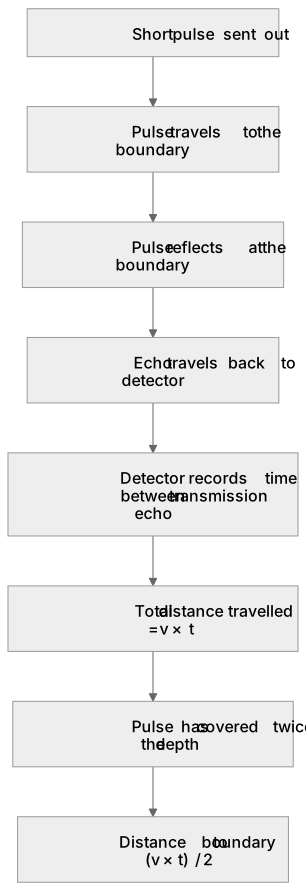
Put it in order
Put these steps in the order they happen.
- 1. Detector records time t between transmission and echo
- 2. Distance to boundary = (v × t) / 2
- 3. Total distance travelled = v × t
- 4. Short pulse sent out
- 5. Pulse travels to the boundary
- 6. Pulse has covered twice the depth
- 7. Pulse reflects at the boundary
- 8. Echo travels back to detector
Key words
Say what each word means before you turn the card.
echo timing
Try answering aloud or in your head before turning the card.
there and back distance
Try answering aloud or in your head before turning the card.
speed equals distance over time
Try answering aloud or in your head before turning the card.
unit conversion
Try answering aloud or in your head before turning the card.
See every definition
- echo timing
- A short pulse is sent out, travels to the boundary, reflects and travels back, and the detector records the time between transmission and echo.
- there and back distance
- In the recorded time the pulse has covered twice the depth, so the distance to the boundary is (v × t) / 2.
- speed equals distance over time
- Using speed = distance / time with the speed in the correct medium, then halving the calculated distance because the pulse travels to the boundary and back.
- unit conversion
- Converting microseconds and milliseconds to seconds before substituting, and showing the converted value.
Label the diagram
Some boxes have lost their names. Pick the right name for each number.
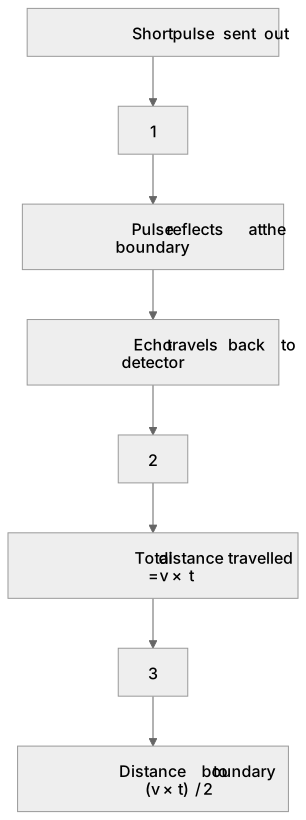
1Box 1
2Box 2
3Box 3
There is more to this lesson
The full lesson goes on to check your understanding and help you earn the marks. Create a free account to carry on, with your progress saved.
A week of Premium from your first lesson · Then the free plan continues · No card, no charge
Test your understanding of Waves for detection and exploration (physics only) (HT only): The time taken for the reflections to reach a detector can be used to determine how far away such a boundary is.
Active recall beats re-reading. Take an instant quiz now to test what you’ve learned and lock it into long-term memory.
A week of Premium from your first lesson · Then the free plan continues · No card, no charge