OCR · A-Level · Physics
Course version: H556 · Version from Sept 2015
(a) a constant net force perpendicular to the velocity of an object causes…
Full specification wording
Centripetal force: (a) a constant net force perpendicular to the velocity of an object causes it to travel in a circular path
When the net force on a moving object is constant in magnitude and always perpendicular to its velocity, the force changes the direction of motion but not the speed.
Checked against the OCR H556 specification (opens in a new tab) on .
- Point 1 of 4
- 4 key terms
Study notes
From the checked teaching notes for this specification point.
The idea
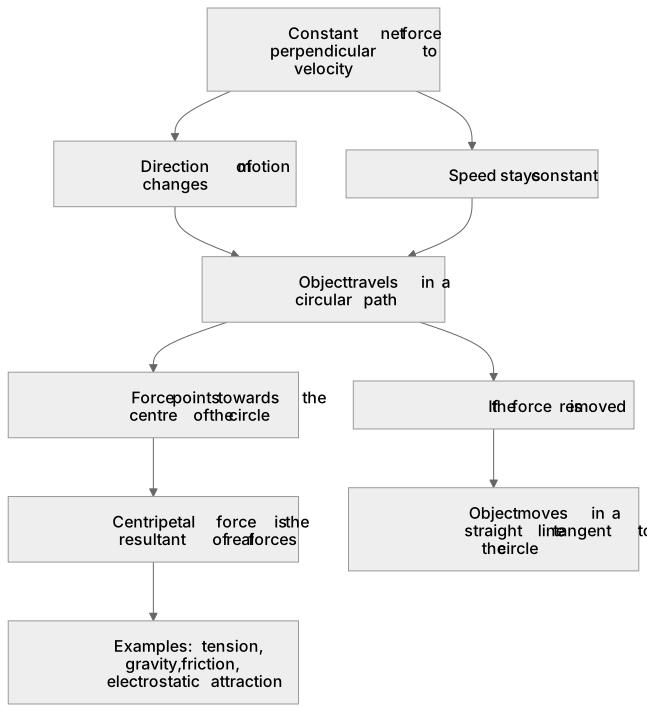
When the net force on a moving object is constant in magnitude and always perpendicular to its velocity, the force changes the direction of motion but not the speed. The object therefore travels in a circular path at constant speed. The force is called the centripetal force and points towards the centre of the circle. For example, a ball on a string whirled in a horizontal circle experiences tension towards the centre; the tension is perpendicular to the velocity at every instant, so the ball moves in a circle. If the force were removed, the ball would continue in a straight line tangent to the circle, as Newton's first law predicts. The centripetal force is not a new kind of force; it is the resultant of real forces such as tension, gravity, friction or electrostatic attraction.
What earns the marks
- A constant net force perpendicular to the velocity changes direction but not speed.
- The resulting path is circular, with the force directed towards the centre of the circle.
- The centripetal force is the resultant of real forces such as tension, gravity, friction or electrostatic attraction.
- If the net force is removed, the object moves in a straight line tangent to the circle.
- The speed remains constant because the force does no work on the object.
Common mistakes and how to put them right
Thinking a force is needed to keep the object moving.
Put it right: The net force is directed inward, towards the centre.
Confusing centripetal force with a separate type of force.
Put it right: It is the resultant of real forces such as tension or gravity.
Believing the object would fly radially outward if the force stopped.
Put it right: It moves along the tangent, in a straight line.
Assuming the force does work and changes the speed.
Put it right: A force perpendicular to velocity does no work, so speed stays constant.
Exam tips
- Draw the force arrow pointing towards the centre and the velocity arrow along the tangent to show the perpendicular relationship.
- Name the real force providing the centripetal force, such as tension, friction or gravitational attraction, rather than writing 'centripetal force' alone.
- Use Newton's first law to justify the straight-line path when the force is removed.
Try the lesson
The start of the Centripetal force: (a) a constant net force perpendicular to the velocity of an object causes it to travel in a circular path lesson, made from checked teaching notes for this specification point.
Listen
When the net force on a moving object is constant in magnitude and always perpendicular to its velocity, the force changes the direction of motion but not the speed. The object therefore travels in a circular path at constant speed. The force is called the centripetal force and points towards the centre of the circle. For example, a ball on a string whirled in a horizontal circle experiences tension towards the centre; the tension is perpendicular to the velocity at every instant, so the ball moves in a circle. If the force were removed, the ball would continue in a straight line tangent to the circle, as Newton's first law predicts. The centripetal force is not a new kind of force; it is the resultant of real forces such as tension, gravity, friction or electrostatic attraction. A strong answer earns marks for these points. A constant net force perpendicular to the velocity changes direction but not speed. The resulting path is circular, with the force directed towards the centre of the circle. The centripetal force is the resultant of real forces such as tension, gravity, friction or electrostatic attraction. If the net force is removed, the object moves in a straight line tangent to the circle. A common slip: Thinking a force is needed to keep the object moving: the error is believing circular motion needs an outward force. Instead, the net force is directed inward, towards the centre. Exam tip: Draw the force arrow pointing towards the centre and the velocity arrow along the tangent to show the perpendicular relationship.
See it
Key words
Say what each word means before you turn the card.
Centripetal force
Try answering aloud or in your head before turning the card.
Perpendicular force and change of direction
Try answering aloud or in your head before turning the card.
Constant speed in circular motion
Try answering aloud or in your head before turning the card.
Newton's first law and inertia
Try answering aloud or in your head before turning the card.
See every definition
- Centripetal force
- The name given to the constant net force perpendicular to the velocity that points towards the centre of the circle.
- Perpendicular force and change of direction
- A constant net force perpendicular to the velocity changes the direction of motion but not the speed.
- Constant speed in circular motion
- The object travels in a circular path at constant speed because the force does no work on it.
- Newton's first law and inertia
- If the force were removed, the object would continue in a straight line tangent to the circle, as Newton's first law predicts.
Label the diagram
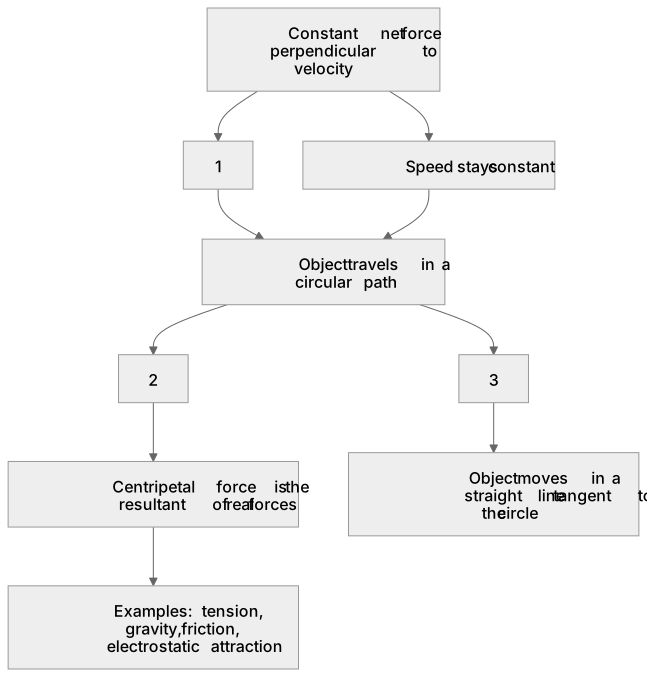
Some boxes have lost their names. Pick the right name for each number.
1Box 1
2Box 2
3Box 3
There is more to this lesson
The full lesson goes on to check your understanding and help you earn the marks. Create a free account to carry on, with your progress saved.
A week of Premium from your first lesson · Then the free plan continues · No card, no charge
Test your understanding of Centripetal force: (a) a constant net force perpendicular to the velocity of an object causes it to travel in a circular path
Active recall beats re-reading. Take an instant quiz now to test what you’ve learned and lock it into long-term memory.
A week of Premium from your first lesson · Then the free plan continues · No card, no charge