OCR · A-Level · Physics
Course version: H556 · Version from Sept 2015
(d) graphical methods and spreadsheet modelling of the equation ΔQ/Δt =…
Full specification wording
Charging and discharging capacitors: (d) graphical methods and spreadsheet modelling of the equation ΔQ/Δt = −Q/CR for a discharging capacitor
The differential equation ΔQ/Δt = −Q/CR describes the rate of change of charge Q on a discharging capacitor, where C is capacitance, R is resistance and CR is the time constant τ.
Checked against the OCR H556 specification (opens in a new tab) on .
- Point 5 of 6
- 4 key terms
Study notes
From the checked teaching notes for this specification point.
The idea
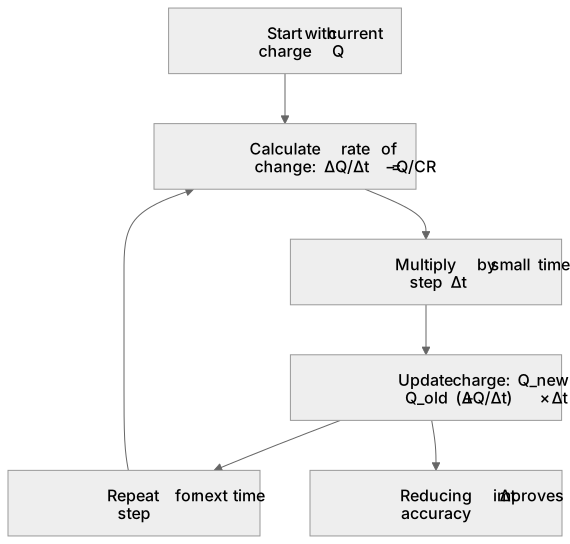
The differential equation ΔQ/Δt = −Q/CR describes the rate of change of charge Q on a discharging capacitor, where C is capacitance, R is resistance and CR is the time constant τ. The negative sign shows that charge is decreasing. Graphical methods include plotting Q against t to obtain an exponential decay curve, or plotting ln Q against t to obtain a straight line of gradient −1/CR. The gradient of the Q–t graph at any instant equals ΔQ/Δt, so the initial gradient is −Q₀/CR. Spreadsheet modelling involves using a small time step Δt to update Q iteratively: Q_new = Q_old + (ΔQ/Δt) × Δt, where ΔQ/Δt is calculated from the current Q. This numerical method approximates the exponential solution and allows the effect of changing C or R to be explored. The accuracy improves as Δt is made smaller.
What earns the marks
- Interpret the differential equation ΔQ/Δt = −Q/CR as the rate of change of charge on a discharging capacitor.
- Explain that the negative sign indicates a decreasing charge and that CR is the time constant τ.
- Use a graph of Q against t to find the gradient at a point, which equals ΔQ/Δt, and relate the initial gradient to −Q₀/CR.
- Use a graph of ln Q against t to obtain a straight line of gradient −1/CR and hence determine τ.
- Describe how a spreadsheet can model the equation by iterative steps: Q_new = Q_old + (ΔQ/Δt) × Δt, with ΔQ/Δt calculated from the current Q.
- Explain that reducing the time step Δt improves the accuracy of the numerical model.
Common mistakes and how to put them right
Ignoring the negative sign in ΔQ/Δt = −Q/CR.
Put it right: The negative sign shows that charge is decreasing; when modelling, ensure the change in charge is subtracted from the current value.
Confusing the gradient of a Q–t graph with the time constant.
Put it right: The gradient at a point is ΔQ/Δt, not τ; the time constant is found from the gradient of ln Q against t, which is −1/CR.
Using a large time step in a spreadsheet model and expecting accurate results.
Put it right: The numerical approximation improves as Δt becomes smaller; a large Δt leads to significant error.
Assuming the differential equation applies to charging as well as discharging.
Put it right: This form with a negative sign applies to discharging; for charging, the rate of change is positive and the equation is ΔQ/Δt = (Q₀ − Q)/CR.
Exam tips
- When using a spreadsheet model, always calculate the rate of change using the current value of Q, then update Q by adding (ΔQ/Δt) × Δt.
- To find τ from a graph, plot ln Q against t for a discharging capacitor; the gradient is −1/CR, so τ = −1/gradient.
- Remember that the initial gradient of a Q–t graph for a discharging capacitor is −Q₀/CR, which can be used to estimate τ if Q₀ is known.
Try the lesson
The start of the Charging and discharging capacitors: (d) graphical methods and spreadsheet modelling of the equation ΔQ/Δt = −Q/CR for a discharging capacitor lesson, made from checked teaching notes for this specification point.
Listen
The differential equation ΔQ/Δt = −Q/CR describes the rate of change of charge Q on a discharging capacitor, where C is capacitance, R is resistance and CR is the time constant τ. The negative sign shows that charge is decreasing. Graphical methods include plotting Q against t to obtain an exponential decay curve, or plotting ln Q against t to obtain a straight line of gradient −1/CR. The gradient of the Q–t graph at any instant equals ΔQ/Δt, so the initial gradient is −Q₀/CR. Spreadsheet modelling involves using a small time step Δt to update Q iteratively: Q_new = Q_old + (ΔQ/Δt) × Δt, where ΔQ/Δt is calculated from the current Q. This numerical method approximates the exponential solution and allows the effect of changing C or R to be explored. The accuracy improves as Δt is made smaller. A strong answer earns marks for these points. Interpret the differential equation ΔQ/Δt = −Q/CR as the rate of change of charge on a discharging capacitor. Explain that the negative sign indicates a decreasing charge and that CR is the time constant τ. Use a graph of Q against t to find the gradient at a point, which equals ΔQ/Δt, and relate the initial gradient to −Q₀/CR. Use a graph of ln Q against t to obtain a straight line of gradient −1/CR and hence determine τ. A common slip: Ignoring the negative sign in ΔQ/Δt = −Q/CR. Instead, the negative sign shows that charge is decreasing; when modelling, ensure the change in charge is subtracted from the current value. Exam tip: When using a spreadsheet model, always calculate the rate of change using the current value of Q, then update Q by adding (ΔQ/Δt) × Δt.
See it
Key words
Say what each word means before you turn the card.
Differential equation for discharging a capacitor
Try answering aloud or in your head before turning the card.
Graphical determination of rate of change and time constant
Try answering aloud or in your head before turning the card.
Numerical modelling using spreadsheets
Try answering aloud or in your head before turning the card.
Effect of time step on accuracy of numerical methods
Try answering aloud or in your head before turning the card.
See every definition
- Differential equation for discharging a capacitor
- The equation ΔQ/Δt = −Q/CR describes the rate of change of charge Q on a discharging capacitor, where C is capacitance, R is resistance and CR is the time constant τ.
- Graphical determination of rate of change and time constant
- The gradient of the Q–t graph at any instant equals ΔQ/Δt, and plotting ln Q against t gives a straight line of gradient −1/CR.
- Numerical modelling using spreadsheets
- A small time step Δt is used to update Q iteratively as Q_new = Q_old + (ΔQ/Δt) × Δt, with ΔQ/Δt calculated from the current Q.
- Effect of time step on accuracy of numerical methods
- The accuracy improves as Δt is made smaller.
Label the diagram
Some boxes have lost their names. Pick the right name for each number.
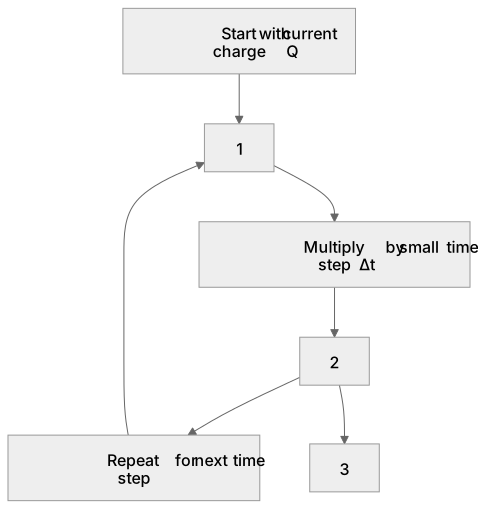
1Box 1
2Box 2
3Box 3
There is more to this lesson
The full lesson goes on to check your understanding and help you earn the marks. Create a free account to carry on, with your progress saved.
A week of Premium from your first lesson · Then the free plan continues · No card, no charge
Test your understanding of Charging and discharging capacitors: (d) graphical methods and spreadsheet modelling of the equation ΔQ/Δt = −Q/CR for a discharging capacitor
Active recall beats re-reading. Take an instant quiz now to test what you’ve learned and lock it into long-term memory.
A week of Premium from your first lesson · Then the free plan continues · No card, no charge