OCR · A-Level · Physics
Course version: H556 · Version from Sept 2015
(i) charging and discharging capacitor through a resistor
Full specification wording
Charging and discharging capacitors: (i) charging and discharging capacitor through a resistor
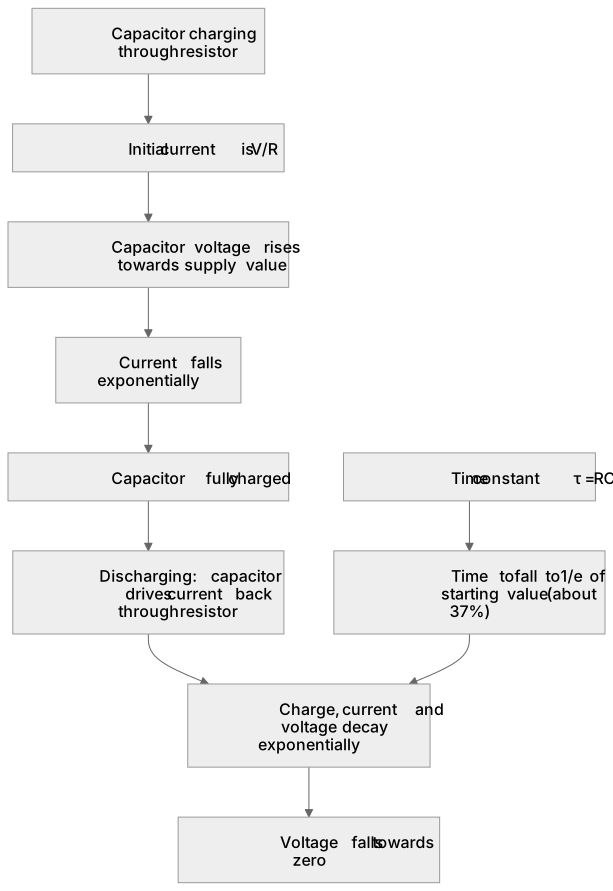
When a capacitor charges through a resistor, the current is initially V/R and falls exponentially as the capacitor voltage rises towards the supply value.
Checked against the OCR H556 specification (opens in a new tab) on .
- Point 1 of 6
- 3 key terms
Study notes
From the checked teaching notes for this specification point.
The idea
When a capacitor charges through a resistor, the current is initially V/R and falls exponentially as the capacitor voltage rises towards the supply value. Discharging reverses the process: the capacitor drives current back through the resistor, and charge, current and voltage all decay exponentially. The time constant τ = RC is the time for charge or current to fall to 1/e of its starting value, about 37%, and for a discharging capacitor q = Q₀e^(−t/RC). For example, a 100 µF capacitor with a 10 kΩ resistor has τ = 100 × 10⁻⁶ F × 10 × 10³ Ω = 1.0 s. Graphs of charge, current and potential difference against time are exponential curves, and the area under a current-time graph gives charge.
What earns the marks
- States that charging current is largest at the start and falls exponentially as the capacitor voltage rises.
- Applies the time constant τ = RC and interprets it as the time to fall to 1/e of the initial value.
- Uses q = Q₀e^(−t/RC) or I = I₀e^(−t/RC) for discharging.
- Explains that the capacitor voltage rises towards the supply voltage during charging and falls towards zero during discharging.
- Relates the area under a current-time graph to charge transferred.
Common mistakes and how to put them right
Thinking the current stays constant during charging.
Put it right: It falls because the potential difference across the resistor decreases as the capacitor voltage rises.
Confusing the time constant with the time to fully charge or discharge.
Put it right: After one time constant the value has changed by about 63%, not completely.
Using τ = R/C instead of τ = RC, which gives the wrong unit and magnitude.
Exam tips
- Check that resistance is in ohms and capacitance in farads before multiplying to find τ.
- Use the initial value and the 1/e point to sketch or identify an exponential decay curve.
- Remember that charging and discharging graphs are mirror images in shape but differ in direction and final value.
Try the lesson
The start of the Charging and discharging capacitors: (i) charging and discharging capacitor through a resistor lesson, made from checked teaching notes for this specification point.
Listen
When a capacitor charges through a resistor, the current is initially V/R and falls exponentially as the capacitor voltage rises towards the supply value. Discharging reverses the process: the capacitor drives current back through the resistor, and charge, current and voltage all decay exponentially. The time constant τ = RC is the time for charge or current to fall to 1/e of its starting value, about 37%, and for a discharging capacitor q = Q₀e^(−t/RC). For example, a 100 µF capacitor with a 10 kΩ resistor has τ = 100 × 10⁻⁶ F × 10 × 10³ Ω = 1.0 s. Graphs of charge, current and potential difference against time are exponential curves, and the area under a current-time graph gives charge. A strong answer earns marks for these points. States that charging current is largest at the start and falls exponentially as the capacitor voltage rises. Applies the time constant τ = RC and interprets it as the time to fall to 1/e of the initial value. Uses q = Q₀e^(−t/RC) or I = I₀e^(−t/RC) for discharging. Explains that the capacitor voltage rises towards the supply voltage during charging and falls towards zero during discharging. Exam tip: Check that resistance is in ohms and capacitance in farads before multiplying to find τ.
See it
Key words
Say what each word means before you turn the card.
Exponential charging and discharging
Try answering aloud or in your head before turning the card.
Time constant τ = RC
Try answering aloud or in your head before turning the card.
Current, charge and voltage graphs
Try answering aloud or in your head before turning the card.
See every definition
- Exponential charging and discharging
- Charging current is largest at the start and falls exponentially as the capacitor voltage rises, while discharging reverses the process so charge, current and voltage all decay exponentially.
- Time constant τ = RC
- The time for charge or current to fall to 1/e of its starting value, about 37%, found by multiplying resistance in ohms by capacitance in farads.
- Current, charge and voltage graphs
- Graphs of charge, current and potential difference against time are exponential curves, and the area under a current-time graph gives charge.
Label the diagram
Some boxes have lost their names. Pick the right name for each number.
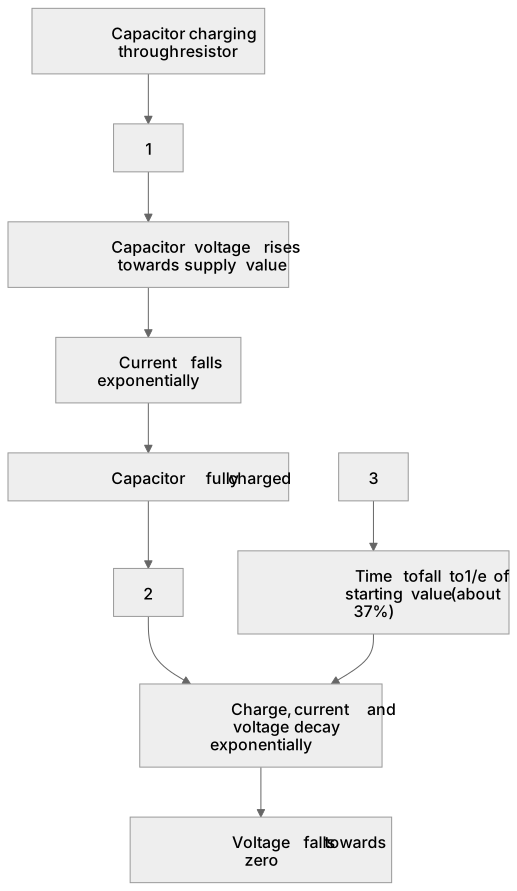
1Box 1
2Box 2
3Box 3
There is more to this lesson
The full lesson goes on to check your understanding and help you earn the marks. Create a free account to carry on, with your progress saved.
A week of Premium from your first lesson · Then the free plan continues · No card, no charge
Test your understanding of Charging and discharging capacitors: (i) charging and discharging capacitor through a resistor
Active recall beats re-reading. Take an instant quiz now to test what you’ve learned and lock it into long-term memory.
A week of Premium from your first lesson · Then the free plan continues · No card, no charge