OCR · A-Level · Physics
Course version: H556 · Version from Sept 2015
Cosmology: (a) distances measured in astronomical unit (AU), light-year
Cosmological distances are so large that metres are impractical, so astronomers use the astronomical unit (AU) and the light-year (ly).
Checked against the OCR H556 specification (opens in a new tab) on .
- Point 1 of 17
- 4 key terms
Study notes
From the checked teaching notes for this specification point.
The idea
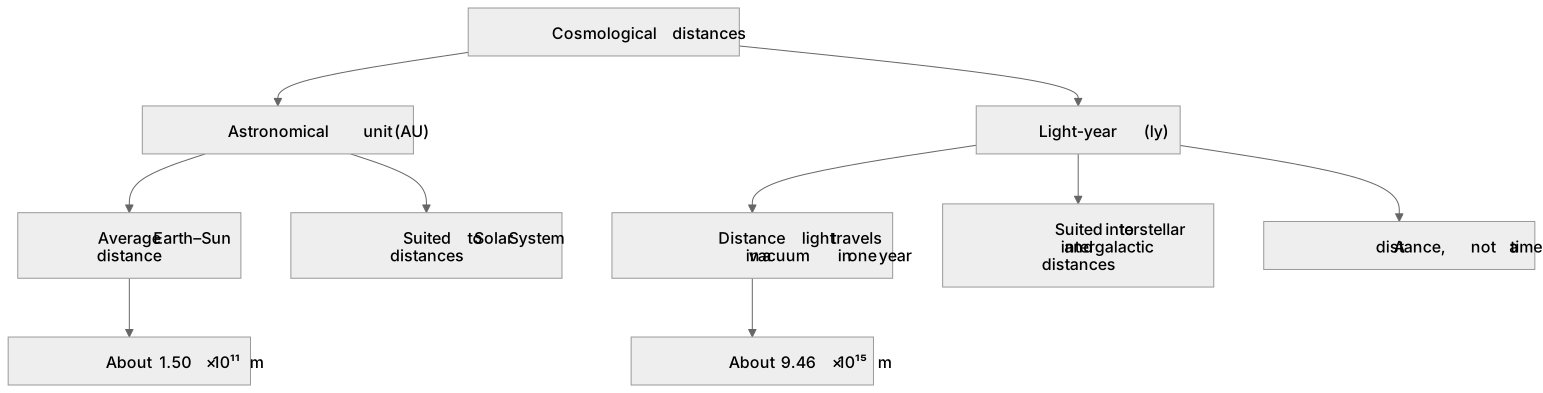
Cosmological distances are so large that metres are impractical, so astronomers use the astronomical unit (AU) and the light-year (ly). One AU is the average Earth–Sun distance, about 1.50 × 10¹¹ m, convenient for distances within the Solar System. One light-year is the distance light travels in a vacuum in one year, about 9.46 × 10¹⁵ m, convenient for distances to stars and galaxies. To convert, multiply the number of AU or ly by the appropriate metre value. For example, 4.2 ly ≈ 4.2 × 9.46 × 10¹⁵ m ≈ 3.97 × 10¹⁶ m. Choose the unit that keeps numbers manageable and state it clearly.
What earns the marks
- One astronomical unit (AU) is the average distance from the Earth to the Sun, approximately 1.50 × 10¹¹ m.
- One light-year (ly) is the distance electromagnetic radiation travels through a vacuum in one year, approximately 9.46 × 10¹⁵ m.
- The light-year is a distance, not a time, despite containing the word ‘year’.
- Convert AU to metres by multiplying by 1.50 × 10¹¹, and ly to metres by multiplying by 9.46 × 10¹⁵.
- AU is suited to Solar System distances, while ly is suited to interstellar and intergalactic distances.
- A light-year equals the speed of light multiplied by the number of seconds in a year: 3.00 × 10⁸ m s⁻¹ × 3.16 × 10⁷ s ≈ 9.46 × 10¹⁵ m.
Common mistakes and how to put them right
Treating the light-year as a unit of time.
Put it right: It is a distance, defined as the distance light travels in one year.
Confusing AU with the radius of the Sun.
Put it right: AU is the Earth–Sun distance, not the Sun’s radius.
Using 365 days exactly without converting to seconds when deriving the light-year.
Put it right: Convert one year to about 3.16 × 10⁷ s before multiplying by the speed of light.
Mixing units within a calculation, such as adding AU to metres.
Put it right: Convert all distances to the same unit before combining them.
Exam tips
- Quote the metre equivalent of AU or ly when converting, and keep units visible throughout.
- Check whether the question expects an answer in AU, ly or metres, and convert only at the end.
- Remember that a light-year is a distance; if a question asks for time, use the light-travel time instead.
Try the lesson
The start of the Cosmology: (a) distances measured in astronomical unit (AU), light-year lesson, made from checked teaching notes for this specification point.
Listen
Cosmological distances are so large that metres are impractical, so astronomers use the astronomical unit (AU) and the light-year (ly). One AU is the average Earth–Sun distance, about 1.50 × 10¹¹ m, convenient for distances within the Solar System. One light-year is the distance light travels in a vacuum in one year, about 9.46 × 10¹⁵ m, convenient for distances to stars and galaxies. To convert, multiply the number of AU or ly by the appropriate metre value. For example, 4.2 ly ≈ 4.2 × 9.46 × 10¹⁵ m ≈ 3.97 × 10¹⁶ m. Choose the unit that keeps numbers manageable and state it clearly. A strong answer earns marks for these points. One astronomical unit (AU) is the average distance from the Earth to the Sun, approximately 1.50 × 10¹¹ m. One light-year (ly) is the distance electromagnetic radiation travels through a vacuum in one year, approximately 9.46 × 10¹⁵ m. The light-year is a distance, not a time, despite containing the word ‘year’. Convert AU to metres by multiplying by 1.50 × 10¹¹, and ly to metres by multiplying by 9.46 × 10¹⁵. A common slip: Treating the light-year as a unit of time. Instead, it is a distance, defined as the distance light travels in one year. Exam tip: Quote the metre equivalent of AU or ly when converting, and keep units visible throughout.
See it
Key words
Say what each word means before you turn the card.
Astronomical unit (AU)
Try answering aloud or in your head before turning the card.
Light-year (ly)
Try answering aloud or in your head before turning the card.
Unit conversion in cosmology
Try answering aloud or in your head before turning the card.
Choosing appropriate units for large distances
Try answering aloud or in your head before turning the card.
See every definition
- Astronomical unit (AU)
- The average Earth–Sun distance, about 1.50 × 10¹¹ m, convenient for distances within the Solar System.
- Light-year (ly)
- The distance light travels in a vacuum in one year, about 9.46 × 10¹⁵ m, convenient for distances to stars and galaxies.
- Unit conversion in cosmology
- Multiplying the number of AU or ly by the appropriate metre value to convert the distance to metres.
- Choosing appropriate units for large distances
- Selecting the unit that keeps numbers manageable and stating it clearly.
Label the diagram
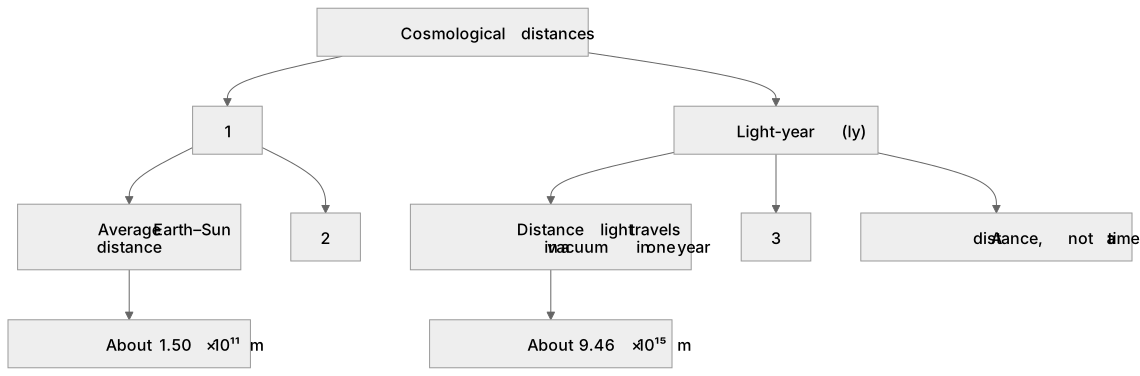
Some boxes have lost their names. Pick the right name for each number.
1Box 1
2Box 2
3Box 3
There is more to this lesson
The full lesson goes on to check your understanding and help you earn the marks. Create a free account to carry on, with your progress saved.
A week of Premium from your first lesson · Then the free plan continues · No card, no charge
Test your understanding of Cosmology: (a) distances measured in astronomical unit (AU), light-year
Active recall beats re-reading. Take an instant quiz now to test what you’ve learned and lock it into long-term memory.
A week of Premium from your first lesson · Then the free plan continues · No card, no charge