OCR · A-Level · Physics
Course version: H556 · Version from Sept 2015
Cosmology: (pc)
The abbreviation (pc) stands for the parsec, the distance unit used throughout OCR A Level Physics A cosmology.
Checked against the OCR H556 specification (opens in a new tab) on .
- Point 3 of 17
- 4 key terms
Study notes
From the checked teaching notes for this specification point.
The idea
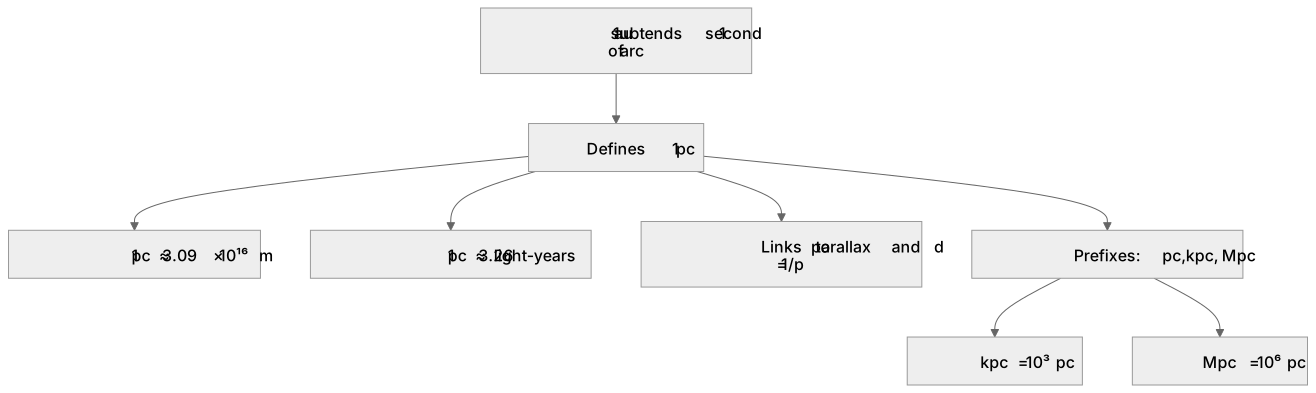
The abbreviation (pc) stands for the parsec, the distance unit used throughout OCR A Level Physics A cosmology. One parsec is defined as the distance at which one astronomical unit subtends an angle of one second of arc, so 1 pc ≈ 3.09 × 10¹⁶ m, about 3.26 light-years. Because the definition is built from a parallax angle, the parsec links directly to stellar parallax and to the equation d = 1/p. In multiple-choice questions you may be asked to identify the parsec from its definition, to convert between parsecs, metres and light-years, or to choose the correct order of magnitude for a stellar or galactic distance. Always check whether the value given is in pc, kpc or Mpc before selecting an answer.
What earns the marks
- States that pc is the symbol for the parsec, a unit of astronomical distance.
- Defines 1 pc as the distance at which 1 au subtends an angle of 1 second of arc.
- Recalls 1 pc ≈ 3.09 × 10¹⁶ m, equivalently about 3.26 light-years.
- Links the parsec to parallax measurement and to the equation d = 1/p.
- Applies the correct prefix when converting between pc, kpc and Mpc.
Common mistakes and how to put them right
Confusing the parsec with the light-year.
Put it right: The parsec is defined from a parallax angle, whereas the light-year is the distance light travels in one year; 1 pc ≈ 3.26 ly.
Treating 1 pc as the distance to a star with parallax 1 second of arc measured in degrees.
Put it right: The parallax must be in seconds of arc, so a parallax of 1° would give a far smaller distance.
Using the wrong power of ten when converting parsecs to metres.
Put it right: The correct value is about 3.09 × 10¹⁶ m, not 10¹³ m or 10¹⁹ m.
Assuming kpc and Mpc are smaller than a parsec.
Put it right: The prefixes kilo- and mega- make them larger by 10³ and 10⁶ respectively.
Exam tips
- Learn the definition of the parsec in words as well as the numerical conversion, because multiple-choice distractors often test the definition rather than the number.
- Write the conversion factor 1 pc ≈ 3.09 × 10¹⁶ m on your rough working before converting, so you do not lose a power of ten under time pressure.
- Check the prefix in the question stem: a distance in kpc is 10³ pc and a distance in Mpc is 10⁶ pc, so convert to pc before comparing options.
- Eliminate options by order of magnitude first; stellar distances are typically a few pc, while galactic distances are kpc and intergalactic distances are Mpc.
Try the lesson
The start of the Cosmology: (pc) lesson, made from checked teaching notes for this specification point.
Listen
The abbreviation (pc) stands for the parsec, the distance unit used throughout OCR A Level Physics A cosmology. One parsec is defined as the distance at which one astronomical unit subtends an angle of one second of arc, so 1 pc ≈ 3.09 × 10¹⁶ m, about 3.26 light-years. Because the definition is built from a parallax angle, the parsec links directly to stellar parallax and to the equation d = 1/p. In multiple-choice questions you may be asked to identify the parsec from its definition, to convert between parsecs, metres and light-years, or to choose the correct order of magnitude for a stellar or galactic distance. Always check whether the value given is in pc, kpc or Mpc before selecting an answer. A strong answer earns marks for these points. States that pc is the symbol for the parsec, a unit of astronomical distance. Defines 1 pc as the distance at which 1 au subtends an angle of 1 second of arc. Recalls 1 pc ≈ 3.09 × 10¹⁶ m, equivalently about 3.26 light-years. Links the parsec to parallax measurement and to the equation d = 1/p. Exam tip: Learn the definition of the parsec in words as well as the numerical conversion, because multiple-choice distractors often test the definition rather than the number.
See it
Key words
Say what each word means before you turn the card.
Astronomical distance units
Try answering aloud or in your head before turning the card.
Definition of the parsec
Try answering aloud or in your head before turning the card.
Parallax and distance measurement
Try answering aloud or in your head before turning the card.
Powers of ten and unit prefixes
Try answering aloud or in your head before turning the card.
See every definition
- Astronomical distance units
- The parsec is the distance unit used throughout OCR A Level Physics A cosmology, and it can be converted between parsecs, metres and light-years.
- Definition of the parsec
- One parsec is defined as the distance at which one astronomical unit subtends an angle of one second of arc, and 1 pc ≈ 3.09 × 10¹⁶ m, about 3.26 light-years.
- Parallax and distance measurement
- Because the definition is built from a parallax angle, the parsec links directly to stellar parallax and to the equation d = 1/p.
- Powers of ten and unit prefixes
- The prefixes kilo- and mega- make kpc and Mpc larger than a parsec by 10³ and 10⁶ respectively, so the prefix must be checked when converting.
Label the diagram
Some boxes have lost their names. Pick the right name for each number.
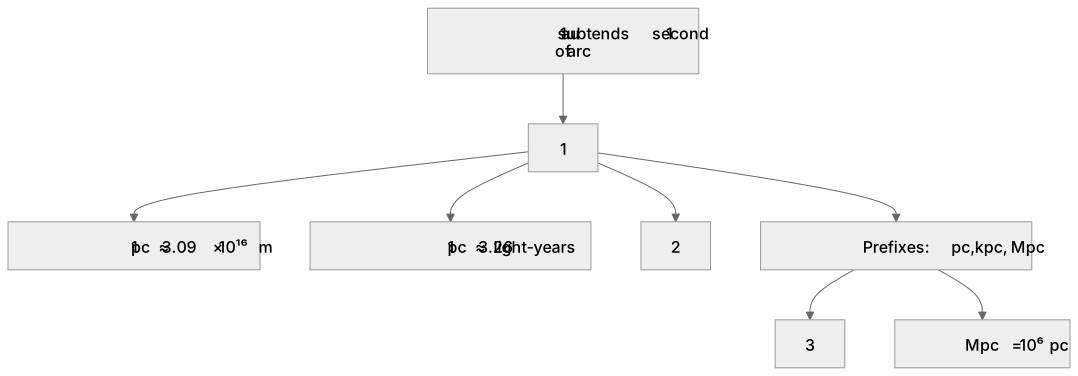
1Box 1
2Box 2
3Box 3
There is more to this lesson
The full lesson goes on to check your understanding and help you earn the marks. Create a free account to carry on, with your progress saved.
A week of Premium from your first lesson · Then the free plan continues · No card, no charge
Test your understanding of Cosmology: (pc)
Active recall beats re-reading. Take an instant quiz now to test what you’ve learned and lock it into long-term memory.
A week of Premium from your first lesson · Then the free plan continues · No card, no charge