OCR · A-Level · Physics
Course version: H556 · Version from Sept 2015
(a) Coulomb’s law; F = Qq / (4πε₀r²) for the force between two point charges
Full specification wording
Coulomb’s law: (a) Coulomb’s law; F = Qq / (4πε₀r²) for the force between two point charges
Coulomb’s law gives the magnitude of the electrostatic force between two point charges in a vacuum or air.
Checked against the OCR H556 specification (opens in a new tab) on .
- Point 1 of 3
- 3 key terms
Study notes
From the checked teaching notes for this specification point.
The idea
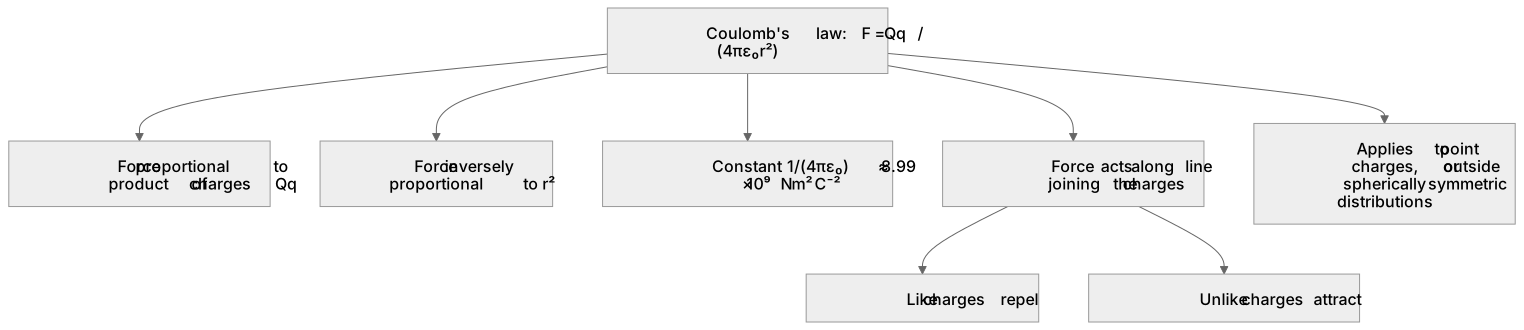
Coulomb’s law gives the magnitude of the electrostatic force between two point charges in a vacuum or air. The force is proportional to the product of the charges Q and q, and inversely proportional to the square of their separation r. The constant 1/(4πε₀) is approximately 8.99 × 10⁹ N m² C⁻², where ε₀ is the permittivity of free space. The force acts along the line joining the charges: like charges repel, unlike charges attract.
For example: Two charges of +2.0 × 10⁻⁶ C and +3.0 × 10⁻⁶ C separated by 0.10 m experience a repulsive force of about 5.4 N. The law applies strictly to point charges; for extended charged objects it is exact only outside a spherically symmetric charge distribution.
What earns the marks
- States that the force is proportional to the product of the two charges, Qq.
- States that the force is inversely proportional to the square of the separation, r².
- Uses the constant 1/(4πε₀) with value approximately 8.99 × 10⁹ N m² C⁻².
- Recognises that the force acts along the line joining the charges and is repulsive for like charges and attractive for unlike charges.
- Applies the law only to point charges or outside spherically symmetric distributions.
Common mistakes and how to put them right
Using r instead of r² in the denominator.
Put it right: The inverse-square dependence must be applied, so doubling r quarters the force.
Forgetting to convert distances to metres or charges to coulombs before substitution.
Put it right: All SI units must be used consistently.
Treating the force as a scalar without direction.
Put it right: Coulomb’s law gives magnitude, and the direction must be determined from the signs of the charges.
Applying the point-charge formula inside a charged sphere.
Put it right: The field and force inside a uniform spherical shell are zero, and inside a uniform solid sphere the enclosed charge changes with r.
Exam tips
- Write the equation as F = Qq / (4πε₀r²) and substitute values only after converting to SI units.
- Check the sign of the force to decide attraction or repulsion, and state the direction relative to the line joining the charges.
- For multiple-choice questions, eliminate options that show F proportional to r or F proportional to 1/r rather than 1/r².
Try the lesson
The start of the Coulomb’s law: (a) Coulomb’s law; F = Qq / (4πε₀r²) for the force between two point charges lesson, made from checked teaching notes for this specification point.
Listen
Coulomb’s law gives the magnitude of the electrostatic force between two point charges in a vacuum or air. The force is proportional to the product of the charges Q and q, and inversely proportional to the square of their separation r. The constant 1/(4πε₀) is approximately 8.99 × 10⁹ N m² C⁻², where ε₀ is the permittivity of free space. The force acts along the line joining the charges: like charges repel, unlike charges attract. For example, two charges of +2.0 × 10⁻⁶ C and +3.0 × 10⁻⁶ C separated by 0.10 m experience a repulsive force of about 5.4 N. The law applies strictly to point charges; for extended charged objects it is exact only outside a spherically symmetric charge distribution. A strong answer earns marks for these points. States that the force is proportional to the product of the two charges, Qq. States that the force is inversely proportional to the square of the separation, r². Uses the constant 1/(4πε₀) with value approximately 8.99 × 10⁹ N m² C⁻². Recognises that the force acts along the line joining the charges and is repulsive for like charges and attractive for unlike charges. Exam tip: Write the equation as F = Qq / (4πε₀r²) and substitute values only after converting to SI units.
See it
Key words
Say what each word means before you turn the card.
Inverse-square law
Try answering aloud or in your head before turning the card.
Electrostatic force between point charges
Try answering aloud or in your head before turning the card.
Vector nature of electrostatic force
Try answering aloud or in your head before turning the card.
See every definition
- Inverse-square law
- The force is inversely proportional to the square of the separation r, so doubling r quarters the force.
- Electrostatic force between point charges
- The force is proportional to the product of the charges Q and q and acts along the line joining them, being repulsive for like charges and attractive for unlike charges.
- Vector nature of electrostatic force
- Coulomb’s law gives the magnitude, and the direction must be determined from the signs of the charges, the force acting along the line joining them.
Label the diagram
Some boxes have lost their names. Pick the right name for each number.
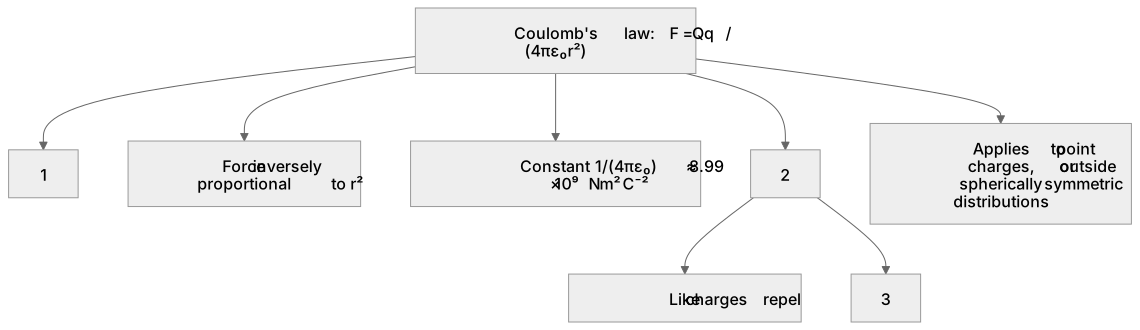
1Box 1
2Box 2
3Box 3
There is more to this lesson
The full lesson goes on to check your understanding and help you earn the marks. Create a free account to carry on, with your progress saved.
A week of Premium from your first lesson · Then the free plan continues · No card, no charge
Test your understanding of Coulomb’s law: (a) Coulomb’s law; F = Qq / (4πε₀r²) for the force between two point charges
Active recall beats re-reading. Take an instant quiz now to test what you’ve learned and lock it into long-term memory.
A week of Premium from your first lesson · Then the free plan continues · No card, no charge