OCR · A-Level · Physics
Course version: H556 · Version from Sept 2015
Density and pressure: (b) pressure; p = F/A for solids, liquids and gases
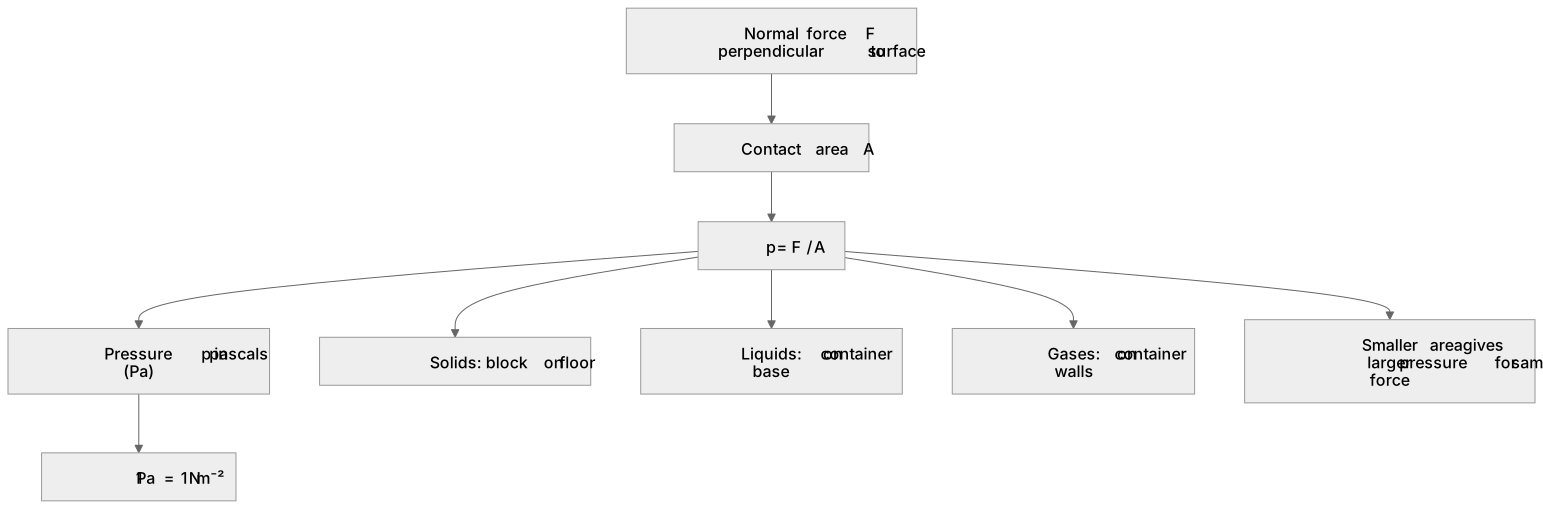
Pressure is the normal force per unit area, p = F/A, where p is in pascals (Pa), F is the force perpendicular to the surface in newtons and A is the area in m².
Checked against the OCR H556 specification (opens in a new tab) on .
- Point 2 of 3
- 3 key terms
Study notes
From the checked teaching notes for this specification point.
The idea
Pressure is the normal force per unit area, p = F/A, where p is in pascals (Pa), F is the force perpendicular to the surface in newtons and A is the area in m². One pascal equals one newton per square metre. The same equation applies to solids, liquids and gases: a solid block exerts pressure on the floor through its contact area, a liquid exerts pressure on a container base, and a gas exerts pressure on the walls of its container through molecular collisions. For a 60 N force spread over 0.030 m², p = 60 ÷ 0.030 = 2.0 × 10³ Pa. A smaller area gives a larger pressure for the same force, which is why sharp edges cut well and wide foundations reduce pressure on soft ground.
What earns the marks
- States p = F/A and identifies p as pressure, F as the normal force and A as the area.
- Uses the pascal as the unit of pressure, with 1 Pa = 1 N m⁻².
- Applies p = F/A to solids, liquids and gases, using the force perpendicular to the relevant surface.
- Calculates pressure, force or area by rearranging the equation correctly.
- Explains that for a fixed force a smaller area produces a larger pressure, and vice versa.
Common mistakes and how to put them right
Using the total force rather than the component perpendicular to the surface.
Put it right: The error is including a parallel component, and the correction is to resolve the force and use only the normal component in p = F/A.
Forgetting to convert area from cm² to m².
Put it right: The error is mixing units, and the correction is to multiply cm² by 10⁻⁴ to obtain m².
Assuming p = F/A applies only to solids.
Put it right: The error is restricting the equation, and the correction is to recognise that it also describes pressure in liquids and gases.
Exam tips
- Identify the surface first, then find the force perpendicular to it before dividing by the contact area.
- Convert areas carefully: 1 cm² = 1 × 10⁻⁴ m² and 1 mm² = 1 × 10⁻⁶ m².
- Give pressure in pascals and check that the answer is reasonable, since everyday pressures are often thousands of pascals.
Try the lesson
The start of the Density and pressure: (b) pressure; p = F/A for solids, liquids and gases lesson, made from checked teaching notes for this specification point.
Listen
Pressure is the normal force per unit area, p = F/A, where p is in pascals (Pa), F is the force perpendicular to the surface in newtons and A is the area in m². One pascal equals one newton per square metre. The same equation applies to solids, liquids and gases: a solid block exerts pressure on the floor through its contact area, a liquid exerts pressure on a container base, and a gas exerts pressure on the walls of its container through molecular collisions. For a 60 N force spread over 0.030 m², p = 60 ÷ 0.030 = 2.0 × 10³ Pa. A smaller area gives a larger pressure for the same force, which is why sharp edges cut well and wide foundations reduce pressure on soft ground. A strong answer earns marks for these points. States p = F/A and identifies p as pressure, F as the normal force and A as the area. Uses the pascal as the unit of pressure, with 1 Pa = 1 N m⁻². Applies p = F/A to solids, liquids and gases, using the force perpendicular to the relevant surface. Calculates pressure, force or area by rearranging the equation correctly. Exam tip: Identify the surface first, then find the force perpendicular to it before dividing by the contact area.
See it
Key words
Say what each word means before you turn the card.
Pressure
Try answering aloud or in your head before turning the card.
Pascal
Try answering aloud or in your head before turning the card.
p = F/A
Try answering aloud or in your head before turning the card.
See every definition
- Pressure
- The normal force per unit area, given by p = F/A, where F is the force perpendicular to the surface and A is the area.
- Pascal
- The unit of pressure, where one pascal equals one newton per square metre.
- p = F/A
- The equation applying to solids, liquids and gases, in which F is the force perpendicular to the relevant surface and A is the area.
Label the diagram
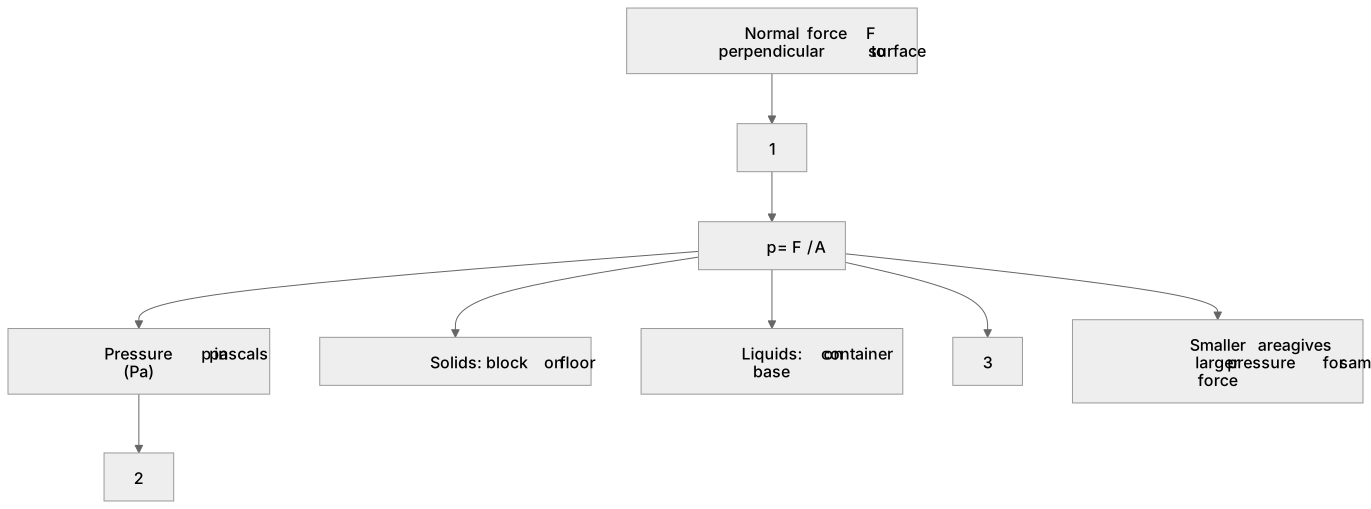
Some boxes have lost their names. Pick the right name for each number.
1Box 1
2Box 2
3Box 3
There is more to this lesson
The full lesson goes on to check your understanding and help you earn the marks. Create a free account to carry on, with your progress saved.
A week of Premium from your first lesson · Then the free plan continues · No card, no charge
Test your understanding of Density and pressure: (b) pressure; p = F/A for solids, liquids and gases
Active recall beats re-reading. Take an instant quiz now to test what you’ve learned and lock it into long-term memory.
A week of Premium from your first lesson · Then the free plan continues · No card, no charge