OCR · A-Level · Physics
Course version: H556 · Version from Sept 2015
(b) electromotive force (e.m.f.) of a source such as a cell or a power…
Full specification wording
E.m.f. and p.d: (b) electromotive force (e.m.f.) of a source such as a cell or a power supply
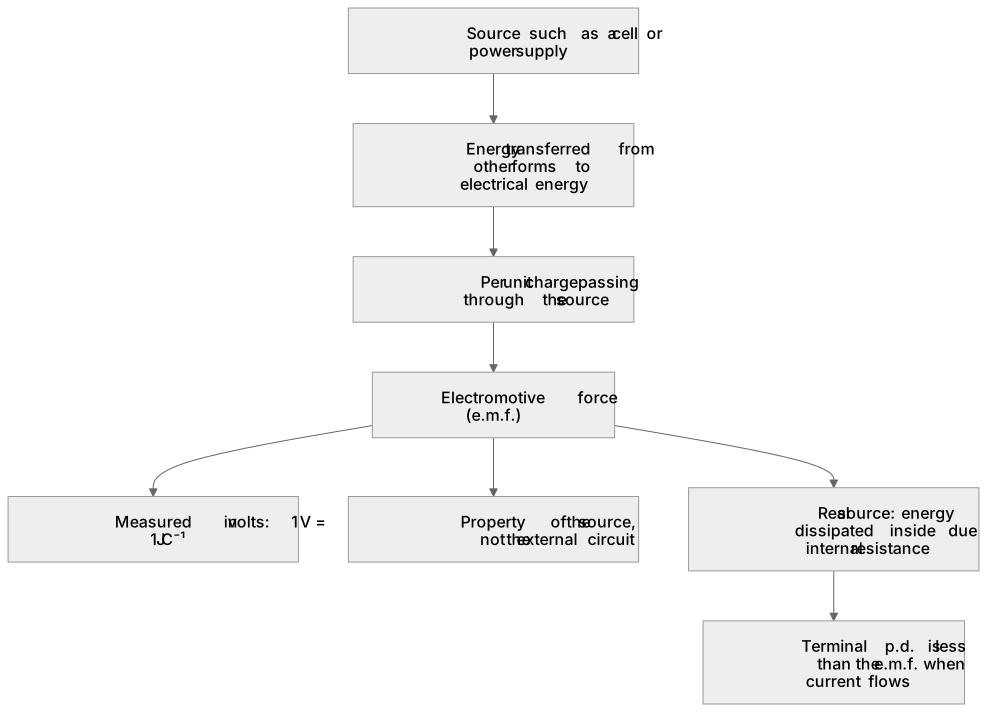
Electromotive force is the energy transferred from other forms to electrical energy per unit charge as charge passes through a source such as a cell or power supply.
Checked against the OCR H556 specification (opens in a new tab) on .
- Point 2 of 5
- 4 key terms
Study notes
From the checked teaching notes for this specification point.
The idea
Electromotive force is the energy transferred from other forms to electrical energy per unit charge as charge passes through a source such as a cell or power supply. A cell that supplies 9 J of electrical energy for every 3 C of charge passing through it has an e.m.f. of 9 J ÷ 3 C = 3 J C⁻¹ = 3 V. The e.m.f. is a property of the source, not of the external circuit, and it is measured in volts for the same reason as p.d.: both are energy per unit charge. In a real cell, some of this energy is dissipated inside the source because of its internal resistance, so the terminal p.d. is less than the e.m.f. when current flows.
What earns the marks
- Electromotive force is the energy transferred from other forms to electrical energy per unit charge passing through a source.
- The e.m.f. of a source such as a cell or power supply is measured in volts, where 1 V = 1 J C⁻¹.
- The e.m.f. is a property of the source itself and represents the energy supplied per unit charge.
- For a real source, the terminal p.d. is less than the e.m.f. when current flows because energy is dissipated inside the source.
- The e.m.f. can be measured by connecting a high-resistance voltmeter across the source when no current flows.
Common mistakes and how to put them right
Thinking e.m.f. is a force.
Put it right: Despite the name, e.m.f. is an energy per unit charge measured in volts, not a force in newtons.
Assuming the terminal p.d. always equals the e.m.f.
Put it right: When current flows, energy is dissipated inside the source, so the terminal p.d. is lower.
Treating e.m.f. as a property of the external components.
Put it right: e.m.f. belongs to the source, whereas p.d. is measured across components in the circuit.
Exam tips
- Use the definition 'energy transferred per unit charge' and state the unit as V, showing 1 V = 1 J C⁻¹ when required.
- When comparing e.m.f. and terminal p.d., mention internal resistance and the energy dissipated inside the source.
- Remember that a high-resistance voltmeter across a source on open circuit reads approximately the e.m.f.
Try the lesson
The start of the E.m.f. and p.d: (b) electromotive force (e.m.f.) of a source such as a cell or a power supply lesson, made from checked teaching notes for this specification point.
Listen
Electromotive force is the energy transferred from other forms to electrical energy per unit charge as charge passes through a source such as a cell or power supply. A cell that supplies 9 J of electrical energy for every 3 C of charge passing through it has an e.m.f. of 9 J ÷ 3 C = 3 J C⁻¹ = 3 V. The e.m.f. is a property of the source, not of the external circuit, and it is measured in volts for the same reason as p.d.: both are energy per unit charge. In a real cell, some of this energy is dissipated inside the source because of its internal resistance, so the terminal p.d. is less than the e.m.f. when current flows. A strong answer earns marks for these points. Electromotive force is the energy transferred from other forms to electrical energy per unit charge passing through a source. The e.m.f. of a source such as a cell or power supply is measured in volts, where 1 V = 1 J C⁻¹. The e.m.f. is a property of the source itself and represents the energy supplied per unit charge. For a real source, the terminal p.d. is less than the e.m.f. when current flows because energy is dissipated inside the source. Exam tip: Use the definition 'energy transferred per unit charge' and state the unit as V, showing 1 V = 1 J C⁻¹ when required.
See it
Key words
Say what each word means before you turn the card.
Electromotive force (e.m.f.)
Try answering aloud or in your head before turning the card.
The volt
Try answering aloud or in your head before turning the card.
E.m.f. as a property of the source
Try answering aloud or in your head before turning the card.
Internal resistance and terminal p.d.
Try answering aloud or in your head before turning the card.
See every definition
- Electromotive force (e.m.f.)
- The energy transferred from other forms to electrical energy per unit charge passing through a source such as a cell or power supply.
- The volt
- The unit in which e.m.f. is measured, where 1 V = 1 J C⁻¹, because it is energy per unit charge.
- E.m.f. as a property of the source
- A property of the source itself, not of the external circuit, representing the energy supplied per unit charge.
- Internal resistance and terminal p.d.
- In a real cell some energy is dissipated inside the source because of its internal resistance, so the terminal p.d. is less than the e.m.f. when current flows.
Label the diagram
Some boxes have lost their names. Pick the right name for each number.
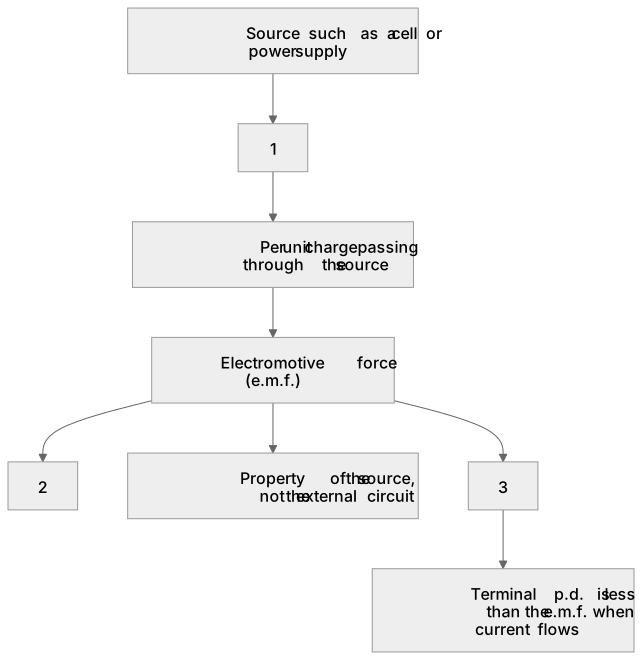
1Box 1
2Box 2
3Box 3
There is more to this lesson
The full lesson goes on to check your understanding and help you earn the marks. Create a free account to carry on, with your progress saved.
A week of Premium from your first lesson · Then the free plan continues · No card, no charge
Test your understanding of E.m.f. and p.d: (b) electromotive force (e.m.f.) of a source such as a cell or a power supply
Active recall beats re-reading. Take an instant quiz now to test what you’ve learned and lock it into long-term memory.
A week of Premium from your first lesson · Then the free plan continues · No card, no charge