OCR · A-Level · Physics
Course version: H556 · Version from Sept 2015
E.m.f. and p.d: (d) energy transfer; W = VQ ; W = EQ .
The equations W = VQ and W = EQ give the energy transferred when charge moves through a potential difference or an electromotive force.
Checked against the OCR H556 specification (opens in a new tab) on .
- Point 4 of 5
- 3 key terms
Study notes
From the checked teaching notes for this specification point.
The idea
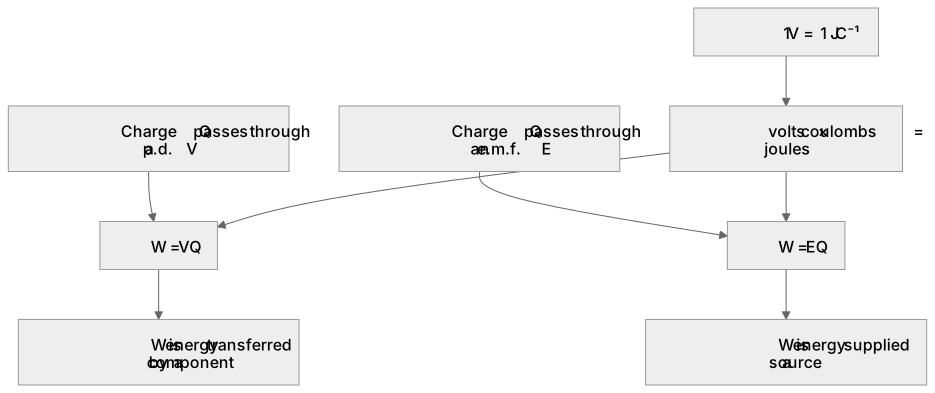
The equations W = VQ and W = EQ give the energy transferred when charge moves through a potential difference or an electromotive force. W is the energy transferred in joules, V is the p.d. in volts, E is the e.m.f. in volts and Q is the charge in coulombs. For example, if 5 C of charge passes through a p.d. of 12 V, the energy transferred is W = 12 V × 5 C = 60 J. Because 1 V = 1 J C⁻¹, the product of volts and coulombs is joules. The two equations have the same form because both e.m.f. and p.d. are energy per unit charge; the symbol used indicates whether the energy is supplied by a source or transferred by a component.
What earns the marks
- W = VQ gives the energy transferred when charge Q passes through a potential difference V.
- W = EQ gives the energy transferred when charge Q passes through an electromotive force E.
- In both equations W is in joules, Q is in coulombs, and V or E is in volts.
- The equations work because 1 V = 1 J C⁻¹, so multiplying volts by coulombs gives joules.
- The same relationship applies to e.m.f. and p.d. because both are energy per unit charge; the symbol used shows whether energy is supplied or transferred away.
Common mistakes and how to put them right
Using the wrong unit for charge.
Put it right: Q must be in coulombs, so convert millicoulombs or microcoulombs before substituting.
Mixing up V and E in the two forms.
Put it right: Use V for a p.d. across a component and E for the e.m.f. of a source.
Forgetting that the product VQ has units of joules.
Put it right: Check by substituting 1 V = 1 J C⁻¹ so that V × C = J.
Exam tips
- Write down the equation, substitute values with units, and state the answer in joules.
- If charge is given in millicoulombs or microcoulombs, convert to coulombs before multiplying.
- Use W = VQ for energy transferred by a component and W = EQ for energy supplied by a source, and label the symbol accordingly.
Try the lesson
The start of the E.m.f. and p.d: (d) energy transfer; W = VQ ; W = EQ . lesson, made from checked teaching notes for this specification point.
Listen
The equations W = VQ and W = EQ give the energy transferred when charge moves through a potential difference or an electromotive force. W is the energy transferred in joules, V is the p.d. in volts, E is the e.m.f. in volts and Q is the charge in coulombs. For example, if 5 C of charge passes through a p.d. of 12 V, the energy transferred is W = 12 V × 5 C = 60 J. Because 1 V = 1 J C⁻¹, the product of volts and coulombs is joules. The two equations have the same form because both e.m.f. and p.d. are energy per unit charge; the symbol used indicates whether the energy is supplied by a source or transferred by a component. A strong answer earns marks for these points. W = VQ gives the energy transferred when charge Q passes through a potential difference V. W = EQ gives the energy transferred when charge Q passes through an electromotive force E. In both equations W is in joules, Q is in coulombs, and V or E is in volts. The equations work because 1 V = 1 J C⁻¹, so multiplying volts by coulombs gives joules. Exam tip: Write down the equation, substitute values with units, and state the answer in joules.
See it
Key words
Say what each word means before you turn the card.
Energy transfer and charge
Try answering aloud or in your head before turning the card.
The volt as joules per coulomb
Try answering aloud or in your head before turning the card.
Applying W = VQ and W = EQ
Try answering aloud or in your head before turning the card.
See every definition
- Energy transfer and charge
- The equations W = VQ and W = EQ give the energy transferred when charge moves through a potential difference or an electromotive force.
- The volt as joules per coulomb
- Because 1 V = 1 J C⁻¹, the product of volts and coulombs is joules.
- Applying W = VQ and W = EQ
- W = VQ gives the energy transferred when charge Q passes through a potential difference V, and W = EQ gives the energy transferred when charge Q passes through an electromotive force E.
Label the diagram
Some boxes have lost their names. Pick the right name for each number.
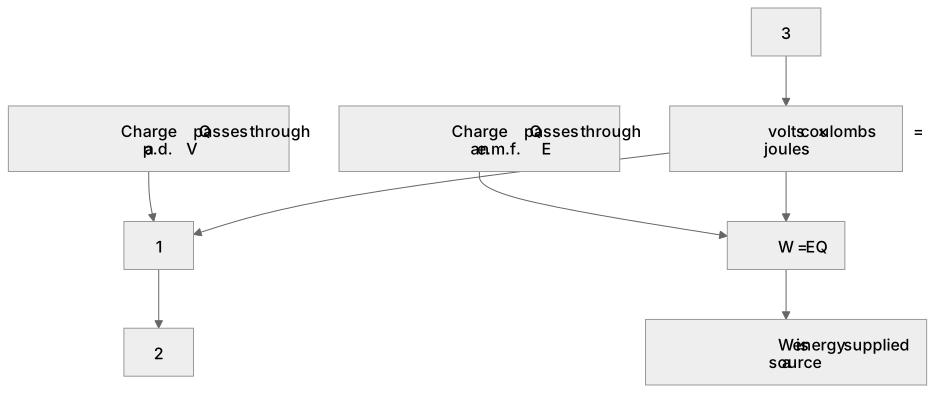
1Box 1
2Box 2
3Box 3
There is more to this lesson
The full lesson goes on to check your understanding and help you earn the marks. Create a free account to carry on, with your progress saved.
A week of Premium from your first lesson · Then the free plan continues · No card, no charge
Test your understanding of E.m.f. and p.d: (d) energy transfer; W = VQ ; W = EQ .
Active recall beats re-reading. Take an instant quiz now to test what you’ve learned and lock it into long-term memory.
A week of Premium from your first lesson · Then the free plan continues · No card, no charge