OCR · A-Level · Physics
Course version: H556 · Version from Sept 2015
(a) energy levels of electrons in isolated gas atoms
Full specification wording
Electromagnetic radiation from stars: (a) energy levels of electrons in isolated gas atoms
In an isolated gas atom, electrons can occupy only certain allowed energy levels.
Checked against the OCR H556 specification (opens in a new tab) on .
- Point 1 of 11
- 2 key terms
Study notes
From the checked teaching notes for this specification point.
The idea
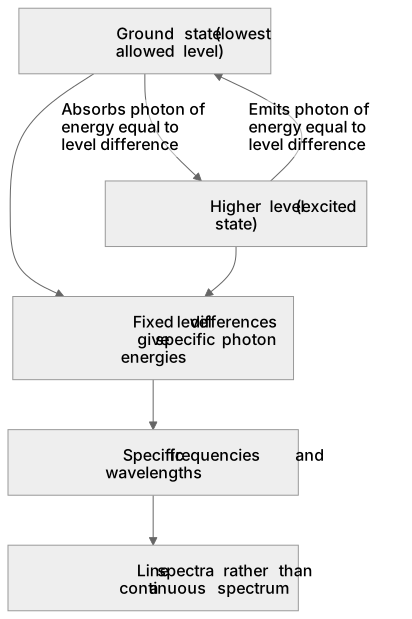
In an isolated gas atom, electrons can occupy only certain allowed energy levels. Each level has a definite energy, and the lowest is the ground state. An electron can move to a higher level only by absorbing an amount of energy exactly equal to the difference between the two levels, for example by absorbing a photon of that energy. It can drop to a lower level by emitting a photon with energy equal to the difference. Because the level spacings are fixed, the photons absorbed or emitted have specific energies and therefore specific frequencies and wavelengths, producing line spectra rather than a continuous spectrum.
What earns the marks
- Electrons in an isolated gas atom can occupy only discrete allowed energy levels.
- The lowest allowed level is the ground state and higher levels are excited states.
- A transition between levels involves absorption or emission of a photon with energy equal to the level difference.
- The fixed energy differences give rise to line spectra with specific frequencies and wavelengths.
Common mistakes and how to put them right
Thinking electrons can have any energy.
Put it right: Only discrete energy levels are allowed.
Believing any photon can cause a transition.
Put it right: The photon energy must match the energy difference between levels.
Confusing excitation with ionisation.
Put it right: Excitation moves an electron to a higher level, while ionisation removes it from the atom.
Exam tips
- Use the equation ΔE = hf to link photon energy to frequency.
- Remember that absorption produces dark lines in a spectrum and emission produces bright lines.
- Check whether the question is about an isolated atom or a solid, because energy bands apply to solids.
Try the lesson
The start of the Electromagnetic radiation from stars: (a) energy levels of electrons in isolated gas atoms lesson, made from checked teaching notes for this specification point.
Listen
In an isolated gas atom, electrons can occupy only certain allowed energy levels. Each level has a definite energy, and the lowest is the ground state. An electron can move to a higher level only by absorbing an amount of energy exactly equal to the difference between the two levels, for example by absorbing a photon of that energy. It can drop to a lower level by emitting a photon with energy equal to the difference. Because the level spacings are fixed, the photons absorbed or emitted have specific energies and therefore specific frequencies and wavelengths, producing line spectra rather than a continuous spectrum. A strong answer earns marks for these points. Electrons in an isolated gas atom can occupy only discrete allowed energy levels. The lowest allowed level is the ground state and higher levels are excited states. A transition between levels involves absorption or emission of a photon with energy equal to the level difference. The fixed energy differences give rise to line spectra with specific frequencies and wavelengths. Exam tip: Use the equation ΔE = hf to link photon energy to frequency.
See it
Key words
Say what each word means before you turn the card.
Energy levels
Try answering aloud or in your head before turning the card.
Line spectra
Try answering aloud or in your head before turning the card.
See every definition
- Energy levels
- In an isolated gas atom, electrons can occupy only certain allowed levels, each with a definite energy.
- Line spectra
- Because the level spacings are fixed, the photons absorbed or emitted have specific energies and therefore specific frequencies and wavelengths, producing line spectra rather than a continuous spectrum.
Label the diagram
Some boxes have lost their names. Pick the right name for each number.
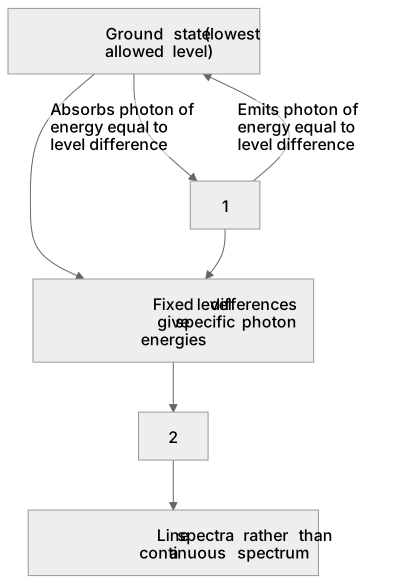
1Box 1
2Box 2
There is more to this lesson
The full lesson goes on to check your understanding and help you earn the marks. Create a free account to carry on, with your progress saved.
A week of Premium from your first lesson · Then the free plan continues · No card, no charge
Test your understanding of Electromagnetic radiation from stars: (a) energy levels of electrons in isolated gas atoms
Active recall beats re-reading. Take an instant quiz now to test what you’ve learned and lock it into long-term memory.
A week of Premium from your first lesson · Then the free plan continues · No card, no charge