OCR · A-Level · Physics
Course version: H556 · Version from Sept 2015
(d) the equations ΔE = hf and ΔE = hc/λ
Full specification wording
Electromagnetic radiation from stars: (d) the equations ΔE = hf and ΔE = hc/λ
These two equations convert between the energy gap of a transition and the electromagnetic radiation produced or absorbed. ΔE = hf gives the photon energy from its frequency, where h is the Planck…
Checked against the OCR H556 specification (opens in a new tab) on .
- Point 4 of 11
- 4 key terms
Study notes
From the checked teaching notes for this specification point.
The idea
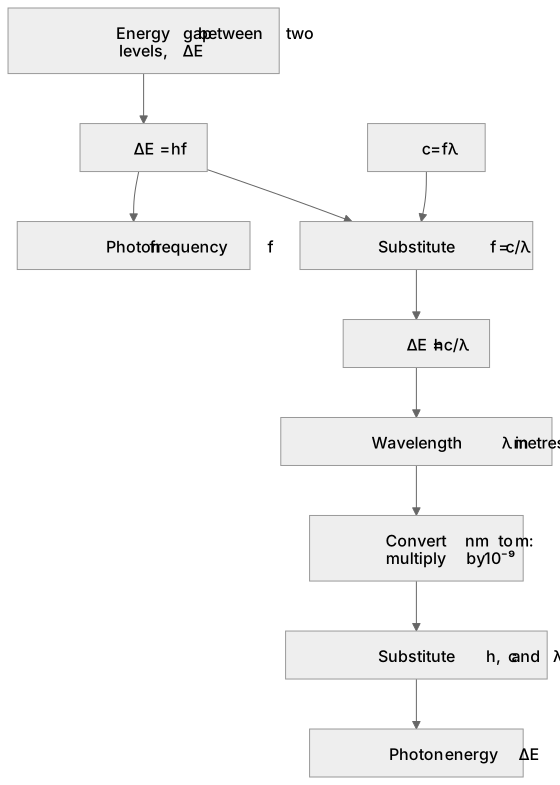
These two equations convert between the energy gap of a transition and the electromagnetic radiation produced or absorbed. ΔE = hf gives the photon energy from its frequency, where h is the Planck constant, about 6.63 × 10⁻³⁴ J s. Because for light in a vacuum c = fλ, substituting f = c/λ gives ΔE = hc/λ, which is useful when a wavelength is known.
For example: A photon of wavelength 656 nm has energy hc/λ = (6.63 × 10⁻³⁴ × 3.00 × 10⁸) ÷ (656 × 10⁻⁹), which is about 3.03 × 10⁻¹⁹ J. Convert nanometres to metres before substituting, and remember that ΔE is the difference between two energy levels, so it is positive for an emitted photon.
What earns the marks
- States ΔE = hf, identifying ΔE as the photon energy and f as its frequency.
- States ΔE = hc/λ, identifying λ as the wavelength in metres and c as the speed of light in a vacuum.
- Uses c = fλ to show how the two forms are equivalent.
- Substitutes values with consistent SI units, converting nm to m by multiplying by 10⁻⁹.
- Calculates photon energy accurately, for example about 3.03 × 10⁻¹⁹ J for 656 nm.
- Relates the calculated ΔE to the difference between two discrete energy levels.
Common mistakes and how to put them right
Substituting a wavelength in nanometres directly into hc/λ.
Put it right: Convert to metres first, since 656 nm is 656 × 10⁻⁹ m.
Using the frequency of the light as the frequency of the electron or vice versa.
Put it right: f in ΔE = hf is the photon frequency.
Treating ΔE as always the full ionisation energy.
Put it right: ΔE is the difference between the two levels involved in that particular transition.
Mixing up h and c values or their powers of ten.
Put it right: Write both constants with units before substituting to catch slips.
Exam tips
- Write the equation, then substitute numbers with units, then evaluate, so unit conversions are visible to the examiner.
- If the answer is needed in eV, divide the joule value by 1.60 × 10⁻¹⁹ J eV⁻¹.
- Check the order of magnitude: visible photons have energies of a few times 10⁻¹⁹ J, so a wildly different value signals a conversion error.
Try the lesson
The start of the Electromagnetic radiation from stars: (d) the equations ΔE = hf and ΔE = hc/λ lesson, made from checked teaching notes for this specification point.
Listen
These two equations convert between the energy gap of a transition and the electromagnetic radiation produced or absorbed. ΔE = hf gives the photon energy from its frequency, where h is the Planck constant, about 6.63 × 10⁻³⁴ J s. Because for light in a vacuum c = fλ, substituting f = c/λ gives ΔE = hc/λ, which is useful when a wavelength is known. For example, a photon of wavelength 656 nm has energy hc/λ = (6.63 × 10⁻³⁴ × 3.00 × 10⁸) ÷ (656 × 10⁻⁹), which is about 3.03 × 10⁻¹⁹ J. Convert nanometres to metres before substituting, and remember that ΔE is the difference between two energy levels, so it is positive for an emitted photon. A strong answer earns marks for these points. States ΔE = hf, identifying ΔE as the photon energy and f as its frequency. States ΔE = hc/λ, identifying λ as the wavelength in metres and c as the speed of light in a vacuum. Uses c = fλ to show how the two forms are equivalent. Substitutes values with consistent SI units, converting nm to m by multiplying by 10⁻⁹. Exam tip: Write the equation, then substitute numbers with units, then evaluate, so unit conversions are visible to the examiner.
See it
Key words
Say what each word means before you turn the card.
Photon energy and the Planck constant
Try answering aloud or in your head before turning the card.
Wave-particle relationship for electromagnetic radiation
Try answering aloud or in your head before turning the card.
Unit conversion in spectroscopy calculations
Try answering aloud or in your head before turning the card.
Energy conservation in atomic transitions
Try answering aloud or in your head before turning the card.
See every definition
- Photon energy and the Planck constant
- ΔE = hf gives the photon energy from its frequency, where h is the Planck constant, about 6.63 × 10⁻³⁴ J s.
- Wave-particle relationship for electromagnetic radiation
- Because for light in a vacuum c = fλ, substituting f = c/λ gives ΔE = hc/λ, which is useful when a wavelength is known.
- Unit conversion in spectroscopy calculations
- Convert nanometres to metres before substituting, multiplying by 10⁻⁹.
- Energy conservation in atomic transitions
- ΔE is the difference between two energy levels, so it is positive for an emitted photon.
Label the diagram
Some boxes have lost their names. Pick the right name for each number.
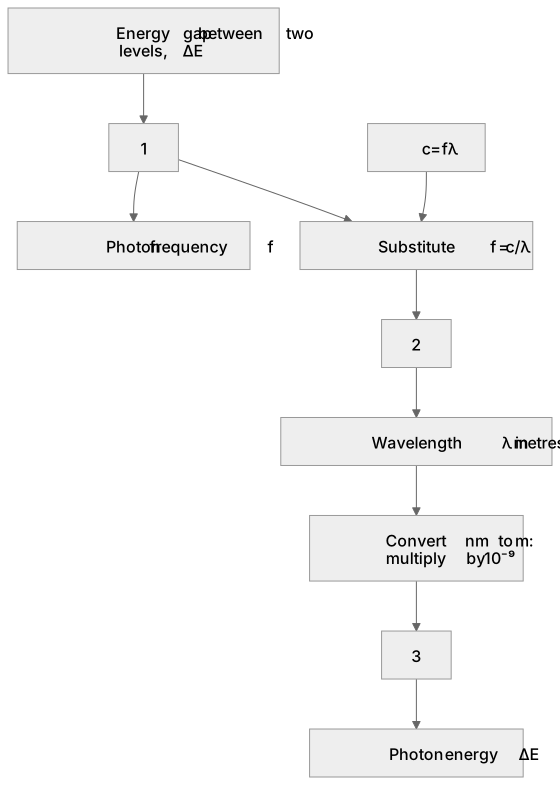
1Box 1
2Box 2
3Box 3
There is more to this lesson
The full lesson goes on to check your understanding and help you earn the marks. Create a free account to carry on, with your progress saved.
A week of Premium from your first lesson · Then the free plan continues · No card, no charge
Test your understanding of Electromagnetic radiation from stars: (d) the equations ΔE = hf and ΔE = hc/λ
Active recall beats re-reading. Take an instant quiz now to test what you’ve learned and lock it into long-term memory.
A week of Premium from your first lesson · Then the free plan continues · No card, no charge