OCR · A-Level · Physics
Course version: H556 · Version from Sept 2015
(h) the condition for maxima d sin θ = nλ, where d is the grating spacing
Full specification wording
Electromagnetic radiation from stars: (h) the condition for maxima d sin θ = nλ, where d is the grating spacing
For a diffraction grating, constructive interference produces maxima when the path difference between light from adjacent slits equals a whole number of wavelengths.
Checked against the OCR H556 specification (opens in a new tab) on .
- Point 8 of 11
- 4 key terms
Study notes
From the checked teaching notes for this specification point.
The idea
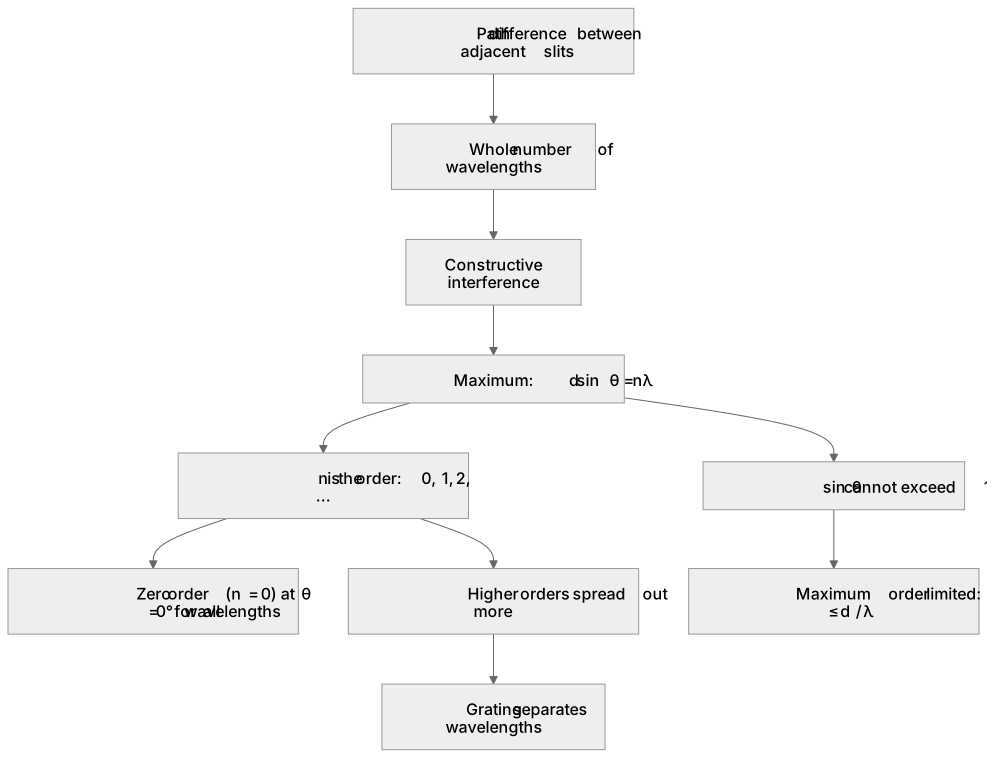
For a diffraction grating, constructive interference produces maxima when the path difference between light from adjacent slits equals a whole number of wavelengths. This condition is d sin θ = nλ, where d is the grating spacing (distance between adjacent slit centres), θ is the angle from the zero-order direction, n is the order (0, 1, 2, ...) and λ is the wavelength. The zero-order maximum (n = 0) occurs at θ = 0° for all wavelengths. Higher orders spread out more, so the grating separates wavelengths, which is why it is used in spectrometry. The maximum possible order is limited because sin θ cannot exceed 1.
What earns the marks
- Constructive interference occurs when the path difference between adjacent slits is a whole number of wavelengths.
- The condition for maxima is d sin θ = nλ, where d is the grating spacing.
- n is the order of the maximum and takes integer values 0, 1, 2, ...
- The zero-order maximum occurs at θ = 0° for all wavelengths.
- The maximum observable order is limited by sin θ ≤ 1, so n ≤ d / λ.
Common mistakes and how to put them right
Treating d as the slit width rather than the distance between adjacent slit centres.
Using degrees in the sine calculation when the calculator is set to radians, or vice versa.
Forgetting that n must be an integer.
Put it right: Non-integer values do not give maxima.
Assuming the zero-order maximum occurs at different angles for different wavelengths.
Put it right: It occurs at θ = 0° for all wavelengths.
Exam tips
- Check that your calculator is in the correct angle mode before evaluating sin θ.
- Rearrange d sin θ = nλ carefully: to find θ use sin θ = nλ / d, then take the inverse sine.
- Remember that the maximum order is the largest integer n for which nλ / d ≤ 1.
Try the lesson
The start of the Electromagnetic radiation from stars: (h) the condition for maxima d sin θ = nλ, where d is the grating spacing lesson, made from checked teaching notes for this specification point.
Listen
For a diffraction grating, constructive interference produces maxima when the path difference between light from adjacent slits equals a whole number of wavelengths. This condition is d sin θ = nλ, where d is the grating spacing (distance between adjacent slit centres), θ is the angle from the zero-order direction, n is the order (0, 1, 2, ...) and λ is the wavelength. The zero-order maximum (n = 0) occurs at θ = 0° for all wavelengths. Higher orders spread out more, so the grating separates wavelengths, which is why it is used in spectrometry. The maximum possible order is limited because sin θ cannot exceed 1. A strong answer earns marks for these points. Constructive interference occurs when the path difference between adjacent slits is a whole number of wavelengths. The condition for maxima is d sin θ = nλ, where d is the grating spacing. n is the order of the maximum and takes integer values 0, 1, 2, ... The zero-order maximum occurs at θ = 0° for all wavelengths. Exam tip: Check that your calculator is in the correct angle mode before evaluating sin θ.
See it
Key words
Say what each word means before you turn the card.
Constructive interference condition for multiple slits
Try answering aloud or in your head before turning the card.
Path difference and order of maxima
Try answering aloud or in your head before turning the card.
Wavelength separation by a grating
Try answering aloud or in your head before turning the card.
Limits on observable orders
Try answering aloud or in your head before turning the card.
See every definition
- Constructive interference condition for multiple slits
- Maxima are produced when the path difference between light from adjacent slits equals a whole number of wavelengths.
- Path difference and order of maxima
- The condition for maxima is d sin θ = nλ, where n is the order and takes integer values 0, 1, 2, ...
- Wavelength separation by a grating
- Higher orders spread out more, so the grating separates wavelengths, which is why it is used in spectrometry.
- Limits on observable orders
- The maximum possible order is limited because sin θ cannot exceed 1, so n ≤ d / λ.
Label the diagram
Some boxes have lost their names. Pick the right name for each number.
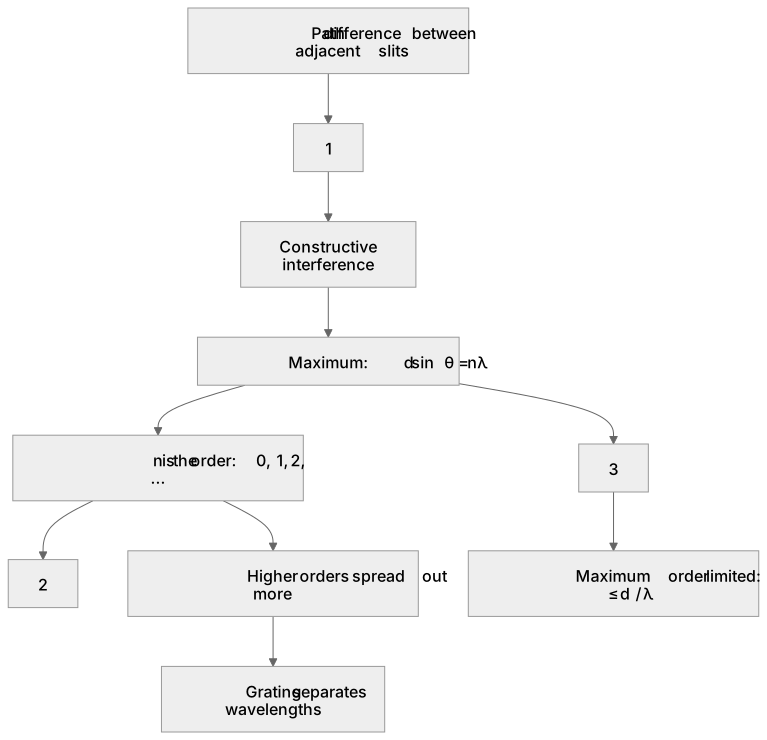
1Box 1
2Box 2
3Box 3
There is more to this lesson
The full lesson goes on to check your understanding and help you earn the marks. Create a free account to carry on, with your progress saved.
A week of Premium from your first lesson · Then the free plan continues · No card, no charge
Test your understanding of Electromagnetic radiation from stars: (h) the condition for maxima d sin θ = nλ, where d is the grating spacing
Active recall beats re-reading. Take an instant quiz now to test what you’ve learned and lock it into long-term memory.
A week of Premium from your first lesson · Then the free plan continues · No card, no charge