OCR · A-Level · Physics
Course version: H556 · Version from Sept 2015
(k) use of Wien’s displacement law and Stefan’s law to estimate the radius…
Full specification wording
Electromagnetic radiation from stars: (k) use of Wien’s displacement law and Stefan’s law to estimate the radius of a star.
Wien’s displacement law, λmaxT = 2.9 × 10⁻³ m K, links a star’s peak-emission wavelength λmax to its surface temperature T. Stefan’s law, L = 4πr²σT⁴, links luminosity, radius and temperature.
Checked against the OCR H556 specification (opens in a new tab) on .
- Point 11 of 11
- 4 key terms
Study notes
From the checked teaching notes for this specification point.
The idea
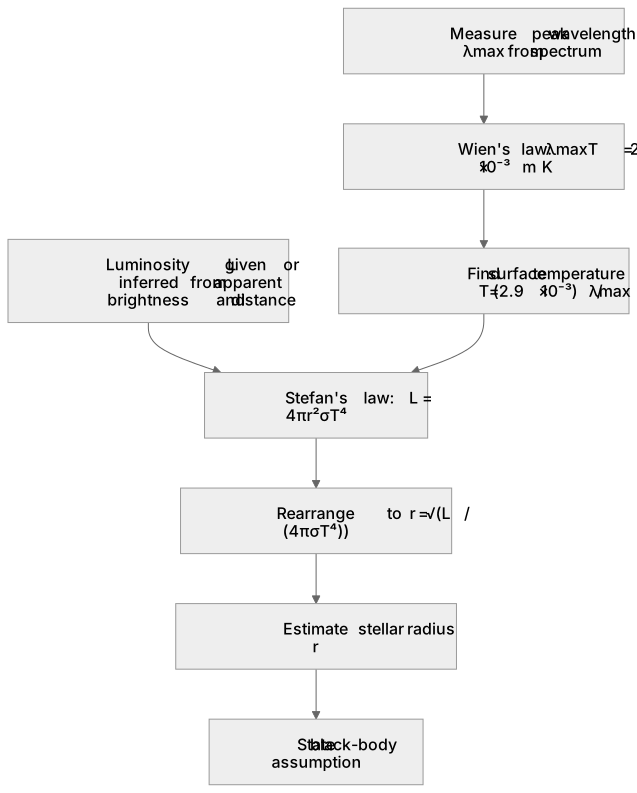
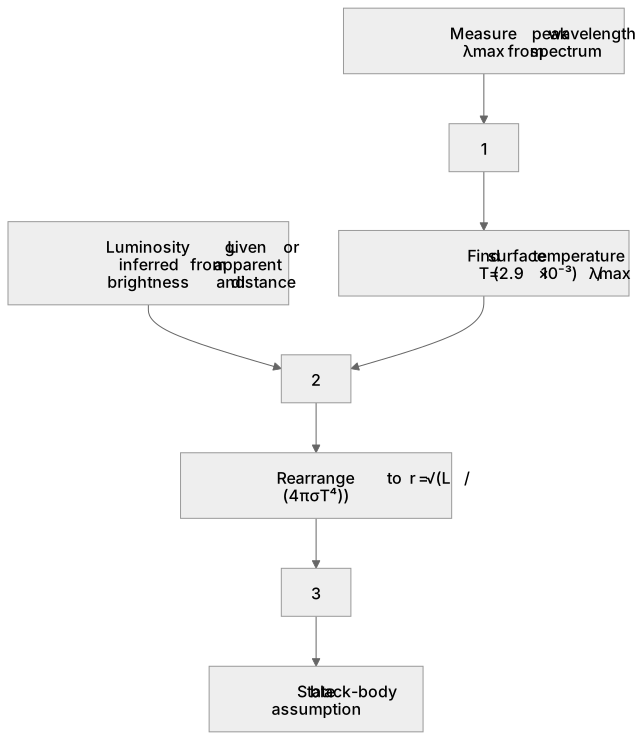
Wien’s displacement law, λmaxT = 2.9 × 10⁻³ m K, links a star’s peak-emission wavelength λmax to its surface temperature T. Stefan’s law, L = 4πr²σT⁴, links luminosity, radius and temperature. To estimate a star’s radius: measure λmax from its spectrum, use Wien’s law to find T = (2.9 × 10⁻³) / λmax, then rearrange Stefan’s law to r = √(L / (4πσT⁴)). Luminosity may be given or inferred from apparent brightness and distance. Work in kelvin and metres throughout. This two-step method is powerful because it needs only the spectrum and the luminosity.
What earns the marks
- Wien’s displacement law is λmaxT = 2.9 × 10⁻³ m K, where λmax is the wavelength of peak emission.
- Use Wien’s law to calculate surface temperature from the observed peak wavelength: T = (2.9 × 10⁻³) / λmax.
- Stefan’s law L = 4πr²σT⁴ relates luminosity, radius and temperature.
- Rearrange Stefan’s law to r = √(L / (4πσT⁴)) and substitute the temperature found from Wien’s law.
- Luminosity may be supplied directly or deduced from apparent brightness and distance before the radius calculation.
- Keep all quantities in SI units: λmax in metres, T in kelvin, L in watts and r in metres.
Common mistakes and how to put them right
Using Wien’s law to find radius directly.
Put it right: Wien’s law gives temperature only, and radius requires Stefan’s law as a second step.
Substituting λmax in nanometres without converting to metres.
Put it right: Convert nm to m by multiplying by 10⁻⁹ before dividing into the constant.
Mixing up the order of operations and squaring the temperature before dividing.
Put it right: Compute T⁴, multiply by 4πσ, then divide L by that product before taking the square root.
Assuming the star is a perfect black body without comment.
Put it right: State that the estimate assumes black-body behaviour, which is an approximation.
Exam tips
- Show both equations explicitly and label the intermediate temperature before calculating the radius.
- Carry extra significant figures through the intermediate temperature to avoid rounding errors in the final radius.
- State the black-body assumption when interpreting the estimate, since real stellar spectra deviate from a perfect black body.
Try the lesson
The start of the Electromagnetic radiation from stars: (k) use of Wien’s displacement law and Stefan’s law to estimate the radius of a star. lesson, made from checked teaching notes for this specification point.
Listen
Wien’s displacement law, λmaxT = 2.9 × 10⁻³ m K, links a star’s peak-emission wavelength λmax to its surface temperature T. Stefan’s law, L = 4πr²σT⁴, links luminosity, radius and temperature. To estimate a star’s radius: measure λmax from its spectrum, use Wien’s law to find T = (2.9 × 10⁻³) / λmax, then rearrange Stefan’s law to r = √(L / (4πσT⁴)). Luminosity may be given or inferred from apparent brightness and distance. Work in kelvin and metres throughout. This two-step method is powerful because it needs only the spectrum and the luminosity. A strong answer earns marks for these points. Wien’s displacement law is λmaxT = 2.9 × 10⁻³ m K, where λmax is the wavelength of peak emission. Use Wien’s law to calculate surface temperature from the observed peak wavelength: T = (2.9 × 10⁻³) / λmax. Stefan’s law L = 4πr²σT⁴ relates luminosity, radius and temperature. Rearrange Stefan’s law to r = √(L / (4πσT⁴)) and substitute the temperature found from Wien’s law. A common slip: Using Wien’s law to find radius directly. Instead, Wien’s law gives temperature only, and radius requires Stefan’s law as a second step. Exam tip: Show both equations explicitly and label the intermediate temperature before calculating the radius.
See it
Key words
Say what each word means before you turn the card.
Wien’s displacement law
Try answering aloud or in your head before turning the card.
Stefan’s law
Try answering aloud or in your head before turning the card.
Luminosity
Try answering aloud or in your head before turning the card.
Black-body modelling of stars
Try answering aloud or in your head before turning the card.
See every definition
- Wien’s displacement law
- λmaxT = 2.9 × 10⁻³ m K, where λmax is the wavelength of peak emission, linking a star’s peak-emission wavelength to its surface temperature.
- Stefan’s law
- L = 4πr²σT⁴, which relates luminosity, radius and temperature.
- Luminosity
- A quantity that may be given or inferred from apparent brightness and distance, and is used in Stefan’s law.
- Black-body modelling of stars
- An estimate that assumes black-body behaviour, which is an approximation since real stellar spectra deviate from a perfect black body.
Label the diagram
Some boxes have lost their names. Pick the right name for each number.
1Box 1
2Box 2
3Box 3
There is more to this lesson
The full lesson goes on to check your understanding and help you earn the marks. Create a free account to carry on, with your progress saved.
A week of Premium from your first lesson · Then the free plan continues · No card, no charge
Test your understanding of Electromagnetic radiation from stars: (k) use of Wien’s displacement law and Stefan’s law to estimate the radius of a star.
Active recall beats re-reading. Take an instant quiz now to test what you’ve learned and lock it into long-term memory.
A week of Premium from your first lesson · Then the free plan continues · No card, no charge