OCR · A-Level · Physics
Course version: H556 · Version from Sept 2015
(a) interchange between kinetic and potential energy during simple…
Full specification wording
Energy of a simple harmonic oscillator: (a) interchange between kinetic and potential energy during simple harmonic motion
In an undamped simple harmonic oscillator, total energy is conserved while kinetic and potential energy interchange continuously.
Checked against the OCR H556 specification (opens in a new tab) on .
- Point 1 of 2
- 4 key terms
Study notes
From the checked teaching notes for this specification point.
The idea
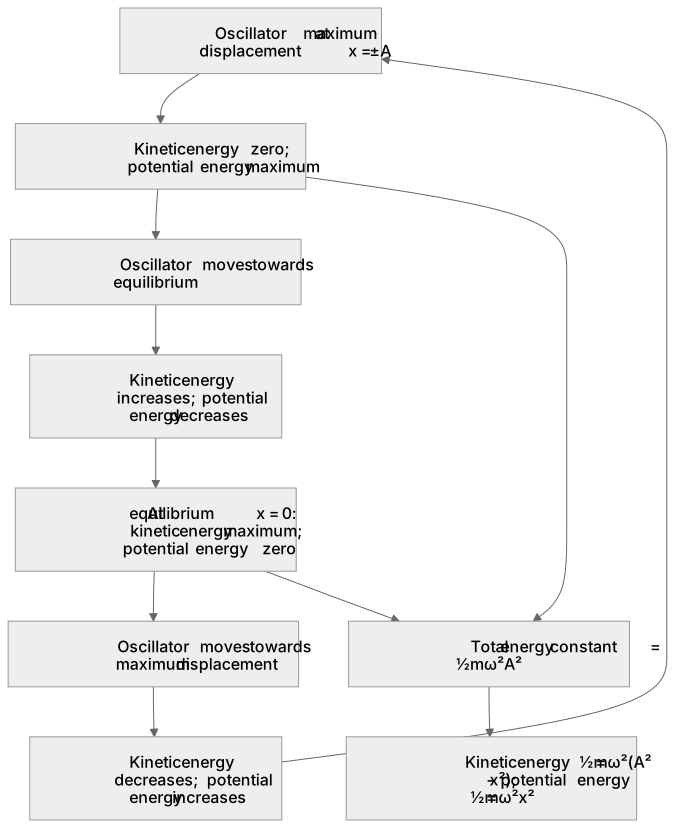
In an undamped simple harmonic oscillator, total energy is conserved while kinetic and potential energy interchange continuously. Kinetic energy is maximum at the equilibrium position, where speed is greatest, and zero at maximum displacement, where the oscillator momentarily stops. Potential energy is zero at equilibrium and maximum at maximum displacement. For a mass–spring system, potential energy is elastic, stored in the spring; for a pendulum, it is gravitational. The total energy E = ½kA² = ½mω²A² remains constant, where A is amplitude. At any displacement x, kinetic energy is ½mω²(A² − x²) and potential energy is ½mω²x², so their sum is constant.
What earns the marks
- Total energy of an undamped simple harmonic oscillator is constant and equals ½mω²A².
- Kinetic energy is maximum at equilibrium (x = 0) and zero at maximum displacement (x = ±A).
- Potential energy is zero at equilibrium and maximum at maximum displacement.
- Kinetic energy at displacement x is ½mω²(A² − x²) and potential energy is ½mω²x².
- The interchange is continuous, with kinetic energy converting to potential energy and back each cycle.
- For a mass–spring oscillator the potential energy is elastic; for a pendulum it is gravitational.
Common mistakes and how to put them right
Thinking total energy changes during the cycle.
Put it right: Total energy is constant when damping is negligible.
Believing kinetic energy is maximum at maximum displacement.
Put it right: Speed is zero there, so kinetic energy is zero.
Assuming potential energy is maximum at equilibrium.
Put it right: Potential energy is zero at equilibrium and maximum at the extremes.
Using E = ½mv² with v as the maximum speed at all positions instead of using the displacement-dependent expression.
Exam tips
- Write the total energy as ½mω²A² and subtract the potential energy to find kinetic energy at any displacement.
- Check the position first: equilibrium means maximum kinetic energy, extremes mean maximum potential energy.
- Keep amplitude A distinct from displacement x in every expression.
Try the lesson
The start of the Energy of a simple harmonic oscillator: (a) interchange between kinetic and potential energy during simple harmonic motion lesson, made from checked teaching notes for this specification point.
Listen
In an undamped simple harmonic oscillator, total energy is conserved while kinetic and potential energy interchange continuously. Kinetic energy is maximum at the equilibrium position, where speed is greatest, and zero at maximum displacement, where the oscillator momentarily stops. Potential energy is zero at equilibrium and maximum at maximum displacement. For a mass–spring system, potential energy is elastic, stored in the spring; for a pendulum, it is gravitational. The total energy E = ½kA² = ½mω²A² remains constant, where A is amplitude. At any displacement x, kinetic energy is ½mω²(A² − x²) and potential energy is ½mω²x², so their sum is constant. A strong answer earns marks for these points. Total energy of an undamped simple harmonic oscillator is constant and equals ½mω²A². Kinetic energy is maximum at equilibrium (x = 0) and zero at maximum displacement (x = ±A). Potential energy is zero at equilibrium and maximum at maximum displacement. Kinetic energy at displacement x is ½mω²(A² − x²) and potential energy is ½mω²x². Exam tip: Write the total energy as ½mω²A² and subtract the potential energy to find kinetic energy at any displacement.
See it
Key words
Say what each word means before you turn the card.
Conservation of energy in simple harmonic motion
Try answering aloud or in your head before turning the card.
Kinetic and potential energy interchange
Try answering aloud or in your head before turning the card.
Energy–displacement relationships
Try answering aloud or in your head before turning the card.
Amplitude and total energy
Try answering aloud or in your head before turning the card.
See every definition
- Conservation of energy in simple harmonic motion
- In an undamped simple harmonic oscillator, total energy is conserved while kinetic and potential energy interchange continuously.
- Kinetic and potential energy interchange
- The interchange is continuous, with kinetic energy converting to potential energy and back each cycle.
- Energy–displacement relationships
- At any displacement x, kinetic energy is ½mω²(A² − x²) and potential energy is ½mω²x², so their sum is constant.
- Amplitude and total energy
- The total energy E = ½kA² = ½mω²A² remains constant, where A is amplitude.
Label the diagram
Some boxes have lost their names. Pick the right name for each number.
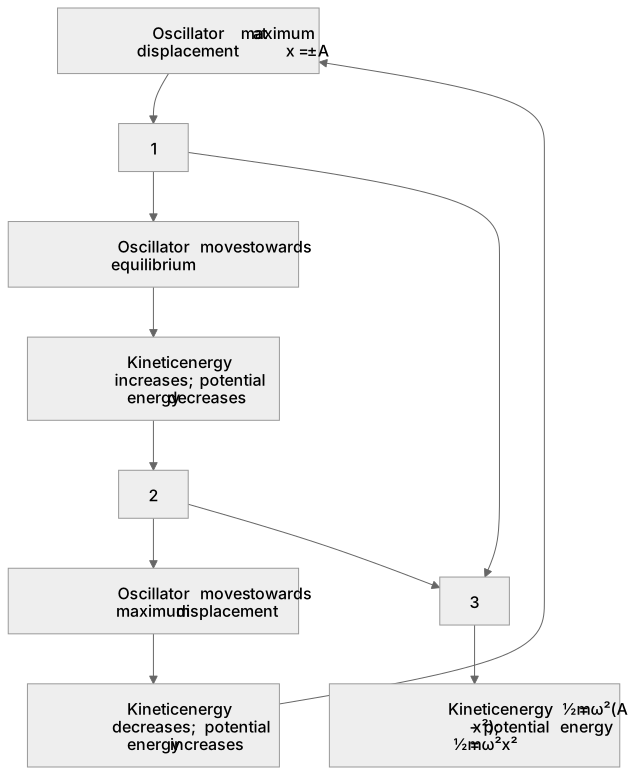
1Box 1
2Box 2
3Box 3
There is more to this lesson
The full lesson goes on to check your understanding and help you earn the marks. Create a free account to carry on, with your progress saved.
A week of Premium from your first lesson · Then the free plan continues · No card, no charge
Test your understanding of Energy of a simple harmonic oscillator: (a) interchange between kinetic and potential energy during simple harmonic motion
Active recall beats re-reading. Take an instant quiz now to test what you’ve learned and lock it into long-term memory.
A week of Premium from your first lesson · Then the free plan continues · No card, no charge