OCR · A-Level · Physics
Course version: H556 · Version from Sept 2015
(b) particle and its corresponding antiparticle have same mass; electron…
Full specification wording
Fundamental particles: (b) particle and its corresponding antiparticle have same mass; electron and positron have opposite charge; proton and antiproton have opposite charge
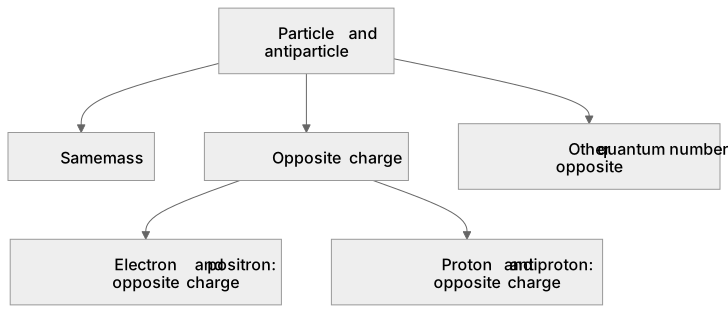
A particle and its antiparticle have exactly the same mass but opposite values of charge and other quantum numbers such as baryon number and lepton number.
Checked against the OCR H556 specification (opens in a new tab) on .
- Point 2 of 12
Study notes
From the checked teaching notes for this specification point.
The idea
A particle and its antiparticle have exactly the same mass but opposite values of charge and other quantum numbers such as baryon number and lepton number.
For example: The electron and positron both have mass 9.11 × 10⁻³¹ kg, but the electron has charge −1.60 × 10⁻¹⁹ C while the positron has charge +1.60 × 10⁻¹⁹ C. Similarly, the proton and antiproton have the same mass (1.67 × 10⁻²⁷ kg) but opposite charge: proton +1.60 × 10⁻¹⁹ C, antiproton −1.60 × 10⁻¹⁹ C. In MCQs, you may be asked to compare masses or charges, or to identify which property is opposite and which is the same.
What earns the marks
- Particle and antiparticle have identical mass.
- Electron and positron have opposite charge.
- Proton and antiproton have opposite charge.
- Other quantum numbers (e.g. baryon number, lepton number) are also opposite.
- Charge is conserved in particle–antiparticle creation and annihilation.
Common mistakes and how to put them right
Thinking antiparticles have negative mass.
Put it right: Mass is always positive and identical for particle and antiparticle.
Assuming all antiparticles are negatively charged.
Put it right: The antiproton is negative, but the antineutron is neutral and the positron is positive.
Believing the positron has the same charge as a proton.
Put it right: The positron has charge +1.60 × 10⁻¹⁹ C, same magnitude as the electron but opposite sign, while the proton also has +1.60 × 10⁻¹⁹ C but a much larger mass.
Forgetting that lepton number and baryon number are opposite for antiparticles, not just charge.
Exam tips
- Compare masses first: they are equal for particle and antiparticle.
- Check the sign of charge: it is opposite for particle and antiparticle.
- Use conservation of charge to check if a proposed reaction is possible.
Try the lesson
The start of the Fundamental particles: (b) particle and its corresponding antiparticle have same mass; electron and positron have opposite charge; proton and antiproton have opposite charge lesson, made from checked teaching notes for this specification point.
Listen
A particle and its antiparticle have exactly the same mass but opposite values of charge and other quantum numbers such as baryon number and lepton number. For example, the electron and positron both have mass 9.11 × 10⁻³¹ kg, but the electron has charge −1.60 × 10⁻¹⁹ C while the positron has charge +1.60 × 10⁻¹⁹ C. Similarly, the proton and antiproton have the same mass (1.67 × 10⁻²⁷ kg) but opposite charge: proton +1.60 × 10⁻¹⁹ C, antiproton −1.60 × 10⁻¹⁹ C. In MCQs, you may be asked to compare masses or charges, or to identify which property is opposite and which is the same. A strong answer earns marks for these points. Particle and antiparticle have identical mass. Electron and positron have opposite charge. Proton and antiproton have opposite charge. Other quantum numbers (e.g. baryon number, lepton number) are also opposite. Exam tip: Compare masses first: they are equal for particle and antiparticle.
See it
Label the diagram
Some boxes have lost their names. Pick the right name for each number.
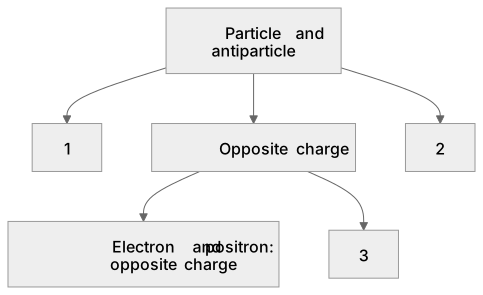
1Box 1
2Box 2
3Box 3
There is more to this lesson
The full lesson goes on to check your understanding and help you earn the marks. Create a free account to carry on, with your progress saved.
A week of Premium from your first lesson · Then the free plan continues · No card, no charge
Test your understanding of Fundamental particles: (b) particle and its corresponding antiparticle have same mass; electron and positron have opposite charge; proton and antiproton have opposite charge
Active recall beats re-reading. Take an instant quiz now to test what you’ve learned and lock it into long-term memory.
A week of Premium from your first lesson · Then the free plan continues · No card, no charge