OCR · A-Level · Physics
Course version: H556 · Version from Sept 2015
(a) gravitational potential at a point as the work done in bringing unit…
Full specification wording
Gravitational potential and energy: (a) gravitational potential at a point as the work done in bringing unit mass from infinity to the point; gravitational potential is zero at infinity
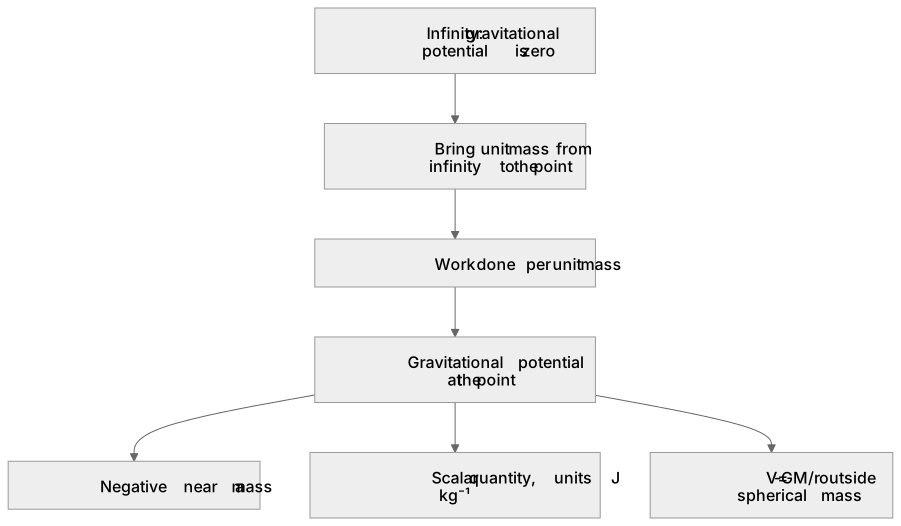
Gravitational potential at a point is defined as the work done per unit mass in bringing a small test mass from infinity to that point.
Checked against the OCR H556 specification (opens in a new tab) on .
- Point 1 of 5
- 4 key terms
Study notes
From the checked teaching notes for this specification point.
The idea
Gravitational potential at a point is defined as the work done per unit mass in bringing a small test mass from infinity to that point. It is a scalar quantity, measured in joules per kilogram (J kg⁻¹). Because the gravitational force is attractive, the work done by the gravitational field is positive when moving from infinity to a point, so the potential is negative. At infinity, the potential is defined as zero. For example, near Earth's surface, the potential is approximately -GM/r, where M is Earth's mass and r is the distance from Earth's centre. The negative sign indicates that energy is released as the mass moves closer. This concept is fundamental for calculating gravitational potential energy and escape velocity.
What earns the marks
- Define gravitational potential as work done per unit mass in bringing a mass from infinity to the point.
- State that gravitational potential is zero at infinity.
- Recognise that gravitational potential is negative for a point near a mass.
- Use the equation V = -GM/r for a point outside a spherical mass.
- Explain that gravitational potential is a scalar quantity with units J kg⁻¹.
Common mistakes and how to put them right
Forgetting the negative sign in the definition or equation.
Put it right by remembering that gravitational potential is always negative near a mass.
Confusing gravitational potential with gravitational potential energy.
Put it right by noting potential is per unit mass.
Thinking potential is zero at the surface of a planet.
Put it right by stating it is zero only at infinity.
Exam tips
- Always include the negative sign when stating the value of gravitational potential.
- Use the definition to derive the equation V = -GM/r if needed.
- Remember that potential is a scalar, so no direction is required.
Try the lesson
The start of the Gravitational potential and energy: (a) gravitational potential at a point as the work done in bringing unit mass from infinity to the point; gravitational potential is zero at infinity lesson, made from checked teaching notes for this specification point.
Listen
Gravitational potential at a point is defined as the work done per unit mass in bringing a small test mass from infinity to that point. It is a scalar quantity, measured in joules per kilogram (J kg⁻¹). Because the gravitational force is attractive, the work done by the gravitational field is positive when moving from infinity to a point, so the potential is negative. At infinity, the potential is defined as zero. For example, near Earth's surface, the potential is approximately -GM/r, where M is Earth's mass and r is the distance from Earth's centre. The negative sign indicates that energy is released as the mass moves closer. This concept is fundamental for calculating gravitational potential energy and escape velocity. A strong answer earns marks for these points. Define gravitational potential as work done per unit mass in bringing a mass from infinity to the point. State that gravitational potential is zero at infinity. Recognise that gravitational potential is negative for a point near a mass. Use the equation V = -GM/r for a point outside a spherical mass. A common slip: Forgetting the negative sign in the definition or equation. Instead, remembering that gravitational potential is always negative near a mass. Exam tip: Always include the negative sign when stating the value of gravitational potential.
See it
Key words
Say what each word means before you turn the card.
Gravitational potential
Try answering aloud or in your head before turning the card.
Zero potential at infinity
Try answering aloud or in your head before turning the card.
Negative potential near masses
Try answering aloud or in your head before turning the card.
Scalar nature of potential
Try answering aloud or in your head before turning the card.
See every definition
- Gravitational potential
- The work done per unit mass in bringing a small test mass from infinity to that point.
- Zero potential at infinity
- At infinity, the potential is defined as zero.
- Negative potential near masses
- Because the gravitational force is attractive, the work done by the gravitational field is positive when moving from infinity to a point, so the potential is negative.
- Scalar nature of potential
- Gravitational potential is a scalar quantity, measured in joules per kilogram (J kg⁻¹).
Label the diagram
Some boxes have lost their names. Pick the right name for each number.
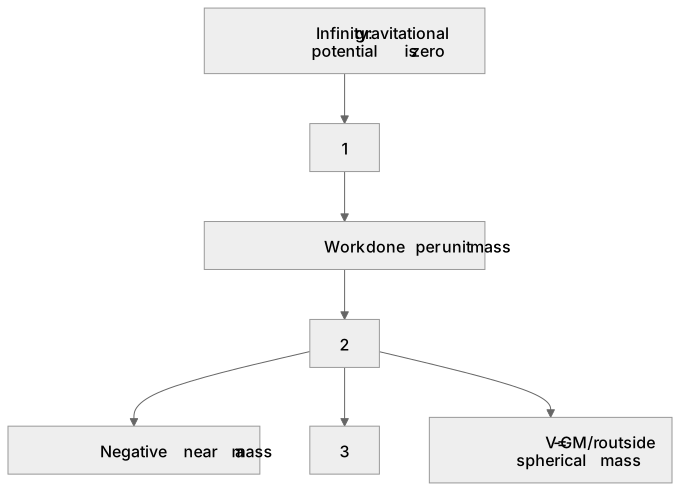
1Box 1
2Box 2
3Box 3
There is more to this lesson
The full lesson goes on to check your understanding and help you earn the marks. Create a free account to carry on, with your progress saved.
A week of Premium from your first lesson · Then the free plan continues · No card, no charge
Test your understanding of Gravitational potential and energy: (a) gravitational potential at a point as the work done in bringing unit mass from infinity to the point; gravitational potential is zero at infinity
Active recall beats re-reading. Take an instant quiz now to test what you’ve learned and lock it into long-term memory.
A week of Premium from your first lesson · Then the free plan continues · No card, no charge