OCR · A-Level · Physics
Course version: H556 · Version from Sept 2015
Implementing: (b) appropriate units for measurements
Choosing appropriate units means matching every measured quantity to the correct SI unit and prefix, then writing it with the right symbol and exponent.
Checked against the OCR H556 specification (opens in a new tab) on .
- Point 2 of 2
Study notes
From the checked teaching notes for this specification point.
The idea
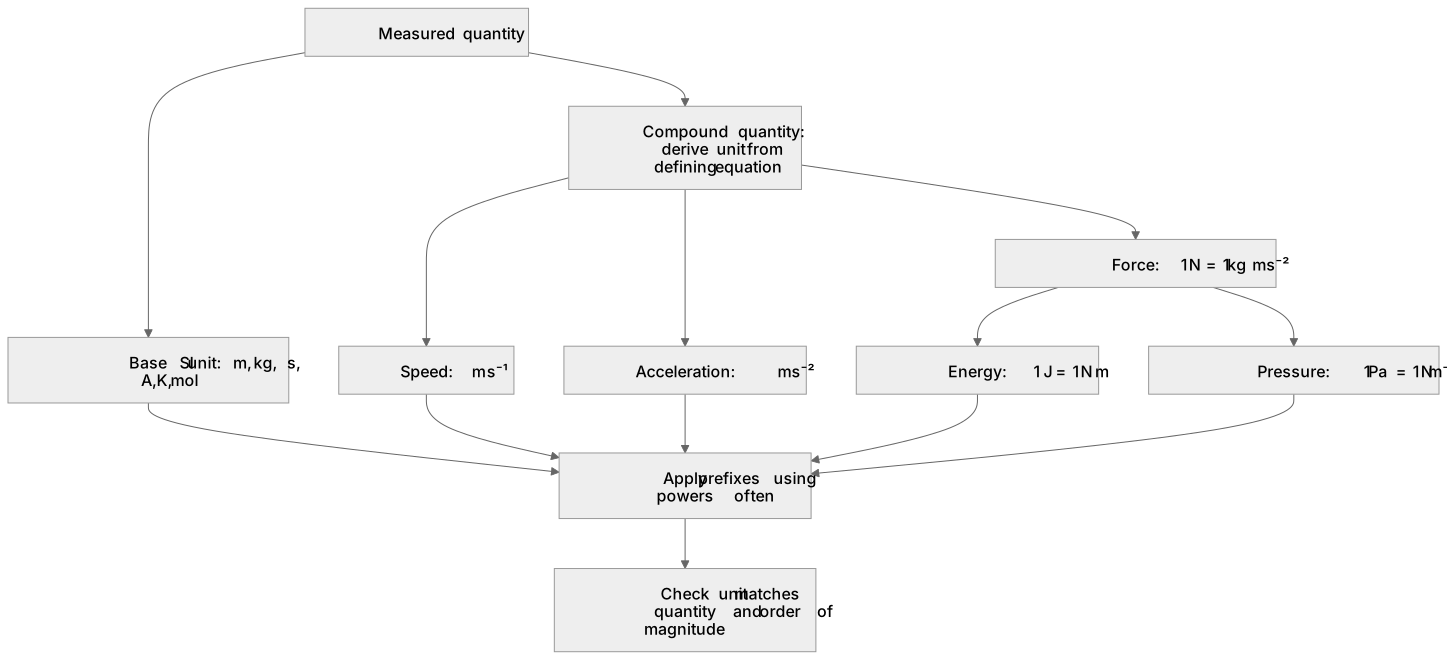
Choosing appropriate units means matching every measured quantity to the correct SI unit and prefix, then writing it with the right symbol and exponent. Length is measured in metres (m), mass in kilograms (kg), time in seconds (s), current in amperes (A), temperature in kelvin (K) and amount of substance in moles (mol). Derived units follow from equations: speed in m s⁻¹, acceleration in m s⁻², force in newtons where 1 N = 1 kg m s⁻², energy in joules where 1 J = 1 N m, and pressure in pascals where 1 Pa = 1 N m⁻². Prefixes scale units by powers of ten, so 1 mm = 1 × 10⁻³ m and 1 km = 1 × 10³ m. In a multiple-choice question you compare each option with the quantity and its magnitude, rejecting any unit that is dimensionally wrong or wrongly scaled.
What earns the marks
- Identify the base SI unit for each measured quantity: m, kg, s, A, K, mol.
- Derive the unit of a compound quantity from its defining equation, for example speed as m s⁻¹ and force as kg m s⁻².
- Recognise named derived units and their base equivalents, such as 1 N = 1 kg m s⁻² and 1 J = 1 N m.
- Apply prefixes correctly, converting between mm, cm, m and km using powers of ten.
- Check that the unit matches both the physical quantity and the order of magnitude recorded.
Common mistakes and how to put them right
Writing a unit without the correct exponent, for example recording area as m rather than m².
Put it right: Square the unit when the quantity is an area.
Confusing mass and force by giving a weight in kg.
Put it right: Give weight in newtons because weight is a force.
Using the prefix as a separate unit, for example writing km h rather than km h⁻¹ for speed.
Put it right: Attach the negative exponent to the time unit.
Exam tips
- Underline the quantity being measured before comparing the options, so you judge the unit against the right physical quantity.
- Convert every option to base SI units mentally; the option that cannot be reduced to the correct base combination is wrong.
- Check prefixes last, since a dimensionally correct unit can still be wrongly scaled by a factor of 10³.
Try the lesson
The start of the Implementing: (b) appropriate units for measurements lesson, made from checked teaching notes for this specification point.
Listen
Choosing appropriate units means matching every measured quantity to the correct SI unit and prefix, then writing it with the right symbol and exponent. Length is measured in metres (m), mass in kilograms (kg), time in seconds (s), current in amperes (A), temperature in kelvin (K) and amount of substance in moles (mol). Derived units follow from equations: speed in m s⁻¹, acceleration in m s⁻², force in newtons where 1 N = 1 kg m s⁻², energy in joules where 1 J = 1 N m, and pressure in pascals where 1 Pa = 1 N m⁻². Prefixes scale units by powers of ten, so 1 mm = 1 × 10⁻³ m and 1 km = 1 × 10³ m. In a multiple-choice question you compare each option with the quantity and its magnitude, rejecting any unit that is dimensionally wrong or wrongly scaled. A strong answer earns marks for these points. Identify the base SI unit for each measured quantity: m, kg, s, A, K, mol. Derive the unit of a compound quantity from its defining equation, for example speed as m s⁻¹ and force as kg m s⁻². Recognise named derived units and their base equivalents, such as 1 N = 1 kg m s⁻² and 1 J = 1 N m. Apply prefixes correctly, converting between mm, cm, m and km using powers of ten. A common slip: Writing a unit without the correct exponent, for example recording area as m rather than m². Instead, square the unit when the quantity is an area. Exam tip: Underline the quantity being measured before comparing the options, so you judge the unit against the right physical quantity.
See it
Label the diagram
Some boxes have lost their names. Pick the right name for each number.
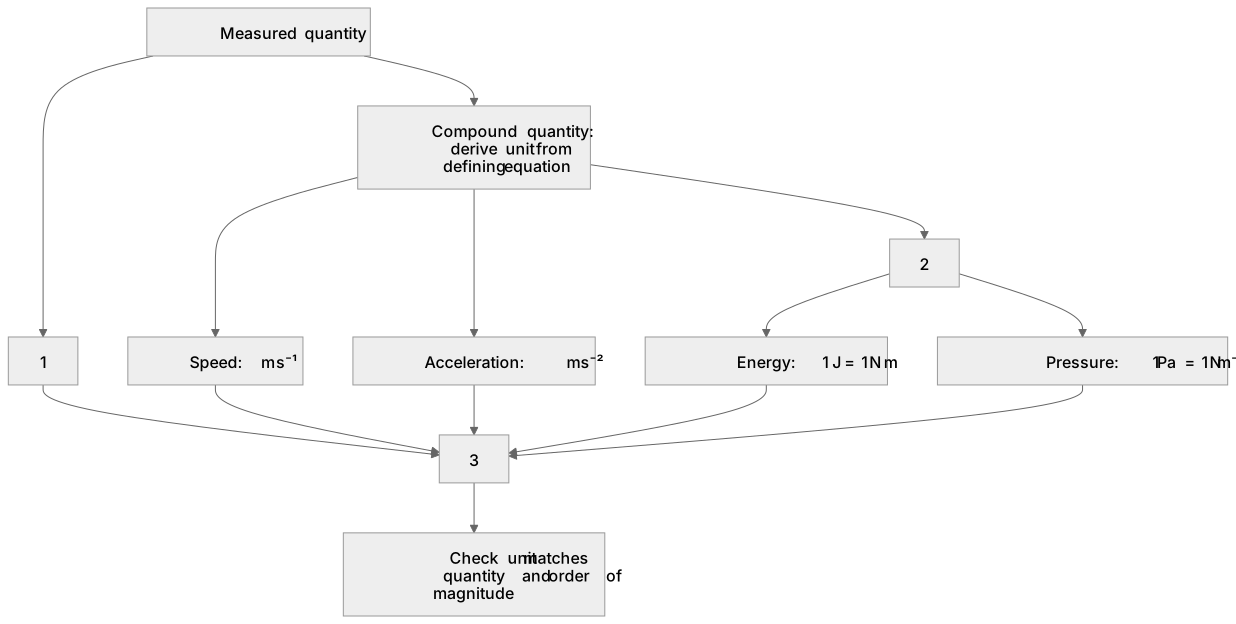
1Box 1
2Box 2
3Box 3
There is more to this lesson
The full lesson goes on to check your understanding and help you earn the marks. Create a free account to carry on, with your progress saved.
A week of Premium from your first lesson · Then the free plan continues · No card, no charge
Test your understanding of Implementing: (b) appropriate units for measurements
Active recall beats re-reading. Take an instant quiz now to test what you’ve learned and lock it into long-term memory.
A week of Premium from your first lesson · Then the free plan continues · No card, no charge