OCR · A-Level · Physics
Course version: H556 · Version from Sept 2015
Internal resistance: (a) source of e.m.f.; internal resistance
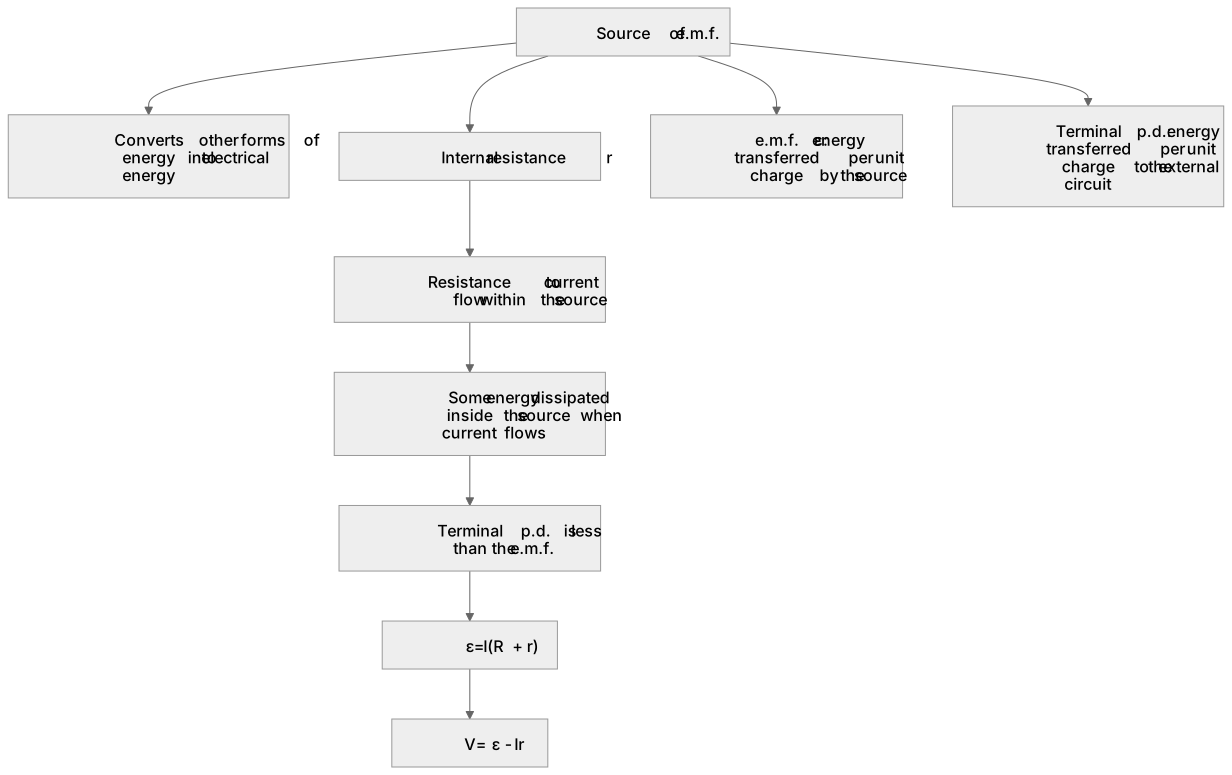
A source of e.m.f. is a device that converts other forms of energy into electrical energy, maintaining a potential difference across its terminals.
Checked against the OCR H556 specification (opens in a new tab) on .
- Point 1 of 3
- 3 key terms
Study notes
From the checked teaching notes for this specification point.
The idea
A source of e.m.f. is a device that converts other forms of energy into electrical energy, maintaining a potential difference across its terminals. Real sources have internal resistance, which is the resistance to current flow within the source itself. The e.m.f. (ε) is the energy transferred per unit charge by the source, while the terminal p.d. is the energy transferred per unit charge by the source to the external circuit. When current flows, some energy is dissipated inside the source, so the terminal p.d. is less than the e.m.f. The relationship is ε = I(R + r), where R is external resistance and r is internal resistance.
For example: A battery with ε = 9.0 V and r = 1.0 Ω connected to a 4.0 Ω resistor gives I = 9.0 / (4.0 + 1.0) = 1.8 A.
What earns the marks
- Define e.m.f. as the energy transferred per unit charge by the source.
- Define internal resistance as the resistance within the source that causes a potential drop when current flows.
- State the relationship ε = I(R + r) for a source with internal resistance r and external resistance R.
- Explain that terminal p.d. equals ε minus the p.d. across the internal resistance (Ir).
- Calculate current, terminal p.d. or internal resistance using ε = I(R + r) and V = ε - Ir.
Common mistakes and how to put them right
Confusing e.m.f. with terminal p.d.
Put it right: e.m.f. is the energy per unit charge supplied by the source, while terminal p.d. is the energy per unit charge available to the external circuit and is less than e.m.f. when current flows.
Ignoring internal resistance when calculating current.
Put it right: Include r in the total resistance, so I = ε / (R + r).
Assuming internal resistance is always negligible.
Put it right: In many real sources it is significant and must be accounted for.
Thinking that e.m.f. and terminal p.d. are always equal.
Put it right: They are equal only when no current flows (open circuit).
Exam tips
- Remember that e.m.f. is measured in volts and is the energy per unit charge, not a force.
- When using ε = I(R + r), ensure all resistances are in ohms and current in amperes.
- To find terminal p.d., use V = ε - Ir or V = IR.
Try the lesson
The start of the Internal resistance: (a) source of e.m.f.; internal resistance lesson, made from checked teaching notes for this specification point.
Listen
A source of e.m.f. is a device that converts other forms of energy into electrical energy, maintaining a potential difference across its terminals. Real sources have internal resistance, which is the resistance to current flow within the source itself. The e.m.f. (ε) is the energy transferred per unit charge by the source, while the terminal p.d. is the energy transferred per unit charge by the source to the external circuit. When current flows, some energy is dissipated inside the source, so the terminal p.d. is less than the e.m.f. The relationship is ε = I(R + r), where R is external resistance and r is internal resistance. For example, a battery with ε = 9.0 V and r = 1.0 Ω connected to a 4.0 Ω resistor gives I = 9.0 / (4.0 + 1.0) = 1.8 A. A strong answer earns marks for these points. Define e.m.f. as the energy transferred per unit charge by the source. Define internal resistance as the resistance within the source that causes a potential drop when current flows. State the relationship ε = I(R + r) for a source with internal resistance r and external resistance R. Explain that terminal p.d. equals ε minus the p.d. across the internal resistance (Ir). A common slip: Confusing e.m.f. with terminal p.d. Instead, e.m.f. is the energy per unit charge supplied by the source, while terminal p.d. is the energy per unit charge available to the external circuit and is less than e.m.f. when current flows. Exam tip: Remember that e.m.f. is measured in volts and is the energy per unit charge, not a force.
See it
Key words
Say what each word means before you turn the card.
Electromotive force
Try answering aloud or in your head before turning the card.
Internal resistance
Try answering aloud or in your head before turning the card.
Terminal potential difference
Try answering aloud or in your head before turning the card.
See every definition
- Electromotive force
- The energy transferred per unit charge by the source.
- Internal resistance
- The resistance to current flow within the source itself, which causes a potential drop when current flows.
- Terminal potential difference
- The energy transferred per unit charge by the source to the external circuit, which is less than the e.m.f. when current flows.
Label the diagram
Some boxes have lost their names. Pick the right name for each number.
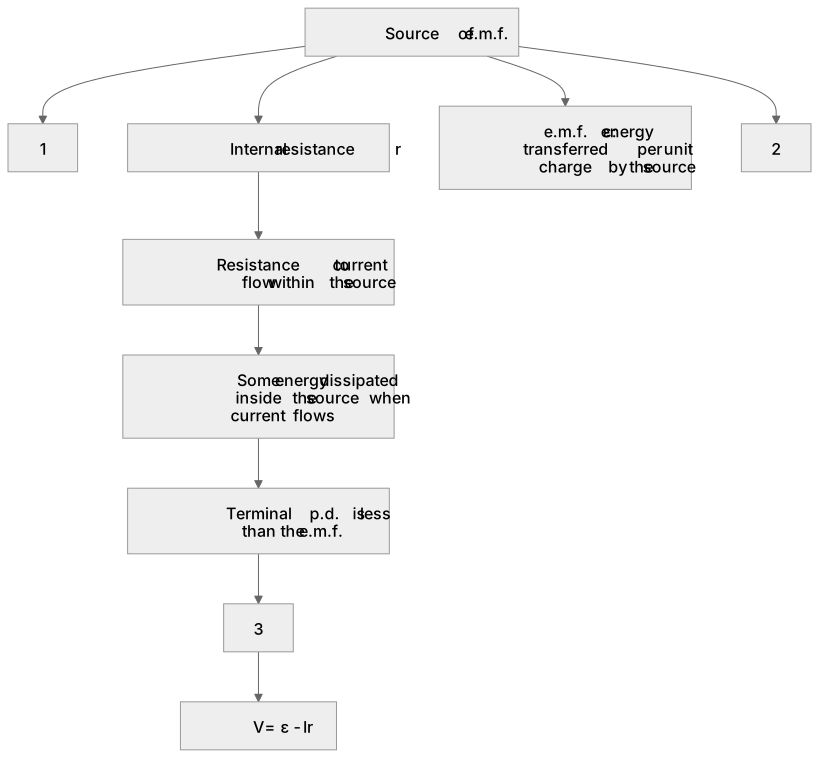
1Box 1
2Box 2
3Box 3
There is more to this lesson
The full lesson goes on to check your understanding and help you earn the marks. Create a free account to carry on, with your progress saved.
A week of Premium from your first lesson · Then the free plan continues · No card, no charge
Test your understanding of Internal resistance: (a) source of e.m.f.; internal resistance
Active recall beats re-reading. Take an instant quiz now to test what you’ve learned and lock it into long-term memory.
A week of Premium from your first lesson · Then the free plan continues · No card, no charge