OCR · A-Level · Physics
Course version: H556 · Version from Sept 2015
(b) period and frequency of an object in circular motion
Full specification wording
Kinematics of circular motion: (b) period and frequency of an object in circular motion
For an object moving in a circular path, the period T is the time taken to complete one full revolution, measured in seconds (s).
Checked against the OCR H556 specification (opens in a new tab) on .
- Point 2 of 3
- 4 key terms
Study notes
From the checked teaching notes for this specification point.
The idea
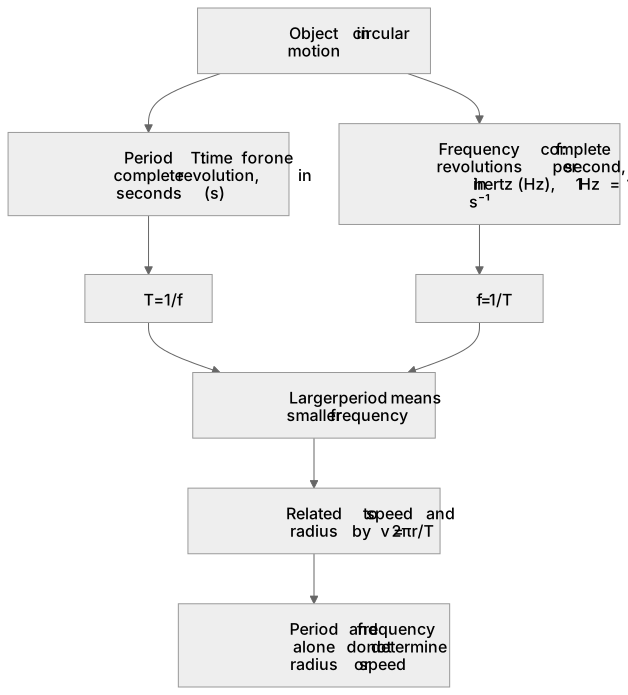
For an object moving in a circular path, the period T is the time taken to complete one full revolution, measured in seconds (s). The frequency f is the number of complete revolutions per second, measured in hertz (Hz), where 1 Hz = 1 s⁻¹. Period and frequency are reciprocals: T = 1/f and f = 1/T. For example, a satellite completing an orbit in T = 120 s has f = 1/120 ≈ 8.3 × 10⁻³ Hz. If a wheel spins at f = 5.0 Hz, each revolution takes T = 1/5.0 = 0.20 s. Period and frequency describe the timing of the motion. They are related to speed v and radius r by the equation v = 2πr/T; therefore, knowing only the period or frequency does not uniquely determine the radius or speed, as a larger radius requires a proportionally greater speed to maintain the same period.
What earns the marks
- Period T is the time for one complete revolution, measured in seconds (s).
- Frequency f is the number of complete revolutions per second, measured in hertz (Hz), where 1 Hz = 1 s⁻¹.
- Period and frequency are reciprocals: T = 1/f and f = 1/T.
- A larger period corresponds to a smaller frequency, and vice versa.
- Period and frequency alone do not determine radius or speed, as they are related by v = 2πr/T.
Common mistakes and how to put them right
Confusing period with frequency.
Put it right: T is time per revolution in seconds while f is revolutions per second in hertz.
Inverting the reciprocal the wrong way.
Put it right: T = 1/f, so a frequency of 4.0 Hz gives T = 0.25 s.
Using degrees or radians per second for frequency.
Put it right: Frequency is measured in hertz (s⁻¹), while angular velocity in rad s⁻¹ is a different quantity.
Assuming period is independent of speed and radius.
Put it right: For a fixed period, speed must increase proportionally with radius.
Exam tips
- Check the unit: if the answer is in seconds it is a period; if in hertz or s⁻¹ it is a frequency.
- When a question gives revolutions per minute, convert to hertz by dividing by 60 before using T = 1/f.
- Sketch one full revolution and label the start and end of one period to avoid counting part-revolutions as whole ones.
Try the lesson
The start of the Kinematics of circular motion: (b) period and frequency of an object in circular motion lesson, made from checked teaching notes for this specification point.
Listen
For an object moving in a circular path, the period T is the time taken to complete one full revolution, measured in seconds (s). The frequency f is the number of complete revolutions per second, measured in hertz (Hz), where 1 Hz = 1 s⁻¹. Period and frequency are reciprocals: T = 1/f and f = 1/T. For example, a satellite completing an orbit in T = 120 s has f = 1/120 ≈ 8.3 × 10⁻³ Hz. If a wheel spins at f = 5.0 Hz, each revolution takes T = 1/5.0 = 0.20 s. Period and frequency describe the timing of the motion. They are related to speed v and radius r by the equation v = 2πr/T; therefore, knowing only the period or frequency does not uniquely determine the radius or speed, as a larger radius requires a proportionally greater speed to maintain the same period. A strong answer earns marks for these points. Period T is the time for one complete revolution, measured in seconds (s). Frequency f is the number of complete revolutions per second, measured in hertz (Hz), where 1 Hz = 1 s⁻¹. Period and frequency are reciprocals: T = 1/f and f = 1/T. A larger period corresponds to a smaller frequency, and vice versa. A common slip: Confusing period with frequency: the error is treating T and f as the same quantity. Instead, T is time per revolution in seconds while f is revolutions per second in hertz. Exam tip: Check the unit: if the answer is in seconds it is a period; if in hertz or s⁻¹ it is a frequency.
See it
Key words
Say what each word means before you turn the card.
Period
Try answering aloud or in your head before turning the card.
Frequency
Try answering aloud or in your head before turning the card.
Reciprocals
Try answering aloud or in your head before turning the card.
Relationship between timing quantities, speed and radius
Try answering aloud or in your head before turning the card.
See every definition
- Period
- The time taken to complete one full revolution, measured in seconds (s).
- Frequency
- The number of complete revolutions per second, measured in hertz (Hz), where 1 Hz = 1 s⁻¹.
- Reciprocals
- Period and frequency are reciprocals: T = 1/f and f = 1/T, so a larger period corresponds to a smaller frequency, and vice versa.
- Relationship between timing quantities, speed and radius
- Period and frequency are related to speed v and radius r by the equation v = 2πr/T, so knowing only the period or frequency does not uniquely determine the radius or speed.
Label the diagram
Some boxes have lost their names. Pick the right name for each number.
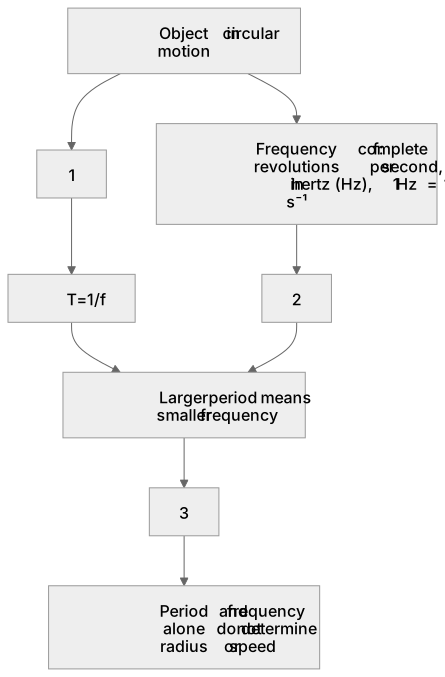
1Box 1
2Box 2
3Box 3
There is more to this lesson
The full lesson goes on to check your understanding and help you earn the marks. Create a free account to carry on, with your progress saved.
A week of Premium from your first lesson · Then the free plan continues · No card, no charge
Test your understanding of Kinematics of circular motion: (b) period and frequency of an object in circular motion
Active recall beats re-reading. Take an instant quiz now to test what you’ve learned and lock it into long-term memory.
A week of Premium from your first lesson · Then the free plan continues · No card, no charge