OCR · A-Level · Physics
Course version: H556 · Version from Sept 2015
(ii) techniques and procedures used to determine the acceleration of free…
Full specification wording
Linear motion: (ii) techniques and procedures used to determine the acceleration of free fall, to include using trapdoor and electromagnet arrangement and light gates and timer arrangement
Two standard laboratory methods determine g.
Checked against the OCR H556 specification (opens in a new tab) on .
- Point 4 of 5
Study notes
From the checked teaching notes for this specification point.
The idea
Two standard laboratory methods determine g. In the trapdoor and electromagnet arrangement, a steel ball is held by an electromagnet; when the current is switched off the ball falls and, on reaching the trapdoor, breaks a circuit and stops a timer. The measured time t and fall height s give g from s = ½gt², so g = 2s/t². In the light-gate arrangement, a card of known length passes through a gate (or two gates a known distance apart) and the timer records the interruption, giving speed and hence acceleration. Both methods reduce timing error by removing human reaction time. Repeat readings, measure s carefully and plot a suitable graph, such as s against t², whose gradient gives ½g.
What earns the marks
- Trapdoor and electromagnet method: the electromagnet releases a steel ball and the trapdoor stops a timer, so g = 2s/t² from s = ½gt².
- Light gates and timer method: a card of measured length passing through a gate gives speed, and two gates a known distance apart give acceleration.
- Repeating readings and plotting a graph such as s against t², with gradient ½g, reduces random error and improves the value of g.
Common mistakes and how to put them right
Rearranging s = ½gt² incorrectly.
Put it right: The correct form is g = 2s/t², so forgetting the factor of 2 halves the value obtained.
Assuming the timer starts when the ball is released.
Put it right: In the trapdoor arrangement the timer starts when the electromagnet circuit is broken, so the release and the start are simultaneous.
Ignoring the finite size of the falling object or card.
Put it right: The measured distance must correspond to the actual fall or the card length used to find speed.
Exam tips
- Identify which quantity each method measures directly: the trapdoor method gives a time for a known distance, while light gates give speeds at known positions.
- When a graph is plotted, state what the gradient represents before using it, for example gradient of s against t² equals ½g.
- Mention repeats and averaging whenever a question asks how to improve the accuracy of a g determination.
Try the lesson
The start of the Linear motion: (ii) techniques and procedures used to determine the acceleration of free fall, to include using trapdoor and electromagnet arrangement and light gates and timer arrangement lesson, made from checked teaching notes for this specification point.
Listen
Two standard laboratory methods determine g. In the trapdoor and electromagnet arrangement, a steel ball is held by an electromagnet; when the current is switched off the ball falls and, on reaching the trapdoor, breaks a circuit and stops a timer. The measured time t and fall height s give g from s = ½gt², so g = 2s/t². In the light-gate arrangement, a card of known length passes through a gate (or two gates a known distance apart) and the timer records the interruption, giving speed and hence acceleration. Both methods reduce timing error by removing human reaction time. Repeat readings, measure s carefully and plot a suitable graph, such as s against t², whose gradient gives ½g. A strong answer earns marks for these points. Trapdoor and electromagnet method: the electromagnet releases a steel ball and the trapdoor stops a timer, so g = 2s/t² from s = ½gt². Light gates and timer method: a card of measured length passing through a gate gives speed, and two gates a known distance apart give acceleration. Repeating readings and plotting a graph such as s against t², with gradient ½g, reduces random error and improves the value of g. Exam tip: Identify which quantity each method measures directly: the trapdoor method gives a time for a known distance, while light gates give speeds at known positions.
See it
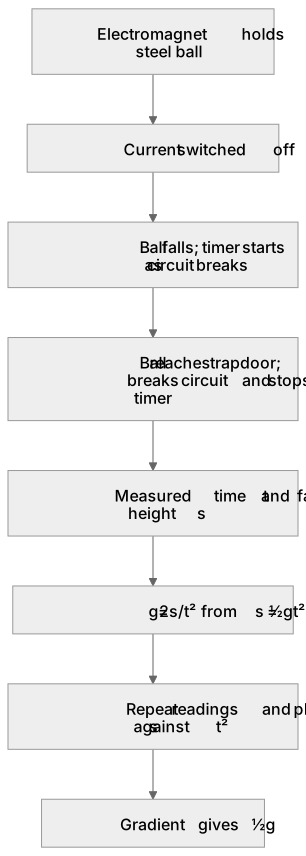
Put it in order
Put these steps in the order they happen.
- 1. Measured time t and fall height s
- 2. Gradient gives ½g
- 3. g = 2s/t² from s = ½gt²
- 4. Electromagnet holds steel ball
- 5. Current switched off
- 6. Repeat readings and plot s against t²
- 7. Ball falls; timer starts as circuit breaks
- 8. Ball reaches trapdoor; breaks circuit and stops timer
Label the diagram
Some boxes have lost their names. Pick the right name for each number.
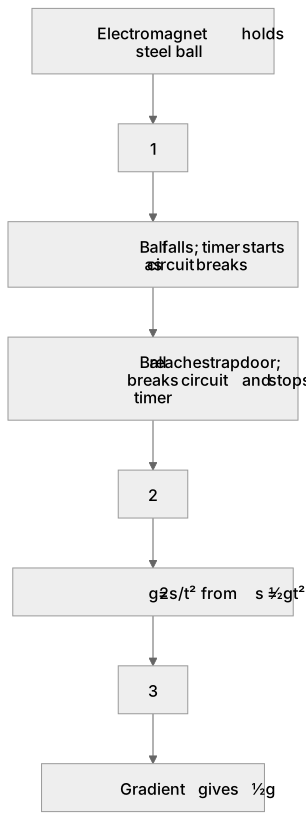
1Box 1
2Box 2
3Box 3
There is more to this lesson
The full lesson goes on to check your understanding and help you earn the marks. Create a free account to carry on, with your progress saved.
A week of Premium from your first lesson · Then the free plan continues · No card, no charge
Test your understanding of Linear motion: (ii) techniques and procedures used to determine the acceleration of free fall, to include using trapdoor and electromagnet arrangement and light gates and timer arrangement
Active recall beats re-reading. Take an instant quiz now to test what you’ve learned and lock it into long-term memory.
A week of Premium from your first lesson · Then the free plan continues · No card, no charge