OCR · A-Level · Physics
Course version: H556 · Version from Sept 2015
(ii) techniques and procedures used to investigate the motion and…
Full specification wording
Linear motion: (ii) techniques and procedures used to investigate the motion and collisions of objects
Investigating motion and collisions involves measuring time, displacement and velocity, then using the equations of motion or conservation laws to analyse the results.
Checked against the OCR H556 specification (opens in a new tab) on .
- Point 2 of 5
- 4 key terms
Study notes
From the checked teaching notes for this specification point.
The idea
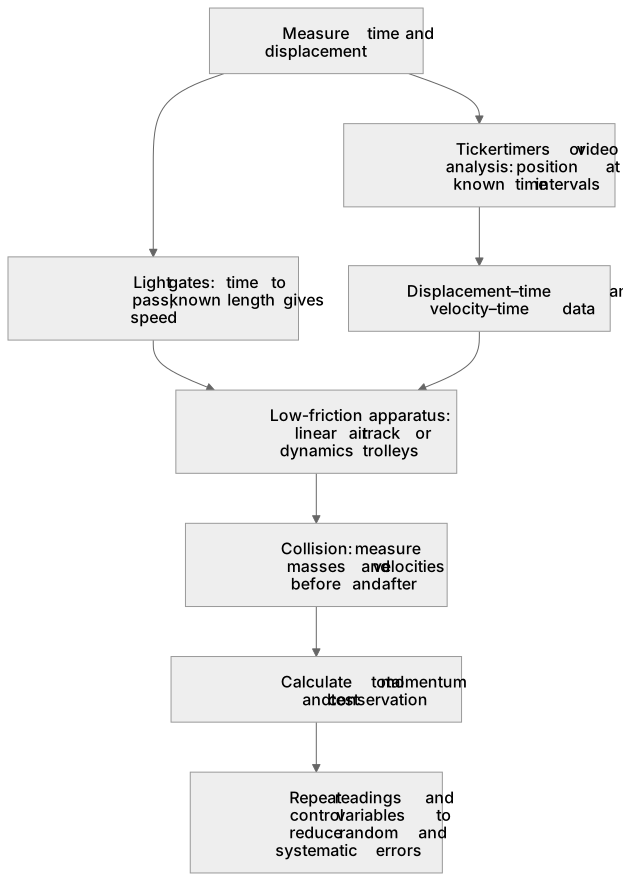
Investigating motion and collisions involves measuring time, displacement and velocity, then using the equations of motion or conservation laws to analyse the results. Typical techniques include light gates to measure speed, ticker timers or video analysis to record position against time, and apparatus such as a linear air track or dynamics trolleys to reduce friction during collisions. For a collision, measure masses and velocities before and after, and compare total momentum to test conservation. For example, two trolleys on a track can be timed through light gates before and after colliding; the measured velocities and masses allow momentum to be calculated. Procedures must control variables, repeat readings and reduce random and systematic errors.
What earns the marks
- Light gates measure the time for an object to pass and, with a known length, allow speed or velocity to be calculated.
- Ticker timers or video analysis record position at known time intervals, allowing displacement–time and velocity–time data to be produced.
- A linear air track or low-friction trolley system reduces friction so that motion and collisions approximate ideal conditions.
- For collisions, masses and velocities before and after are measured so that total momentum can be calculated and conservation tested.
- Repeating readings and controlling variables improve reliability and help identify random and systematic errors.
Common mistakes and how to put them right
Using a single measurement without repeats.
Put it right: Repeat and average readings to reduce random error.
Ignoring friction or air resistance.
Put it right: Use low-friction apparatus or account for the effect.
Measuring speed with a stopwatch over a short distance.
Put it right: Use light gates or a longer distance to improve precision.
Failing to measure mass in a collision experiment.
Put it right: Measure mass as well so that momentum can be calculated.
Exam tips
- State the apparatus and the quantity it measures, and explain how the measurement is converted into velocity or momentum.
- Describe how variables are controlled and how repeats improve reliability.
- For collision questions, identify the before and after states and check whether momentum is conserved.
Try the lesson
The start of the Linear motion: (ii) techniques and procedures used to investigate the motion and collisions of objects lesson, made from checked teaching notes for this specification point.
Listen
Investigating motion and collisions involves measuring time, displacement and velocity, then using the equations of motion or conservation laws to analyse the results. Typical techniques include light gates to measure speed, ticker timers or video analysis to record position against time, and apparatus such as a linear air track or dynamics trolleys to reduce friction during collisions. For a collision, measure masses and velocities before and after, and compare total momentum to test conservation. For example, two trolleys on a track can be timed through light gates before and after colliding; the measured velocities and masses allow momentum to be calculated. Procedures must control variables, repeat readings and reduce random and systematic errors. A strong answer earns marks for these points. Light gates measure the time for an object to pass and, with a known length, allow speed or velocity to be calculated. Ticker timers or video analysis record position at known time intervals, allowing displacement–time and velocity–time data to be produced. A linear air track or low-friction trolley system reduces friction so that motion and collisions approximate ideal conditions. For collisions, masses and velocities before and after are measured so that total momentum can be calculated and conservation tested. A common slip: Using a single measurement without repeats: the error is treating one reading as reliable. Instead, repeat and average readings to reduce random error. Exam tip: State the apparatus and the quantity it measures, and explain how the measurement is converted into velocity or momentum.
See it
Key words
Say what each word means before you turn the card.
Measurement of motion
Try answering aloud or in your head before turning the card.
Experimental design and control of variables
Try answering aloud or in your head before turning the card.
Collision analysis
Try answering aloud or in your head before turning the card.
Conservation of momentum
Try answering aloud or in your head before turning the card.
See every definition
- Measurement of motion
- Techniques such as light gates, ticker timers or video analysis are used to measure time, displacement and velocity.
- Experimental design and control of variables
- Procedures must control variables, repeat readings and reduce random and systematic errors.
- Collision analysis
- Masses and velocities before and after are measured so that total momentum can be calculated and conservation tested.
- Conservation of momentum
- For a collision, total momentum before and after is compared to test whether it is conserved.
Label the diagram
Some boxes have lost their names. Pick the right name for each number.
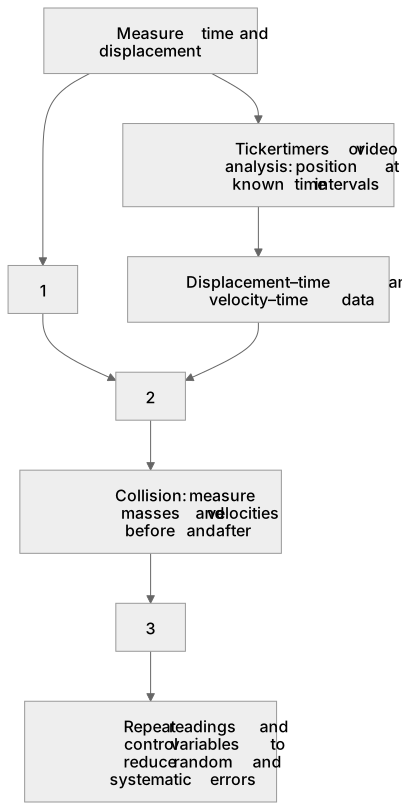
1Box 1
2Box 2
3Box 3
There is more to this lesson
The full lesson goes on to check your understanding and help you earn the marks. Create a free account to carry on, with your progress saved.
A week of Premium from your first lesson · Then the free plan continues · No card, no charge
Test your understanding of Linear motion: (ii) techniques and procedures used to investigate the motion and collisions of objects
Active recall beats re-reading. Take an instant quiz now to test what you’ve learned and lock it into long-term memory.
A week of Premium from your first lesson · Then the free plan continues · No card, no charge