OCR · A-Level · Physics
Course version: H556 · Version from Sept 2015
(ii) techniques and procedures used to determine the uniform magnetic flux…
Full specification wording
Magnetic fields: (ii) techniques and procedures used to determine the uniform magnetic flux density between the poles of a magnet using a current-carrying wire and digital balance
To measure the flux density between the poles of a magnet, mount a rigid straight wire horizontally between the poles so it is perpendicular to the field, and support the magnet on a digital balance.
Checked against the OCR H556 specification (opens in a new tab) on .
- Point 6 of 7
- 4 key terms
Study notes
From the checked teaching notes for this specification point.
The idea
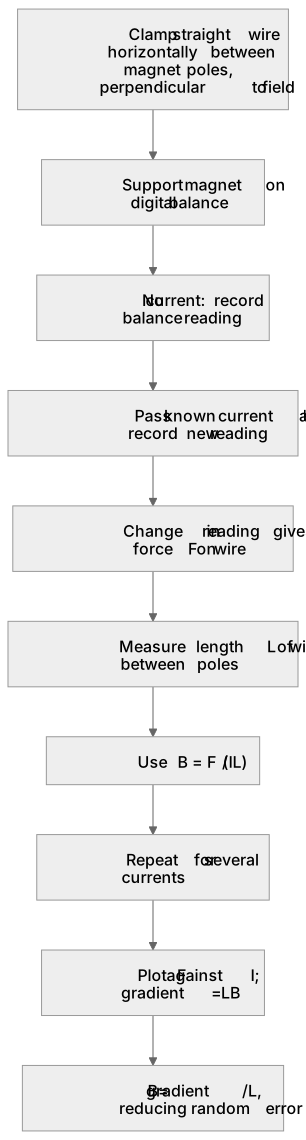
To measure the flux density between the poles of a magnet, mount a rigid straight wire horizontally between the poles so it is perpendicular to the field, and support the magnet on a digital balance. With no current, record the balance reading. Pass a known current I through the wire and record the new reading; the change in reading gives the force F on the wire (using the balance's force reading, F = mg where needed). Measure the length L of wire between the poles. Since the wire is perpendicular to the field, F = ILB, so B = F / (IL). Repeat for several currents and plot F against I; the gradient is LB, so B = gradient / L. This averages random errors and improves reliability.
What earns the marks
- Describe the apparatus: a straight wire clamped perpendicular to the field between the poles of a magnet, with the magnet resting on a digital balance.
- Explain that the change in balance reading when current flows gives the magnetic force on the wire.
- Measure the length L of wire within the field and the current I, then use B = F / (IL) because the wire is perpendicular to the field.
- Repeat for several values of current and plot a graph of force against current; the gradient equals LB, so B = gradient / L, reducing random error.
Common mistakes and how to put them right
Using the total length of the wire instead of the length between the magnet poles.
Put it right: Only the length inside the uniform field contributes to the force.
Ignoring the zero-current balance reading.
Put it right: Subtract the initial reading so only the magnetic force is used.
Assuming the wire is perpendicular without checking.
Put it right: Align the wire at 90° to the field lines, or include sin θ if it is not.
Exam tips
- State clearly that the balance reading changes by the magnetic force, and explain how you isolate that change.
- Describe taking repeat readings and plotting a graph to improve reliability.
- Include the equation B = F / (IL) and show how the gradient of an F–I graph gives LB.
Try the lesson
The start of the Magnetic fields: (ii) techniques and procedures used to determine the uniform magnetic flux density between the poles of a magnet using a current-carrying wire and digital balance lesson, made from checked teaching notes for this specification point.
Listen
To measure the flux density between the poles of a magnet, mount a rigid straight wire horizontally between the poles so it is perpendicular to the field, and support the magnet on a digital balance. With no current, record the balance reading. Pass a known current I through the wire and record the new reading; the change in reading gives the force F on the wire (using the balance's force reading, F = mg where needed). Measure the length L of wire between the poles. Since the wire is perpendicular to the field, F = ILB, so B = F / (IL). Repeat for several currents and plot F against I; the gradient is LB, so B = gradient / L. This averages random errors and improves reliability. A strong answer earns marks for these points. Describe the apparatus: a straight wire clamped perpendicular to the field between the poles of a magnet, with the magnet resting on a digital balance. Explain that the change in balance reading when current flows gives the magnetic force on the wire. Measure the length L of wire within the field and the current I, then use B = F / (IL) because the wire is perpendicular to the field. Repeat for several values of current and plot a graph of force against current; the gradient equals LB, so B = gradient / L, reducing random error. A common slip: Using the total length of the wire instead of the length between the magnet poles. Instead, only the length inside the uniform field contributes to the force. Exam tip: State clearly that the balance reading changes by the magnetic force, and explain how you isolate that change.
See it
Key words
Say what each word means before you turn the card.
Experimental technique
Try answering aloud or in your head before turning the card.
Magnetic flux density measurement
Try answering aloud or in your head before turning the card.
Graphical analysis
Try answering aloud or in your head before turning the card.
Error reduction
Try answering aloud or in your head before turning the card.
See every definition
- Experimental technique
- Mounting a rigid straight wire horizontally between the poles so it is perpendicular to the field, with the magnet supported on a digital balance.
- Magnetic flux density measurement
- Using the change in balance reading when current flows to give the force F on the wire, then B = F / (IL) because the wire is perpendicular to the field.
- Graphical analysis
- Repeating for several currents and plotting F against I, where the gradient is LB, so B = gradient / L.
- Error reduction
- Repeating for several currents and plotting a graph, which averages random errors and improves reliability.
Label the diagram
Some boxes have lost their names. Pick the right name for each number.
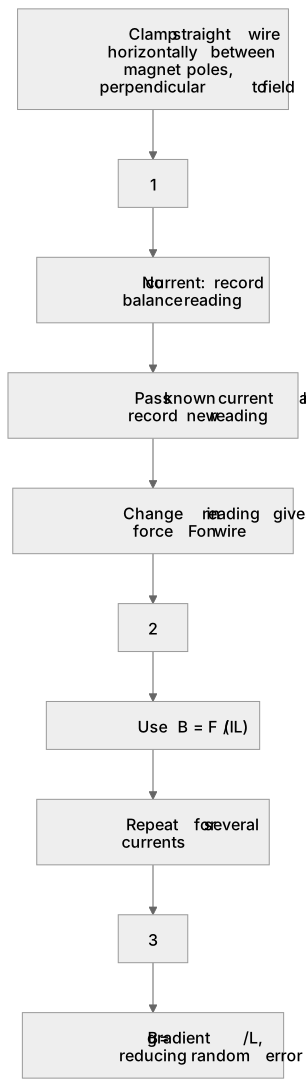
1Box 1
2Box 2
3Box 3
There is more to this lesson
The full lesson goes on to check your understanding and help you earn the marks. Create a free account to carry on, with your progress saved.
A week of Premium from your first lesson · Then the free plan continues · No card, no charge
Test your understanding of Magnetic fields: (ii) techniques and procedures used to determine the uniform magnetic flux density between the poles of a magnet using a current-carrying wire and digital balance
Active recall beats re-reading. Take an instant quiz now to test what you’ve learned and lock it into long-term memory.
A week of Premium from your first lesson · Then the free plan continues · No card, no charge