OCR · A-Level · Physics
Course version: H556 · Version from Sept 2015
(f) elastic and plastic deformations of materials.
Full specification wording
Mechanical properties of matter: (f) elastic and plastic deformations of materials.
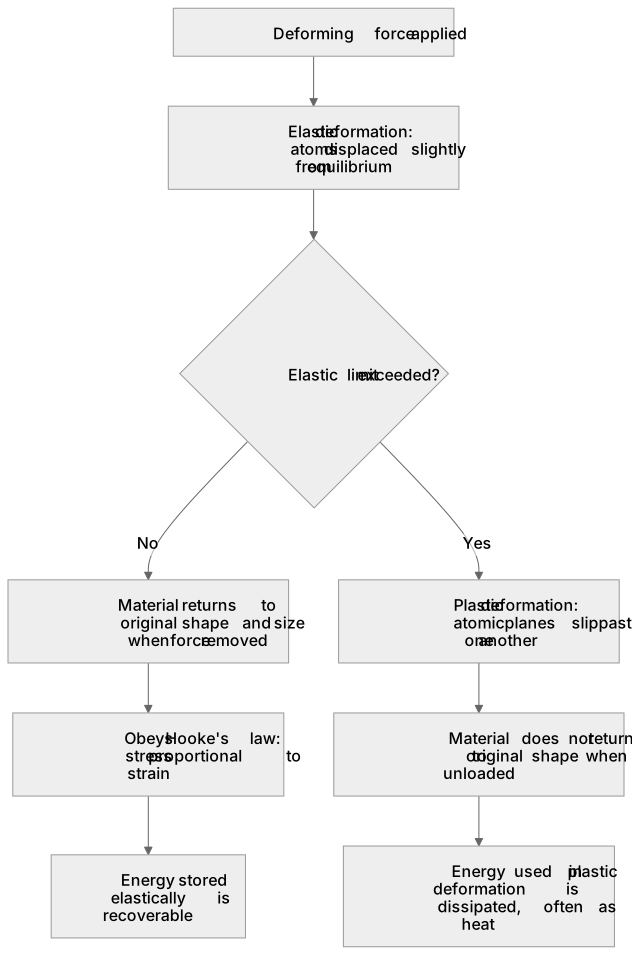
Elastic deformation is reversible: when the deforming force is removed, the material returns to its original shape and size.
Checked against the OCR H556 specification (opens in a new tab) on .
- Point 7 of 7
- 4 key terms
Study notes
From the checked teaching notes for this specification point.
The idea
Elastic deformation is reversible: when the deforming force is removed, the material returns to its original shape and size. Atoms are displaced slightly from equilibrium positions but return, and the material obeys Hooke's law up to the elastic limit, where stress is proportional to strain. Plastic deformation is permanent: the force exceeds the elastic limit, atomic planes slip past one another, and the material does not return to its original shape when unloaded. A wire stretched beyond its elastic limit remains longer; a ductile metal may neck and eventually fracture. The elastic limit, yield point and breaking point mark transitions on a stress–strain graph. Energy stored elastically is recoverable; energy used in plastic deformation is dissipated, often as heat.
What earns the marks
- Defines elastic deformation as reversible, with the material returning to its original dimensions when the load is removed.
- Defines plastic deformation as permanent, with the material retaining a changed shape after unloading.
- Links elastic behaviour to Hooke's law and the elastic limit, and plastic behaviour to atomic plane slip.
- Interprets the elastic limit, yield point and breaking point on a stress–strain graph.
- Distinguishes recoverable elastic strain energy from energy dissipated during plastic deformation.
Common mistakes and how to put them right
Believing elastic deformation means the material does not change shape at all.
Put it right: It changes shape but returns to the original shape when unloaded.
Thinking plastic deformation occurs before the elastic limit.
Put it right: Plastic deformation begins once the elastic limit is exceeded.
Assuming all energy put into deforming a material is recovered.
Put it right: Energy used in plastic deformation is dissipated, often as heat.
Confusing the elastic limit with the breaking point.
Put it right: The elastic limit is where permanent deformation starts, while the breaking point is where the material fractures.
Exam tips
- Use the words reversible and permanent explicitly when defining elastic and plastic deformation.
- Refer to a stress–strain graph and mark the elastic limit, yield point and breaking point to support your explanation.
- When discussing energy, state whether it is stored elastically and recovered or dissipated during plastic flow.
Try the lesson
The start of the Mechanical properties of matter: (f) elastic and plastic deformations of materials. lesson, made from checked teaching notes for this specification point.
Listen
Elastic deformation is reversible: when the deforming force is removed, the material returns to its original shape and size. Atoms are displaced slightly from equilibrium positions but return, and the material obeys Hooke's law up to the elastic limit, where stress is proportional to strain. Plastic deformation is permanent: the force exceeds the elastic limit, atomic planes slip past one another, and the material does not return to its original shape when unloaded. A wire stretched beyond its elastic limit remains longer; a ductile metal may neck and eventually fracture. The elastic limit, yield point and breaking point mark transitions on a stress–strain graph. Energy stored elastically is recoverable; energy used in plastic deformation is dissipated, often as heat. A strong answer earns marks for these points. Defines elastic deformation as reversible, with the material returning to its original dimensions when the load is removed. Defines plastic deformation as permanent, with the material retaining a changed shape after unloading. Links elastic behaviour to Hooke's law and the elastic limit, and plastic behaviour to atomic plane slip. Interprets the elastic limit, yield point and breaking point on a stress–strain graph. A common slip: Believing elastic deformation means the material does not change shape at all. Instead, it changes shape but returns to the original shape when unloaded. Exam tip: Use the words reversible and permanent explicitly when defining elastic and plastic deformation.
See it
Key words
Say what each word means before you turn the card.
Elastic deformation
Try answering aloud or in your head before turning the card.
Plastic deformation
Try answering aloud or in your head before turning the card.
Elastic limit
Try answering aloud or in your head before turning the card.
Energy storage and dissipation
Try answering aloud or in your head before turning the card.
See every definition
- Elastic deformation
- Reversible change in which the material returns to its original shape and size when the deforming force is removed.
- Plastic deformation
- Permanent change in which the material does not return to its original shape when unloaded, because atomic planes slip past one another.
- Elastic limit
- The point up to which the material obeys Hooke's law, with stress proportional to strain, and beyond which permanent deformation starts.
- Energy storage and dissipation
- Energy stored elastically is recoverable, whereas energy used in plastic deformation is dissipated, often as heat.
Label the diagram
Some boxes have lost their names. Pick the right name for each number.
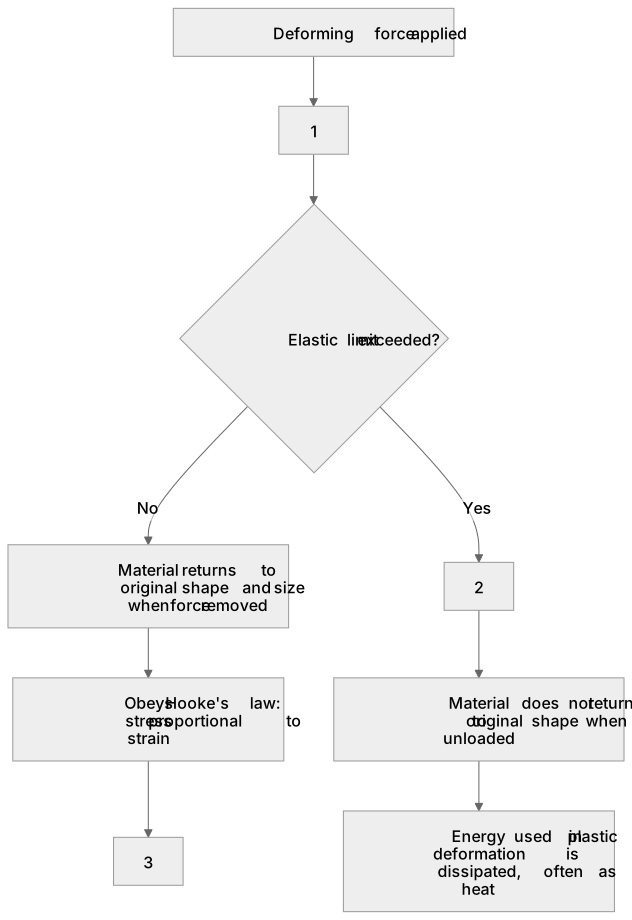
1Box 1
2Box 2
3Box 3
There is more to this lesson
The full lesson goes on to check your understanding and help you earn the marks. Create a free account to carry on, with your progress saved.
A week of Premium from your first lesson · Then the free plan continues · No card, no charge
Test your understanding of Mechanical properties of matter: (f) elastic and plastic deformations of materials.
Active recall beats re-reading. Take an instant quiz now to test what you’ve learned and lock it into long-term memory.
A week of Premium from your first lesson · Then the free plan continues · No card, no charge