OCR · A-Level · Physics
Course version: H556 · Version from Sept 2015
(b) charged particles moving in a uniform magnetic field; circular orbits…
Full specification wording
Motion of charged particles: (b) charged particles moving in a uniform magnetic field; circular orbits of charged particles in a uniform magnetic field
When a charged particle moves at right angles to a uniform magnetic field, the magnetic force is always perpendicular to its velocity.
Checked against the OCR H556 specification (opens in a new tab) on .
- Point 2 of 3
- 3 key terms
Study notes
From the checked teaching notes for this specification point.
The idea
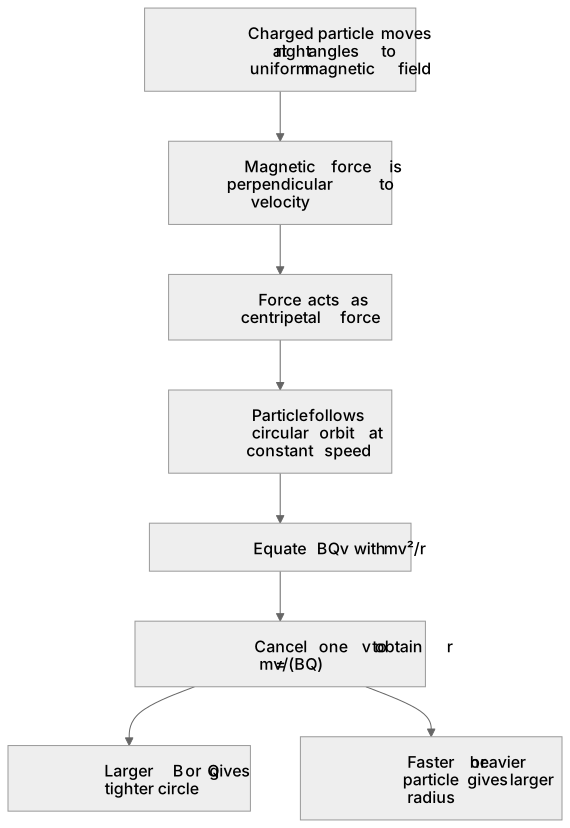
When a charged particle moves at right angles to a uniform magnetic field, the magnetic force is always perpendicular to its velocity. This force provides the centripetal force needed for circular motion, so the particle follows a circular orbit at constant speed. Equating BQv to mv²/r gives r = mv/(BQ), so the radius depends on mass, speed, flux density and charge. A larger B or Q gives a tighter circle; a faster or heavier particle gives a larger radius. Example: an electron with m = 9.11 × 10⁻³¹ kg, v = 3.0 × 10⁶ m s⁻¹, B = 0.20 T and Q = 1.6 × 10⁻¹⁹ C has r = (9.11 × 10⁻³¹ × 3.0 × 10⁶)/(0.20 × 1.6 × 10⁻¹⁹) ≈ 8.5 × 10⁻⁵ m.
What earns the marks
- States that the magnetic force on a charge moving at right angles to a uniform field is perpendicular to velocity and acts as the centripetal force.
- Derives or uses r = mv/(BQ) by equating BQv with mv²/r.
- Explains that speed remains constant in the circular orbit because the magnetic force does no work.
- Applies the radius relationship to compare orbits for different masses, charges, speeds or flux densities.
Common mistakes and how to put them right
Assuming the particle speeds up as it curves.
Put it right: The magnetic force is perpendicular to velocity, so it changes direction only and speed stays constant.
Using r = mv/(BQ) with the wrong charge sign or ignoring charge magnitude.
Put it right: Use the magnitude of Q for the radius and use the sign only to determine the sense of rotation.
Confusing the radius expression with the period expression.
Put it right: r = mv/(BQ) gives the radius, while T = 2πm/(BQ) gives the time for one orbit.
Exam tips
- Start from the force balance BQv = mv²/r and cancel one v to obtain r = mv/(BQ) quickly and reliably.
- Check that the particle enters at right angles to the field; otherwise the path is helical rather than circular.
- Use consistent SI units and keep mass in kg, speed in m s⁻¹, flux density in T and charge in C.
Try the lesson
The start of the Motion of charged particles: (b) charged particles moving in a uniform magnetic field; circular orbits of charged particles in a uniform magnetic field lesson, made from checked teaching notes for this specification point.
Listen
When a charged particle moves at right angles to a uniform magnetic field, the magnetic force is always perpendicular to its velocity. This force provides the centripetal force needed for circular motion, so the particle follows a circular orbit at constant speed. Equating BQv to mv²/r gives r = mv/(BQ), so the radius depends on mass, speed, flux density and charge. A larger B or Q gives a tighter circle; a faster or heavier particle gives a larger radius. Example: an electron with m = 9.11 × 10⁻³¹ kg, v = 3.0 × 10⁶ m s⁻¹, B = 0.20 T and Q = 1.6 × 10⁻¹⁹ C has r = (9.11 × 10⁻³¹ × 3.0 × 10⁶)/(0.20 × 1.6 × 10⁻¹⁹) ≈ 8.5 × 10⁻⁵ m. A strong answer earns marks for these points. States that the magnetic force on a charge moving at right angles to a uniform field is perpendicular to velocity and acts as the centripetal force. Derives or uses r = mv/(BQ) by equating BQv with mv²/r. Explains that speed remains constant in the circular orbit because the magnetic force does no work. Applies the radius relationship to compare orbits for different masses, charges, speeds or flux densities. A common slip: Assuming the particle speeds up as it curves. Instead, the magnetic force is perpendicular to velocity, so it changes direction only and speed stays constant. Exam tip: Start from the force balance BQv = mv²/r and cancel one v to obtain r = mv/(BQ) quickly and reliably.
See it
Key words
Say what each word means before you turn the card.
Centripetal force
Try answering aloud or in your head before turning the card.
Radius of a charged particle orbit
Try answering aloud or in your head before turning the card.
Constant speed under a perpendicular force
Try answering aloud or in your head before turning the card.
See every definition
- Centripetal force
- The magnetic force on a charge moving at right angles to a uniform field is perpendicular to velocity and acts as the centripetal force needed for circular motion.
- Radius of a charged particle orbit
- Equating BQv to mv²/r gives r = mv/(BQ), so the radius depends on mass, speed, flux density and charge.
- Constant speed under a perpendicular force
- Speed remains constant in the circular orbit because the magnetic force is perpendicular to velocity, so it changes direction only and does no work.
Label the diagram
Some boxes have lost their names. Pick the right name for each number.
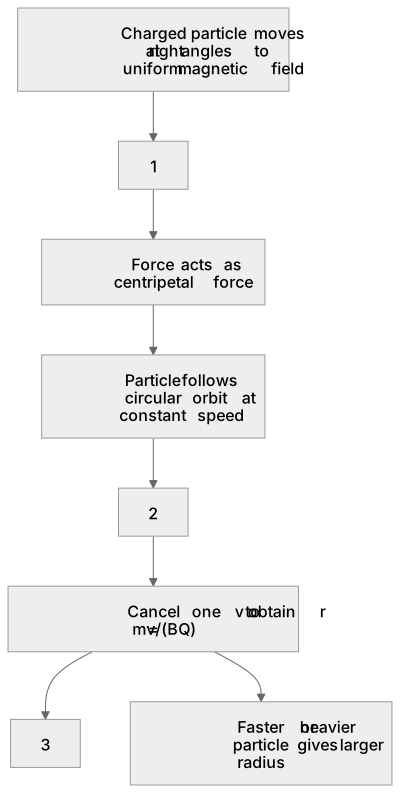
1Box 1
2Box 2
3Box 3
There is more to this lesson
The full lesson goes on to check your understanding and help you earn the marks. Create a free account to carry on, with your progress saved.
A week of Premium from your first lesson · Then the free plan continues · No card, no charge
Test your understanding of Motion of charged particles: (b) charged particles moving in a uniform magnetic field; circular orbits of charged particles in a uniform magnetic field
Active recall beats re-reading. Take an instant quiz now to test what you’ve learned and lock it into long-term memory.
A week of Premium from your first lesson · Then the free plan continues · No card, no charge