OCR · A-Level · Physics
Course version: H556 · Version from Sept 2015
(a) Newton’s law of gravitation; F r GMm 2 =- for the force between two…
Full specification wording
Newton’s law of gravitation: (a) Newton’s law of gravitation; F r GMm 2 =- for the force between two point masses
Newton’s law of gravitation states that the gravitational force F between two point masses is directly proportional to the product of their masses (M and m) and inversely proportional to the…
Checked against the OCR H556 specification (opens in a new tab) on .
- Point 1 of 3
- 4 key terms
Study notes
From the checked teaching notes for this specification point.
The idea
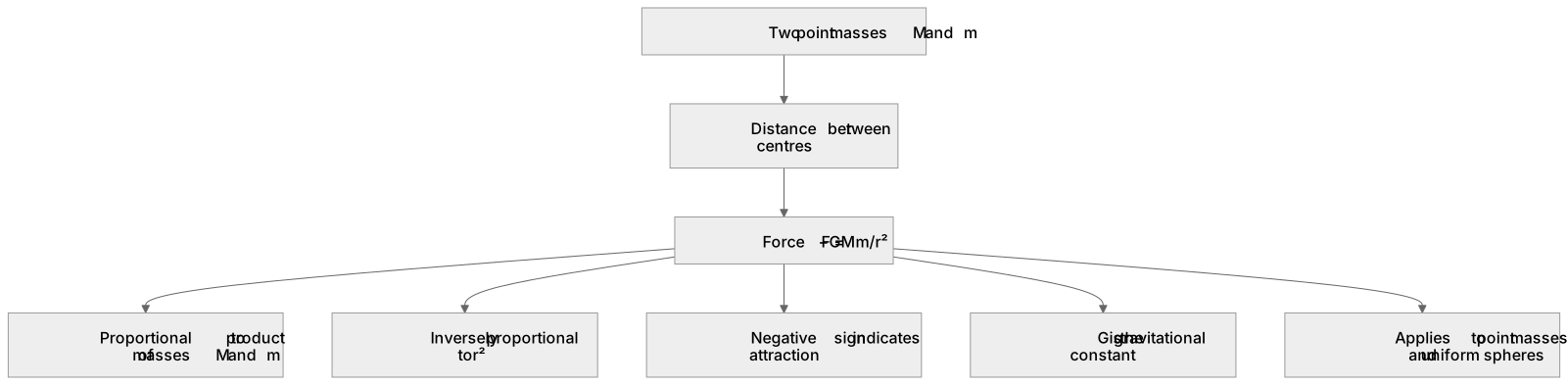
Newton’s law of gravitation states that the gravitational force F between two point masses is directly proportional to the product of their masses (M and m) and inversely proportional to the square of the distance r between their centres. The force is attractive, so the vector form includes a negative sign: F = −GMm/r², where G is the gravitational constant, approximately 6.67 × 10⁻¹¹ N m² kg⁻². The law applies to point masses and, for spherical masses, to their centres. The force acts along the line joining the centres.
What earns the marks
- Newton’s law of gravitation: F = −GMm/r² for two point masses, where the negative sign indicates attraction.
- The force is directly proportional to the product of the masses (M and m).
- The force is inversely proportional to the square of the distance r between the centres of the masses.
- G is the gravitational constant, approximately 6.67 × 10⁻¹¹ N m² kg⁻².
- The law applies to point masses and to uniform spheres, where r is the distance between centres.
Common mistakes and how to put them right
Misunderstanding: the force is repulsive.
Put it right: Gravitational force is always attractive; the negative sign in the vector form indicates attraction.
Misunderstanding: r is the distance between surfaces.
Put it right: r is the distance between the centres of the masses.
Misunderstanding: the law applies to any shape.
Put it right: It applies strictly to point masses; for uniform spheres, it applies as if all mass were at the centre.
Misunderstanding: G is the same as g.
Put it right: G is the universal gravitational constant; g is gravitational field strength, which depends on location.
Exam tips
- Use the equation F = GMm/r² for magnitude; include the negative sign only when direction is required.
- Ensure r is the centre-to-centre distance, not surface-to-surface.
- Remember G is a universal constant with value 6.67 × 10⁻¹¹ N m² kg⁻².
Try the lesson
The start of the Newton’s law of gravitation: (a) Newton’s law of gravitation; F r GMm 2 =- for the force between two point masses lesson, made from checked teaching notes for this specification point.
Listen
Newton’s law of gravitation states that the gravitational force F between two point masses is directly proportional to the product of their masses (M and m) and inversely proportional to the square of the distance r between their centres. The force is attractive, so the vector form includes a negative sign: F = −GMm/r², where G is the gravitational constant, approximately 6.67 × 10⁻¹¹ N m² kg⁻². The law applies to point masses and, for spherical masses, to their centres. The force acts along the line joining the centres. A strong answer earns marks for these points. Newton’s law of gravitation: F = −GMm/r² for two point masses, where the negative sign indicates attraction. The force is directly proportional to the product of the masses (M and m). The force is inversely proportional to the square of the distance r between the centres of the masses. G is the gravitational constant, approximately 6.67 × 10⁻¹¹ N m² kg⁻². A common slip: Misunderstanding: the force is repulsive. Instead, gravitational force is always attractive; the negative sign in the vector form indicates attraction. Exam tip: Use the equation F = GMm/r² for magnitude; include the negative sign only when direction is required.
See it
Key words
Say what each word means before you turn the card.
Newton’s law of gravitation
Try answering aloud or in your head before turning the card.
Inverse-square law
Try answering aloud or in your head before turning the card.
Gravitational constant G
Try answering aloud or in your head before turning the card.
Attractive force between masses
Try answering aloud or in your head before turning the card.
See every definition
- Newton’s law of gravitation
- The gravitational force F between two point masses is directly proportional to the product of their masses and inversely proportional to the square of the distance r between their centres.
- Inverse-square law
- The force is inversely proportional to the square of the distance r between the centres of the masses.
- Gravitational constant G
- A universal constant, approximately 6.67 × 10⁻¹¹ N m² kg⁻², appearing in F = −GMm/r².
- Attractive force between masses
- Gravitational force is always attractive, so the vector form includes a negative sign.
Label the diagram
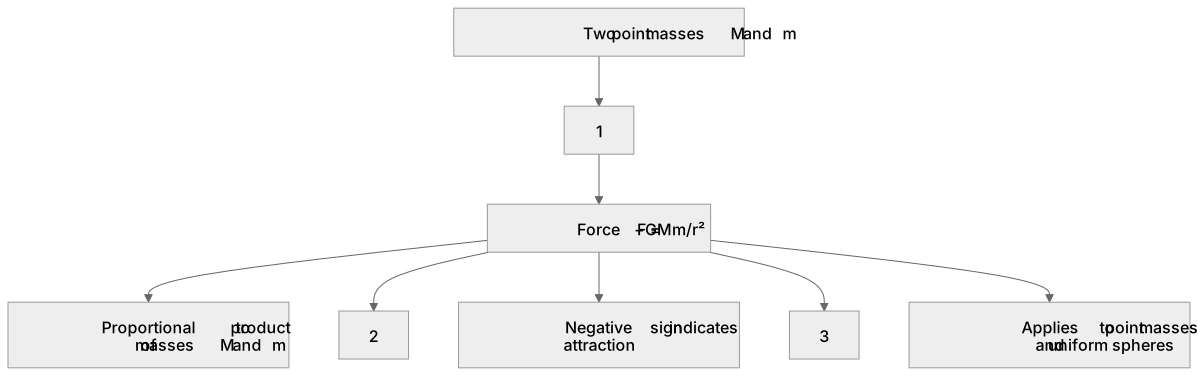
Some boxes have lost their names. Pick the right name for each number.
1Box 1
2Box 2
3Box 3
There is more to this lesson
The full lesson goes on to check your understanding and help you earn the marks. Create a free account to carry on, with your progress saved.
A week of Premium from your first lesson · Then the free plan continues · No card, no charge
Test your understanding of Newton’s law of gravitation: (a) Newton’s law of gravitation; F r GMm 2 =- for the force between two point masses
Active recall beats re-reading. Take an instant quiz now to test what you’ve learned and lock it into long-term memory.
A week of Premium from your first lesson · Then the free plan continues · No card, no charge