OCR · A-Level · Physics
Course version: H556 · Version from Sept 2015
(c) gravitational field strength is uniform close to the surface of the…
Full specification wording
Newton’s law of gravitation: (c) gravitational field strength is uniform close to the surface of the Earth and numerically equal to the acceleration of free fall.
Close to the Earth's surface, over distances small compared with the Earth's radius, the gravitational field strength g is effectively uniform: its magnitude and direction are the same everywhere…
Checked against the OCR H556 specification (opens in a new tab) on .
- Point 3 of 3
- 3 key terms
Study notes
From the checked teaching notes for this specification point.
The idea
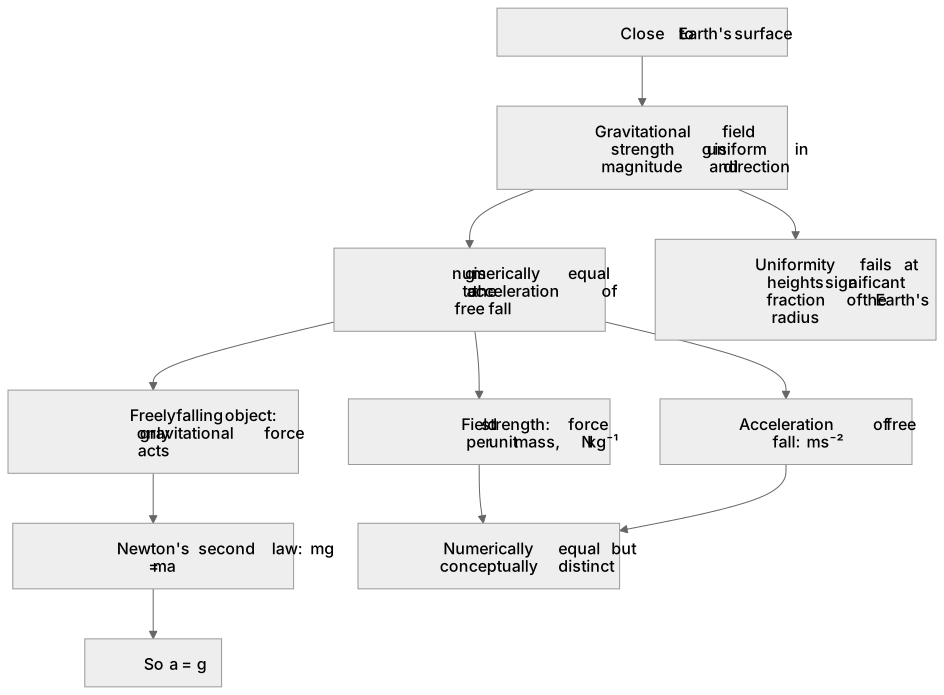
Close to the Earth's surface, over distances small compared with the Earth's radius, the gravitational field strength g is effectively uniform: its magnitude and direction are the same everywhere in that region. Numerically g equals the acceleration of free fall, about 9.81 m s⁻², because a freely falling object experiences only the gravitational force, so Newton's second law gives a = F/m = g. The two quantities share the same value but differ in meaning: field strength is force per unit mass at a point, while acceleration of free fall is the acceleration of an object moving under gravity alone. Uniformity fails over large heights, where g decreases as 1/r².
What earns the marks
- States that near the Earth's surface the gravitational field is approximately uniform in magnitude and direction.
- Explains that g is numerically equal to the acceleration of free fall, approximately 9.81 m s⁻².
- Derives the equality from Newton's second law: for a freely falling body, mg = ma, so a = g.
- Distinguishes field strength (force per unit mass, N kg⁻¹) from acceleration (m s⁻²) while noting their numerical equivalence.
- Recognises that the uniform-field approximation breaks down at heights that are a significant fraction of the Earth's radius.
Common mistakes and how to put them right
Claiming g and the acceleration of free fall are the same physical quantity.
Put it right: They are numerically equal but conceptually distinct.
Using g = 9.81 m s⁻² at all heights above the Earth.
Put it right: The field weakens with distance and is only uniform close to the surface.
Confusing the units N kg⁻¹ and m s⁻² as different in value.
Put it right: They are equivalent units for the same numerical quantity.
Forgetting that the uniform-field approximation requires the region to be small compared with the Earth's radius.
Exam tips
- Quote g as 9.81 m s⁻² unless the question specifies a different value such as 9.8 m s⁻².
- When asked to justify uniformity, refer to the small change in height compared with the Earth's radius.
- Show the link mg = ma explicitly when explaining why g equals the acceleration of free fall.
- Use N kg⁻¹ when discussing field strength and m s⁻² when discussing acceleration, even though the values match.
Try the lesson
The start of the Newton’s law of gravitation: (c) gravitational field strength is uniform close to the surface of the Earth and numerically equal to the acceleration of free fall. lesson, made from checked teaching notes for this specification point.
Listen
Close to the Earth's surface, over distances small compared with the Earth's radius, the gravitational field strength g is effectively uniform: its magnitude and direction are the same everywhere in that region. Numerically g equals the acceleration of free fall, about 9.81 m s⁻², because a freely falling object experiences only the gravitational force, so Newton's second law gives a = F/m = g. The two quantities share the same value but differ in meaning: field strength is force per unit mass at a point, while acceleration of free fall is the acceleration of an object moving under gravity alone. Uniformity fails over large heights, where g decreases as 1/r². A strong answer earns marks for these points. States that near the Earth's surface the gravitational field is approximately uniform in magnitude and direction. Explains that g is numerically equal to the acceleration of free fall, approximately 9.81 m s⁻². Derives the equality from Newton's second law: for a freely falling body, mg = ma, so a = g. Distinguishes field strength (force per unit mass, N kg⁻¹) from acceleration (m s⁻²) while noting their numerical equivalence. Exam tip: Quote g as 9.81 m s⁻² unless the question specifies a different value such as 9.8 m s⁻².
See it
Key words
Say what each word means before you turn the card.
Uniform gravitational field near the Earth's surface
Try answering aloud or in your head before turning the card.
Newton's second law applied to falling bodies
Try answering aloud or in your head before turning the card.
Limits of the uniform-field approximation
Try answering aloud or in your head before turning the card.
See every definition
- Uniform gravitational field near the Earth's surface
- Close to the Earth's surface, over distances small compared with the Earth's radius, the gravitational field strength is effectively uniform: its magnitude and direction are the same everywhere in that region.
- Newton's second law applied to falling bodies
- A freely falling object experiences only the gravitational force, so Newton's second law gives a = F/m = g.
- Limits of the uniform-field approximation
- Uniformity fails over large heights, where g decreases as 1/r².
Label the diagram
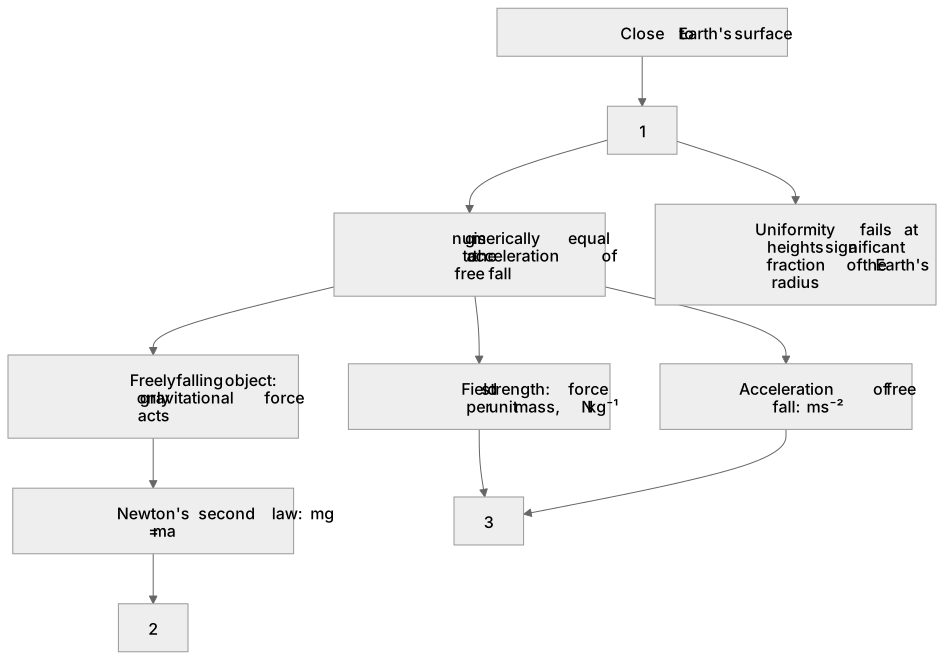
Some boxes have lost their names. Pick the right name for each number.
1Box 1
2Box 2
3Box 3
There is more to this lesson
The full lesson goes on to check your understanding and help you earn the marks. Create a free account to carry on, with your progress saved.
A week of Premium from your first lesson · Then the free plan continues · No card, no charge
Test your understanding of Newton’s law of gravitation: (c) gravitational field strength is uniform close to the surface of the Earth and numerically equal to the acceleration of free fall.
Active recall beats re-reading. Take an instant quiz now to test what you’ve learned and lock it into long-term memory.
A week of Premium from your first lesson · Then the free plan continues · No card, no charge