OCR · A-Level · Physics
Course version: H556 · Version from Sept 2015
(a) basic structure of an X-ray tube; components – heater
Full specification wording
Nuclear fission and fusion: (a) basic structure of an X-ray tube; components – heater
An X-ray tube accelerates electrons and stops them at a metal target, producing X-rays.
Checked against the OCR H556 specification (opens in a new tab) on .
- Point 11 of 18
- 4 key terms
Study notes
From the checked teaching notes for this specification point.
The idea
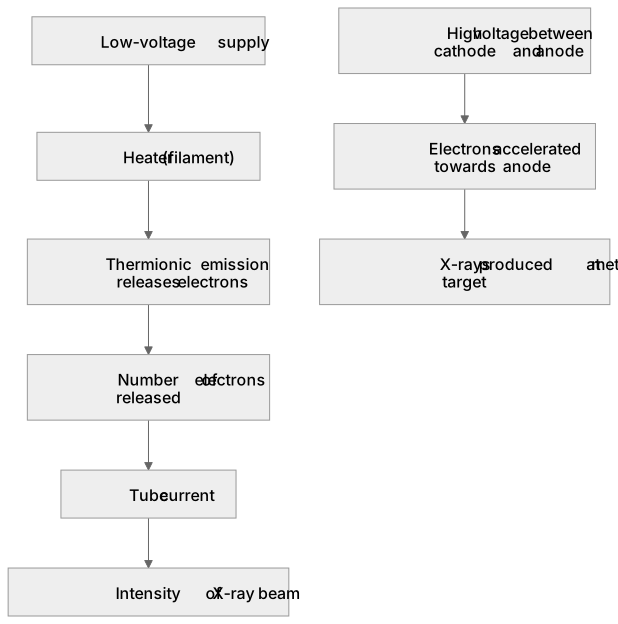
An X-ray tube accelerates electrons and stops them at a metal target, producing X-rays. The heater, usually a filament, is heated by a low-voltage supply so that thermionic emission releases electrons from its surface. Those electrons are then accelerated towards the anode by a high voltage. The heater therefore controls the number of electrons available and so affects the tube current and the intensity of the X-ray beam. The heater does not accelerate the electrons; that is the role of the high voltage between cathode and anode.
What earns the marks
- The heater is a filament that is heated by a low-voltage supply.
- Heating the filament causes thermionic emission of electrons.
- The heater controls the number of electrons released and hence the tube current.
- The heater does not accelerate the electrons; the high voltage between cathode and anode does that.
- The heater is part of the cathode assembly in the basic X-ray tube.
Common mistakes and how to put them right
Thinking the heater accelerates the electrons.
Put it right: It releases them by thermionic emission, while the high voltage accelerates them.
Confusing the heater with the target.
Put it right: The target is the anode metal where X-rays are produced.
Believing the heater produces X-rays directly.
Put it right: X-rays are produced when accelerated electrons interact with the target.
Assuming the heater uses a high voltage.
Put it right: It is operated by a low-voltage supply.
Exam tips
- Link the heater to thermionic emission and electron release.
- Separate the roles of heater, cathode, anode and high-voltage supply in your answer.
- Use the phrase low-voltage supply for the heater and high voltage for acceleration.
- Check whether the question asks about electron number or electron energy before choosing.
Try the lesson
The start of the Nuclear fission and fusion: (a) basic structure of an X-ray tube; components – heater lesson, made from checked teaching notes for this specification point.
Listen
An X-ray tube accelerates electrons and stops them at a metal target, producing X-rays. The heater, usually a filament, is heated by a low-voltage supply so that thermionic emission releases electrons from its surface. Those electrons are then accelerated towards the anode by a high voltage. The heater therefore controls the number of electrons available and so affects the tube current and the intensity of the X-ray beam. The heater does not accelerate the electrons; that is the role of the high voltage between cathode and anode. A strong answer earns marks for these points. The heater is a filament that is heated by a low-voltage supply. Heating the filament causes thermionic emission of electrons. The heater controls the number of electrons released and hence the tube current. The heater does not accelerate the electrons; the high voltage between cathode and anode does that. Exam tip: Link the heater to thermionic emission and electron release.
See it
Key words
Say what each word means before you turn the card.
Thermionic emission
Try answering aloud or in your head before turning the card.
Heater
Try answering aloud or in your head before turning the card.
Electron acceleration
Try answering aloud or in your head before turning the card.
X-ray production
Try answering aloud or in your head before turning the card.
See every definition
- Thermionic emission
- The release of electrons from the surface of a filament when it is heated by a low-voltage supply.
- Heater
- A filament that is heated by a low-voltage supply and controls the number of electrons released and hence the tube current.
- Electron acceleration
- The role of the high voltage between cathode and anode, which accelerates the electrons towards the anode.
- X-ray production
- Occurs when accelerated electrons are stopped at a metal target, the anode metal where X-rays are produced.
Label the diagram
Some boxes have lost their names. Pick the right name for each number.
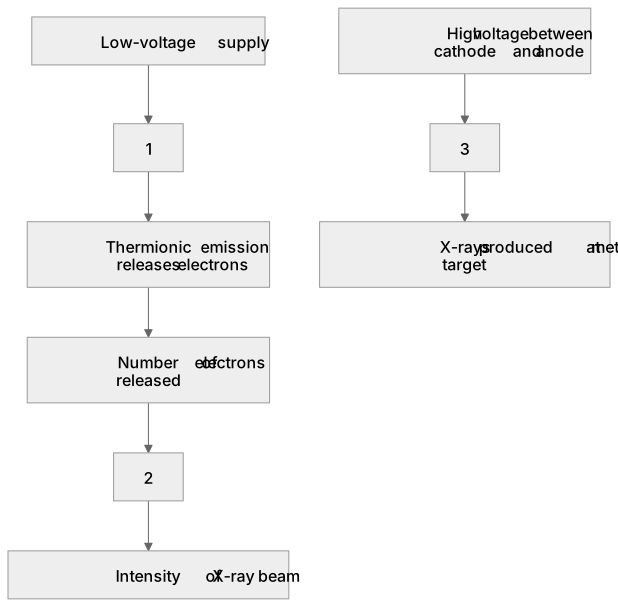
1Box 1
2Box 2
3Box 3
There is more to this lesson
The full lesson goes on to check your understanding and help you earn the marks. Create a free account to carry on, with your progress saved.
A week of Premium from your first lesson · Then the free plan continues · No card, no charge
Test your understanding of Nuclear fission and fusion: (a) basic structure of an X-ray tube; components – heater
Active recall beats re-reading. Take an instant quiz now to test what you’ve learned and lock it into long-term memory.
A week of Premium from your first lesson · Then the free plan continues · No card, no charge