OCR · A-Level · Physics
Course version: H556 · Version from Sept 2015
Nuclear fission and fusion: (a) Einstein’s mass–energy equation; ΔE = Δm c²
Einstein's mass–energy equation states that mass and energy are equivalent: ΔE = Δm c², where ΔE is the energy released or absorbed, Δm is the change in mass and c is the speed of light in a…
Checked against the OCR H556 specification (opens in a new tab) on .
- Point 1 of 18
- 2 key terms
Study notes
From the checked teaching notes for this specification point.
The idea
Einstein's mass–energy equation states that mass and energy are equivalent: ΔE = Δm c², where ΔE is the energy released or absorbed, Δm is the change in mass and c is the speed of light in a vacuum, about 3.00 × 10⁸ m s⁻¹. In nuclear fission and fusion, the total mass of the products is slightly less than that of the reactants; this mass defect appears as energy. For example, if Δm = 0.020 u, converting to kilograms and multiplying by c² gives the energy released. The equation explains why nuclear reactions release far more energy per kilogram than chemical reactions.
What earns the marks
- The equation ΔE = Δm c² relates the energy change to the mass change, with c = 3.00 × 10⁸ m s⁻¹.
- In fission and fusion, the products have slightly less mass than the reactants, and this mass defect is released as energy.
- Mass must be converted to kilograms before multiplying by c² to obtain energy in joules.
- The large value of c² means even a tiny mass defect corresponds to a very large energy release.
- The equation applies to any process where mass changes, including annihilation and pair production.
Common mistakes and how to put them right
Using the mass defect in atomic mass units directly in ΔE = Δm c².
Put it right: The mass must first be converted to kilograms.
Forgetting to square the speed of light.
Put it right: c² is about 9.00 × 10¹⁶ m² s⁻², not 3.00 × 10⁸.
Assuming mass is destroyed.
Put it right: Mass is converted to energy, and the total mass–energy is conserved.
Mixing up the sign.
Put it right: Energy is released when the products have less mass than the reactants.
Exam tips
- Always convert mass defect to kilograms before substituting into ΔE = Δm c².
- Keep the value of c² to a sensible number of significant figures and carry units through the calculation.
- Check that the answer is in joules and is positive for an energy release.
Try the lesson
The start of the Nuclear fission and fusion: (a) Einstein’s mass–energy equation; ΔE = Δm c² lesson, made from checked teaching notes for this specification point.
Listen
Einstein's mass–energy equation states that mass and energy are equivalent: ΔE = Δm c², where ΔE is the energy released or absorbed, Δm is the change in mass and c is the speed of light in a vacuum, about 3.00 × 10⁸ m s⁻¹. In nuclear fission and fusion, the total mass of the products is slightly less than that of the reactants; this mass defect appears as energy. For example, if Δm = 0.020 u, converting to kilograms and multiplying by c² gives the energy released. The equation explains why nuclear reactions release far more energy per kilogram than chemical reactions. A strong answer earns marks for these points. The equation ΔE = Δm c² relates the energy change to the mass change, with c = 3.00 × 10⁸ m s⁻¹. In fission and fusion, the products have slightly less mass than the reactants, and this mass defect is released as energy. Mass must be converted to kilograms before multiplying by c² to obtain energy in joules. The large value of c² means even a tiny mass defect corresponds to a very large energy release. Exam tip: Always convert mass defect to kilograms before substituting into ΔE = Δm c².
See it
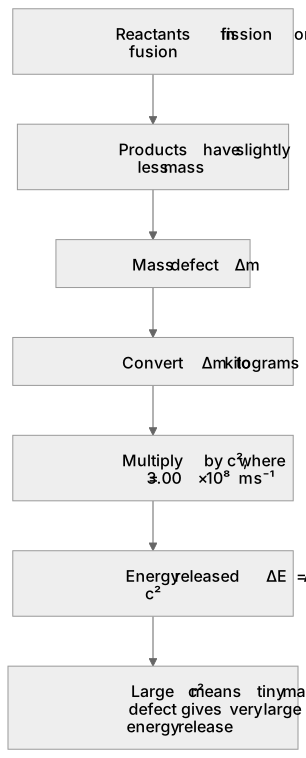
Put it in order
Put these steps in the order they happen.
- 1. Large c² means tiny mass defect gives very large energy release
- 2. Energy released ΔE = Δm c²
- 3. Mass defect Δm
- 4. Multiply by c², where c = 3.00 × 10⁸ m s⁻¹
- 5. Reactants in fission or fusion
- 6. Products have slightly less mass
- 7. Convert Δm to kilograms
Key words
Say what each word means before you turn the card.
Mass defect
Try answering aloud or in your head before turning the card.
Energy release in nuclear reactions
Try answering aloud or in your head before turning the card.
See every definition
- Mass defect
- In nuclear fission and fusion, the total mass of the products is slightly less than that of the reactants, and this difference appears as energy.
- Energy release in nuclear reactions
- The large value of c² means even a tiny mass defect corresponds to a very large energy release, which is why nuclear reactions release far more energy per kilogram than chemical reactions.
Label the diagram
Some boxes have lost their names. Pick the right name for each number.
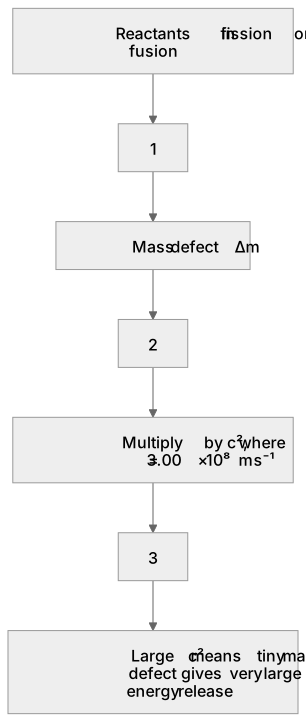
1Box 1
2Box 2
3Box 3
There is more to this lesson
The full lesson goes on to check your understanding and help you earn the marks. Create a free account to carry on, with your progress saved.
A week of Premium from your first lesson · Then the free plan continues · No card, no charge
Test your understanding of Nuclear fission and fusion: (a) Einstein’s mass–energy equation; ΔE = Δm c²
Active recall beats re-reading. Take an instant quiz now to test what you’ve learned and lock it into long-term memory.
A week of Premium from your first lesson · Then the free plan continues · No card, no charge