OCR · A-Level · Physics
Course version: H556 · Version from Sept 2015
(j) nuclear fusion; fusion reactions and temperature
Full specification wording
Nuclear fission and fusion: (j) nuclear fusion; fusion reactions and temperature
Nuclear fusion joins two light nuclei into one heavier nucleus, releasing energy because the product has greater binding energy per nucleon.
Checked against the OCR H556 specification (opens in a new tab) on .
- Point 9 of 18
Study notes
From the checked teaching notes for this specification point.
The idea
Nuclear fusion joins two light nuclei into one heavier nucleus, releasing energy because the product has greater binding energy per nucleon. In stars, hydrogen nuclei fuse to form helium, and related reactions build heavier elements. Fusion needs extremely high temperatures, around 10⁷ K or more, so nuclei have enough kinetic energy to overcome the electrostatic repulsion between their positive charges and approach within the short range of the strong nuclear force. At lower temperatures, Coulomb repulsion prevents the nuclei from getting close enough to fuse. A tokamak confines a hot plasma with magnetic fields to sustain these conditions.
What earns the marks
- Fusion combines two light nuclei to form a heavier nucleus, releasing energy.
- Energy is released because the product nucleus has a higher binding energy per nucleon than the reactants.
- Very high temperatures, of order 10⁷ K, give nuclei sufficient kinetic energy to overcome electrostatic repulsion.
- The strong nuclear force acts only over very short ranges, so nuclei must approach closely before fusion can occur.
- A typical fusion equation, such as ²H + ³H → ⁴He + n, conserves nucleon number and charge.
- Fusion differs from fission, which splits a heavy nucleus rather than joining light nuclei.
Common mistakes and how to put them right
Thinking fusion happens at low temperatures.
Put it right: It requires very high temperatures so nuclei can overcome Coulomb repulsion.
Confusing fusion with fission.
Put it right: Fusion joins light nuclei, while fission splits a heavy nucleus.
Assuming energy is released because mass is destroyed.
Put it right: The mass difference appears as energy, and binding energy per nucleon increases.
Ignoring the short range of the strong force.
Put it right: Nuclei must be very close before it can act.
Exam tips
- Check the nucleon numbers on both sides of a fusion equation before choosing an answer.
- Link the temperature requirement to kinetic energy and Coulomb repulsion, not to a chemical reaction.
- Compare binding energy per nucleon for reactants and products to decide whether energy is released.
- Eliminate options that describe fission when the question asks about fusion.
Try the lesson
The start of the Nuclear fission and fusion: (j) nuclear fusion; fusion reactions and temperature lesson, made from checked teaching notes for this specification point.
Listen
Nuclear fusion joins two light nuclei into one heavier nucleus, releasing energy because the product has greater binding energy per nucleon. In stars, hydrogen nuclei fuse to form helium, and related reactions build heavier elements. Fusion needs extremely high temperatures, around 10⁷ K or more, so nuclei have enough kinetic energy to overcome the electrostatic repulsion between their positive charges and approach within the short range of the strong nuclear force. At lower temperatures, Coulomb repulsion prevents the nuclei from getting close enough to fuse. A tokamak confines a hot plasma with magnetic fields to sustain these conditions. A strong answer earns marks for these points. Fusion combines two light nuclei to form a heavier nucleus, releasing energy. Energy is released because the product nucleus has a higher binding energy per nucleon than the reactants. Very high temperatures, of order 10⁷ K, give nuclei sufficient kinetic energy to overcome electrostatic repulsion. The strong nuclear force acts only over very short ranges, so nuclei must approach closely before fusion can occur. Exam tip: Check the nucleon numbers on both sides of a fusion equation before choosing an answer.
See it
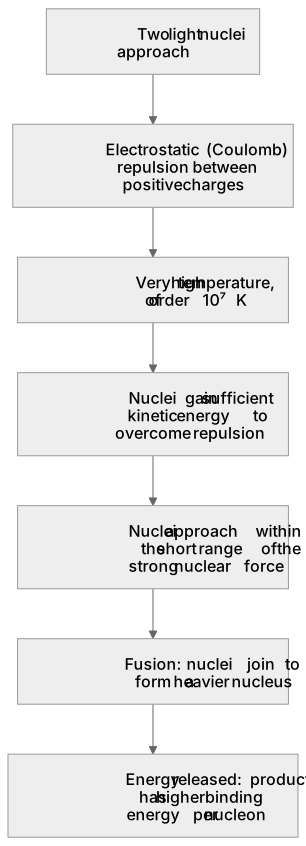
Put it in order
Put these steps in the order they happen.
- 1. Energy released: product has higher binding energy per nucleon
- 2. Fusion: nuclei join to form a heavier nucleus
- 3. Very high temperature, of order 10⁷ K
- 4. Nuclei approach within the short range of the strong nuclear force
- 5. Two light nuclei approach
- 6. Electrostatic (Coulomb) repulsion between positive charges
- 7. Nuclei gain sufficient kinetic energy to overcome repulsion
Label the diagram
Some boxes have lost their names. Pick the right name for each number.
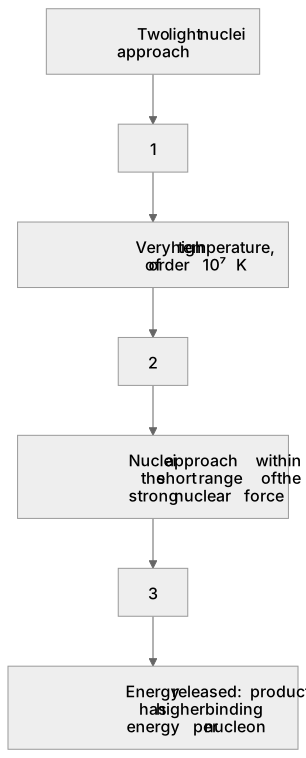
1Box 1
2Box 2
3Box 3
There is more to this lesson
The full lesson goes on to check your understanding and help you earn the marks. Create a free account to carry on, with your progress saved.
A week of Premium from your first lesson · Then the free plan continues · No card, no charge
Test your understanding of Nuclear fission and fusion: (j) nuclear fusion; fusion reactions and temperature
Active recall beats re-reading. Take an instant quiz now to test what you’ve learned and lock it into long-term memory.
A week of Premium from your first lesson · Then the free plan continues · No card, no charge