OCR · A-Level · Physics
Course version: H556 · Version from Sept 2015
(a) the particulate nature (photon model) of electromagnetic radiation
Full specification wording
Photons: (a) the particulate nature (photon model) of electromagnetic radiation
Electromagnetic radiation can be modelled as a stream of discrete packets of energy called photons.
Checked against the OCR H556 specification (opens in a new tab) on .
- Point 1 of 6
- 2 key terms
Study notes
From the checked teaching notes for this specification point.
The idea
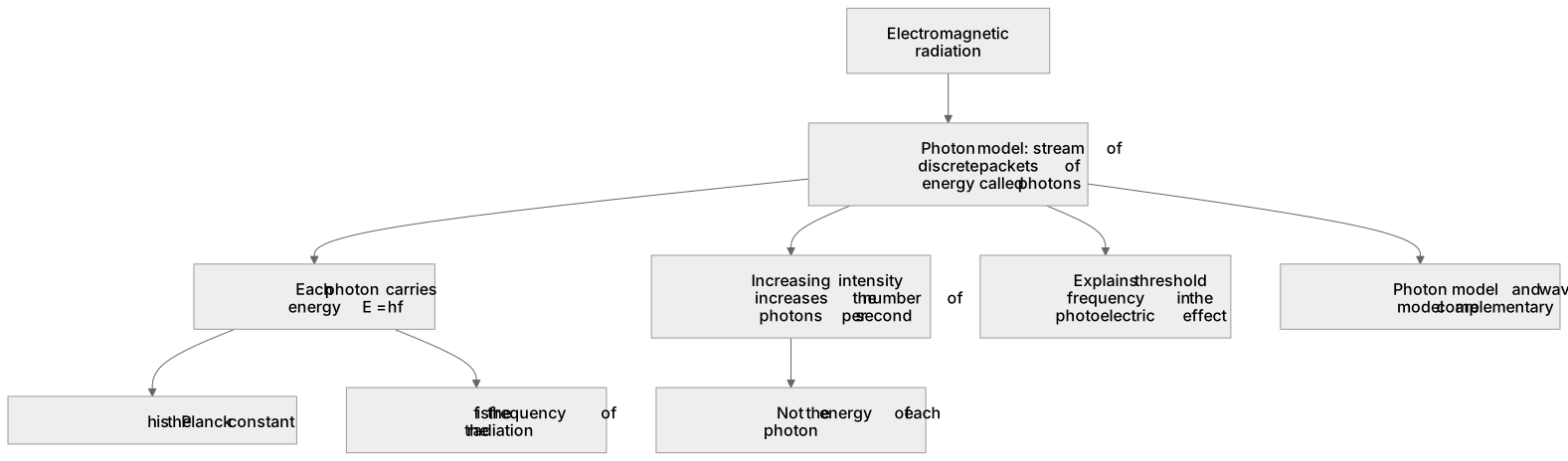
Electromagnetic radiation can be modelled as a stream of discrete packets of energy called photons. This particulate model explains phenomena such as the photoelectric effect, where light below a threshold frequency cannot eject electrons no matter how intense it is. Each photon carries energy E = hf, where h is the Planck constant (6.63 × 10⁻³⁴ J s) and f is the frequency of the radiation. The photon model treats radiation as localised quanta rather than a continuous wave. For example, a beam of ultraviolet light consists of many photons, each with energy determined by its frequency. Increasing intensity increases the number of photons per second, not the energy of each photon.
What earns the marks
- States that electromagnetic radiation can be modelled as discrete packets of energy called photons.
- Recalls that the energy of a photon is given by E = hf.
- Explains that intensity relates to the number of photons per second, not the energy of individual photons.
- Describes how the photon model explains the threshold frequency in the photoelectric effect.
- Recognises that the photon model and wave model are complementary descriptions of electromagnetic radiation.
Common mistakes and how to put them right
Believing that increasing the intensity of light increases the energy of each photon.
Put it right: It increases the number of photons.
Thinking that the photon model replaces the wave model entirely.
Put it right: Both models are needed for different phenomena.
Confusing the Planck constant with other constants or using the wrong value.
Assuming that photons have mass.
Put it right: Photons are massless and travel at the speed of light in a vacuum.
Exam tips
- Use E = hf and remember that f = c/λ if wavelength is given.
- When explaining the photoelectric effect, state that one photon interacts with one electron.
- Check that your answer distinguishes between intensity (photons per second) and photon energy (hf).
- Quote the Planck constant to at least two significant figures when performing calculations.
Try the lesson
The start of the Photons: (a) the particulate nature (photon model) of electromagnetic radiation lesson, made from checked teaching notes for this specification point.
Listen
Electromagnetic radiation can be modelled as a stream of discrete packets of energy called photons. This particulate model explains phenomena such as the photoelectric effect, where light below a threshold frequency cannot eject electrons no matter how intense it is. Each photon carries energy E = hf, where h is the Planck constant (6.63 × 10⁻³⁴ J s) and f is the frequency of the radiation. The photon model treats radiation as localised quanta rather than a continuous wave. For example, a beam of ultraviolet light consists of many photons, each with energy determined by its frequency. Increasing intensity increases the number of photons per second, not the energy of each photon. A strong answer earns marks for these points. States that electromagnetic radiation can be modelled as discrete packets of energy called photons. Recalls that the energy of a photon is given by E = hf. Explains that intensity relates to the number of photons per second, not the energy of individual photons. Describes how the photon model explains the threshold frequency in the photoelectric effect. Exam tip: Use E = hf and remember that f = c/λ if wavelength is given.
See it
Key words
Say what each word means before you turn the card.
Photon model
Try answering aloud or in your head before turning the card.
Photoelectric effect
Try answering aloud or in your head before turning the card.
See every definition
- Photon model
- Electromagnetic radiation can be modelled as a stream of discrete packets of energy called photons, treating radiation as localised quanta rather than a continuous wave.
- Photoelectric effect
- A phenomenon where light below a threshold frequency cannot eject electrons no matter how intense it is, explained by the particulate model.
Label the diagram
Some boxes have lost their names. Pick the right name for each number.
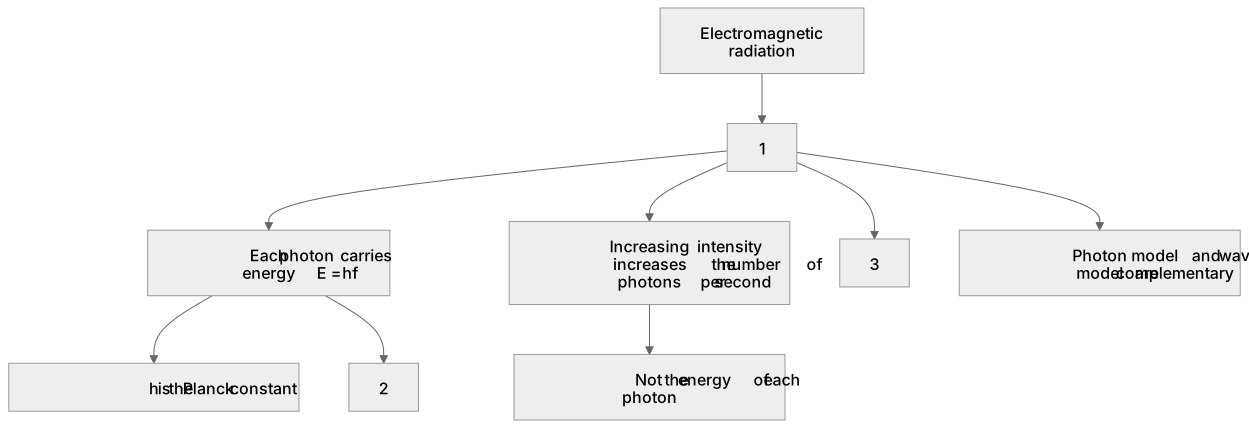
1Box 1
2Box 2
3Box 3
There is more to this lesson
The full lesson goes on to check your understanding and help you earn the marks. Create a free account to carry on, with your progress saved.
A week of Premium from your first lesson · Then the free plan continues · No card, no charge
Test your understanding of Photons: (a) the particulate nature (photon model) of electromagnetic radiation
Active recall beats re-reading. Take an instant quiz now to test what you’ve learned and lock it into long-term memory.
A week of Premium from your first lesson · Then the free plan continues · No card, no charge