OCR · A-Level · Physics
Course version: H556 · Version from Sept 2015
Photons: (d) the electronvolt (eV) as a unit of energy
The electronvolt is a convenient energy unit for atomic and photon scales.
Checked against the OCR H556 specification (opens in a new tab) on .
- Point 4 of 6
- 4 key terms
Study notes
From the checked teaching notes for this specification point.
The idea
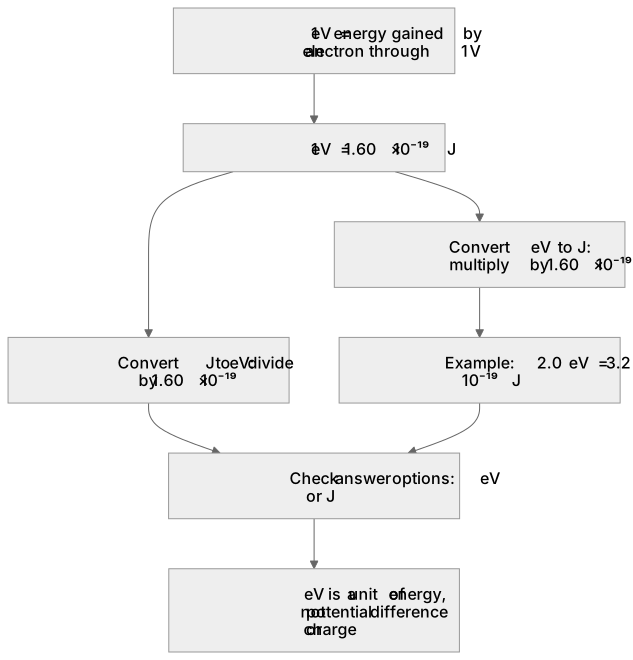
The electronvolt is a convenient energy unit for atomic and photon scales. One electronvolt is the kinetic energy gained by an electron accelerated through a potential difference of one volt, so 1 eV = 1.60 × 10⁻¹⁹ J. To convert, multiply eV by 1.60 × 10⁻¹⁹ to get joules, or divide joules by 1.60 × 10⁻¹⁹ to get eV. For example, a photon of energy 2.0 eV is 2.0 × 1.60 × 10⁻¹⁹ = 3.2 × 10⁻¹⁹ J. In MCQs, check whether the answer options are in eV or J and convert before comparing. The eV is a unit of energy, not potential difference or charge.
What earns the marks
- Defines 1 eV as the energy transferred when an electron moves through a potential difference of 1 V.
- States the conversion 1 eV = 1.60 × 10⁻¹⁹ J and applies it in either direction.
- Converts photon energies between eV and J correctly, for example 2.0 eV = 3.2 × 10⁻¹⁹ J.
- Recognises that the eV is an energy unit, not a unit of potential difference or charge.
- Chooses eV for atomic and photon-scale energies to avoid unwieldy powers of ten.
Common mistakes and how to put them right
Confusing eV with volts.
Put it right: The volt is potential difference, while the electronvolt is energy; convert using 1 eV = 1.60 × 10⁻¹⁹ J.
Multiplying by 1.60 × 10⁻¹⁹ when converting joules to eV.
Put it right: Divide joules by 1.60 × 10⁻¹⁹ instead.
Assuming the eV applies only to electrons.
Put it right: Any particle or photon energy can be expressed in eV.
Exam tips
- Write the conversion factor explicitly before calculating so the direction of conversion is clear.
- Check the unit requested in the answer options and convert your value to match before selecting.
- Use standard form throughout to keep track of the 10⁻¹⁹ factor.
Try the lesson
The start of the Photons: (d) the electronvolt (eV) as a unit of energy lesson, made from checked teaching notes for this specification point.
Listen
The electronvolt is a convenient energy unit for atomic and photon scales. One electronvolt is the kinetic energy gained by an electron accelerated through a potential difference of one volt, so 1 eV = 1.60 × 10⁻¹⁹ J. To convert, multiply eV by 1.60 × 10⁻¹⁹ to get joules, or divide joules by 1.60 × 10⁻¹⁹ to get eV. For example, a photon of energy 2.0 eV is 2.0 × 1.60 × 10⁻¹⁹ = 3.2 × 10⁻¹⁹ J. In MCQs, check whether the answer options are in eV or J and convert before comparing. The eV is a unit of energy, not potential difference or charge. A strong answer earns marks for these points. Defines 1 eV as the energy transferred when an electron moves through a potential difference of 1 V. States the conversion 1 eV = 1.60 × 10⁻¹⁹ J and applies it in either direction. Converts photon energies between eV and J correctly, for example 2.0 eV = 3.2 × 10⁻¹⁹ J. Recognises that the eV is an energy unit, not a unit of potential difference or charge. Exam tip: Write the conversion factor explicitly before calculating so the direction of conversion is clear.
See it
Key words
Say what each word means before you turn the card.
Electronvolt
Try answering aloud or in your head before turning the card.
Conversion between joules and electronvolts
Try answering aloud or in your head before turning the card.
Photon and particle energies
Try answering aloud or in your head before turning the card.
Potential difference and energy transfer
Try answering aloud or in your head before turning the card.
See every definition
- Electronvolt
- A unit of energy equal to the kinetic energy gained by an electron accelerated through a potential difference of one volt.
- Conversion between joules and electronvolts
- Multiply eV by 1.60 × 10⁻¹⁹ to get joules, or divide joules by 1.60 × 10⁻¹⁹ to get eV.
- Photon and particle energies
- The energy of any particle or photon can be expressed in eV, a convenient unit for atomic and photon scales.
- Potential difference and energy transfer
- The eV is an energy unit, not a unit of potential difference or charge; the volt is potential difference.
Label the diagram
Some boxes have lost their names. Pick the right name for each number.
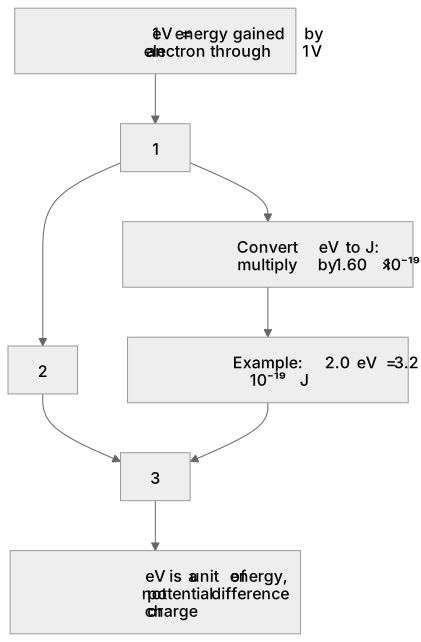
1Box 1
2Box 2
3Box 3
There is more to this lesson
The full lesson goes on to check your understanding and help you earn the marks. Create a free account to carry on, with your progress saved.
A week of Premium from your first lesson · Then the free plan continues · No card, no charge
Test your understanding of Photons: (d) the electronvolt (eV) as a unit of energy
Active recall beats re-reading. Take an instant quiz now to test what you’ve learned and lock it into long-term memory.
A week of Premium from your first lesson · Then the free plan continues · No card, no charge