OCR · A-Level · Physics
Course version: H556 · Version from Sept 2015
Photons: (ii) Determine the Planck constant using different coloured LEDs.
In this practical determination, each LED emits photons when electrons in the junction recombine, and the minimum energy needed equals the photon energy hf.
Checked against the OCR H556 specification (opens in a new tab) on .
- Point 6 of 6
- 4 key terms
Study notes
From the checked teaching notes for this specification point.
The idea
In this practical determination, each LED emits photons when electrons in the junction recombine, and the minimum energy needed equals the photon energy hf. The threshold voltage V across the LED is measured for several colours, so that eV = hf. Since f = c/λ, a graph of V against 1/λ has gradient hc/e, so h = gradient × e ÷ c. You measure V just as each LED begins to conduct, using a voltmeter and a series protective resistor, and take λ from the LED specification. Using several colours gives a range of frequencies and reduces the effect of random uncertainty. The value obtained is approximate because the threshold is not perfectly sharp and the emission wavelength has a spread.
What earns the marks
- Photon energy is related to frequency by E = hf, and to wavelength by E = hc/λ.
- The minimum energy supplied per electron is eV, where V is the threshold voltage of the LED.
- Equating eV = hc/λ gives V = (hc/e)(1/λ), so a graph of V against 1/λ is a straight line through the origin.
- The gradient of the V against 1/λ graph equals hc/e, so h = gradient × e ÷ c.
- Using several different coloured LEDs provides several frequencies and improves the reliability of the gradient.
- The threshold voltage is identified as the voltage at which the LED just begins to emit light or conduct appreciably.
Common mistakes and how to put them right
Using the normal operating voltage of the LED rather than the threshold voltage at which emission just begins.
Put it right: The threshold value is the one that corresponds to the minimum photon energy.
Plotting V against λ instead of V against 1/λ.
Put it right: The linear relationship requires the reciprocal of wavelength.
Forgetting to convert wavelength from nanometres to metres before calculating 1/λ, which changes the gradient by a factor of 10⁹.
Treating the gradient itself as h rather than as hc/e, so the electron charge and speed of light are omitted from the final calculation.
Exam tips
- State the equation eV = hc/λ before rearranging, so the examiner can see the physical link between threshold voltage and photon energy.
- Show the gradient calculation with coordinates read from the line of best fit, not from individual data points.
- Give the final value of h with a sensible unit, J s, and compare it with the accepted value to comment on accuracy.
- Mention one limitation, such as the spread of wavelengths emitted by an LED, when asked to evaluate the method.
Try the lesson
The start of the Photons: (ii) Determine the Planck constant using different coloured LEDs. lesson, made from checked teaching notes for this specification point.
Listen
In this practical determination, each LED emits photons when electrons in the junction recombine, and the minimum energy needed equals the photon energy hf. The threshold voltage V across the LED is measured for several colours, so that eV = hf. Since f = c/λ, a graph of V against 1/λ has gradient hc/e, so h = gradient × e ÷ c. You measure V just as each LED begins to conduct, using a voltmeter and a series protective resistor, and take λ from the LED specification. Using several colours gives a range of frequencies and reduces the effect of random uncertainty. The value obtained is approximate because the threshold is not perfectly sharp and the emission wavelength has a spread. A strong answer earns marks for these points. Photon energy is related to frequency by E = hf, and to wavelength by E = hc/λ. The minimum energy supplied per electron is eV, where V is the threshold voltage of the LED. Equating eV = hc/λ gives V = (hc/e)(1/λ), so a graph of V against 1/λ is a straight line through the origin. The gradient of the V against 1/λ graph equals hc/e, so h = gradient × e ÷ c. Exam tip: State the equation eV = hc/λ before rearranging, so the examiner can see the physical link between threshold voltage and photon energy.
See it
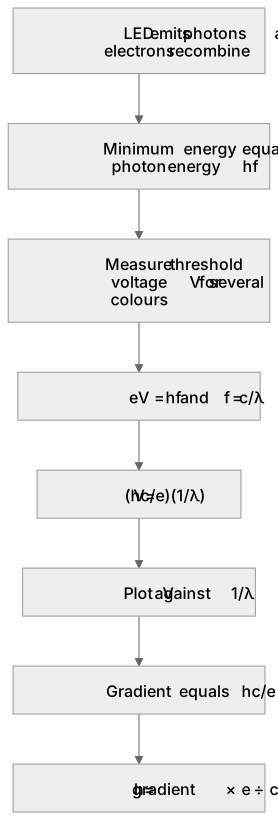
Put it in order
Put these steps in the order they happen.
- 1. V = (hc/e)(1/λ)
- 2. h = gradient × e ÷ c
- 3. Plot V against 1/λ
- 4. LED emits photons as electrons recombine
- 5. Minimum energy equals photon energy hf
- 6. Gradient equals hc/e
- 7. Measure threshold voltage V for several colours
- 8. eV = hf and f = c/λ
Key words
Say what each word means before you turn the card.
Photon energy and the Planck constant
Try answering aloud or in your head before turning the card.
Threshold voltage of an LED
Try answering aloud or in your head before turning the card.
Linearising data using 1/λ
Try answering aloud or in your head before turning the card.
Experimental uncertainty and evaluation
Try answering aloud or in your head before turning the card.
See every definition
- Photon energy and the Planck constant
- The minimum energy needed equals the photon energy hf, and photon energy is related to frequency by E = hf and to wavelength by E = hc/λ.
- Threshold voltage of an LED
- The voltage at which the LED just begins to emit light or conduct appreciably, so that the minimum energy supplied per electron is eV.
- Linearising data using 1/λ
- Since f = c/λ, equating eV = hc/λ gives V = (hc/e)(1/λ), so a graph of V against 1/λ is a straight line through the origin.
- Experimental uncertainty and evaluation
- Using several colours gives a range of frequencies and reduces the effect of random uncertainty, and the value obtained is approximate because the threshold is not perfectly sharp and the emission wavelength has a spread.
Label the diagram
Some boxes have lost their names. Pick the right name for each number.
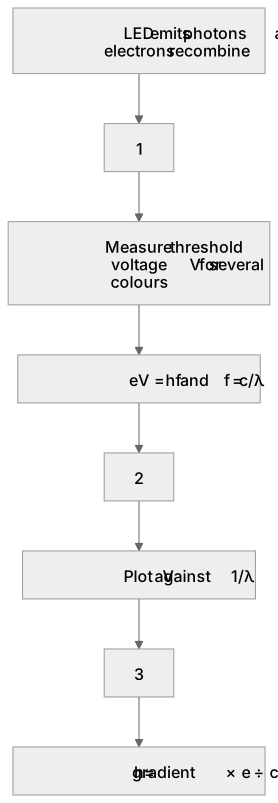
1Box 1
2Box 2
3Box 3
There is more to this lesson
The full lesson goes on to check your understanding and help you earn the marks. Create a free account to carry on, with your progress saved.
A week of Premium from your first lesson · Then the free plan continues · No card, no charge
Test your understanding of Photons: (ii) Determine the Planck constant using different coloured LEDs.
Active recall beats re-reading. Take an instant quiz now to test what you’ve learned and lock it into long-term memory.
A week of Premium from your first lesson · Then the free plan continues · No card, no charge