OCR · A-Level · Physics
Course version: H556 · Version from Sept 2015
(b) making estimates of physical quantities listed in this specification.
Full specification wording
Physical quantities: (b) making estimates of physical quantities listed in this specification.
Estimating means choosing a sensible order-of-magnitude value for a quantity named in the specification, then justifying it with familiar anchors.
Checked against the OCR H556 specification (opens in a new tab) on .
- Point 2 of 2
- 2 key terms
Study notes
From the checked teaching notes for this specification point.
The idea
Estimating means choosing a sensible order-of-magnitude value for a quantity named in the specification, then justifying it with familiar anchors. For example, a person's mass is about 70 kg, so a car's mass is about 1000 kg and a grain of rice about 10⁻⁵ kg. Lengths run from atomic scales (about 10⁻¹⁰ m) to Earth's radius (about 10⁶ m); times from atomic periods (about 10⁻¹⁵ s) to the age of the universe (about 10¹⁷ s). Work in S.I. base units, keep one significant figure, and check the power of ten rather than chasing precision.
What earns the marks
- Recognises that an estimate is an order-of-magnitude value expressed in S.I. base units, not a precise measurement.
- Selects a familiar physical anchor (for example a person's mass of about 70 kg) and scales it to the target quantity.
- States the estimate with a sensible power of ten and a plausible unit, for example the mass of a car as about 10³ kg.
- Checks the reasonableness of the value against everyday experience or a known reference before committing to the answer.
Common mistakes and how to put them right
Treating an estimate as a precise measurement and quoting many significant figures.
Put it right: Give one significant figure with the correct power of ten.
Confusing mass with weight when estimating.
Put it right: Give mass in kg and, if weight is wanted, multiply by g ≈ 9.81 N kg⁻¹.
Choosing a power of ten that is wildly wrong, such as a person's mass as 10⁵ kg.
Put it right: Compare with a familiar anchor before answering.
Exam tips
- Convert every estimate into S.I. base units before comparing options in a multiple-choice question.
- Use anchors you already know, such as a 100 m sprint time of about 10 s or a room height of about 3 m.
- Eliminate options whose power of ten is clearly impossible, then choose between the remaining plausible values.
Try the lesson
The start of the Physical quantities: (b) making estimates of physical quantities listed in this specification. lesson, made from checked teaching notes for this specification point.
Listen
Estimating means choosing a sensible order-of-magnitude value for a quantity named in the specification, then justifying it with familiar anchors. For example, a person's mass is about 70 kg, so a car's mass is about 1000 kg and a grain of rice about 10⁻⁵ kg. Lengths run from atomic scales (about 10⁻¹⁰ m) to Earth's radius (about 10⁶ m); times from atomic periods (about 10⁻¹⁵ s) to the age of the universe (about 10¹⁷ s). Work in S.I. base units, keep one significant figure, and check the power of ten rather than chasing precision. A strong answer earns marks for these points. Recognises that an estimate is an order-of-magnitude value expressed in S.I. base units, not a precise measurement. Selects a familiar physical anchor (for example a person's mass of about 70 kg) and scales it to the target quantity. States the estimate with a sensible power of ten and a plausible unit, for example the mass of a car as about 10³ kg. Checks the reasonableness of the value against everyday experience or a known reference before committing to the answer. A common slip: Treating an estimate as a precise measurement and quoting many significant figures. Instead, give one significant figure with the correct power of ten. Exam tip: Convert every estimate into S.I. base units before comparing options in a multiple-choice question.
See it
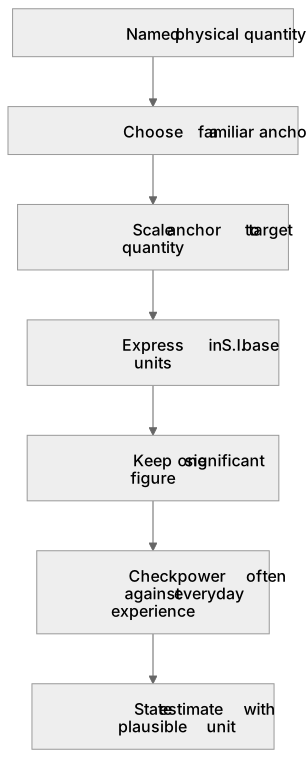
Put it in order
Put these steps in the order they happen.
- 1. State estimate with plausible unit
- 2. Check power of ten against everyday experience
- 3. Scale anchor to target quantity
- 4. Keep one significant figure
- 5. Named physical quantity
- 6. Choose a familiar anchor
- 7. Express in S.I. base units
Key words
Say what each word means before you turn the card.
Familiar physical anchors
Try answering aloud or in your head before turning the card.
Reasonableness checking
Try answering aloud or in your head before turning the card.
See every definition
- Familiar physical anchors
- Known everyday values, such as a person's mass of about 70 kg, that are scaled to the target quantity.
- Reasonableness checking
- Comparing the value against everyday experience or a known reference before committing to the answer.
Label the diagram
Some boxes have lost their names. Pick the right name for each number.
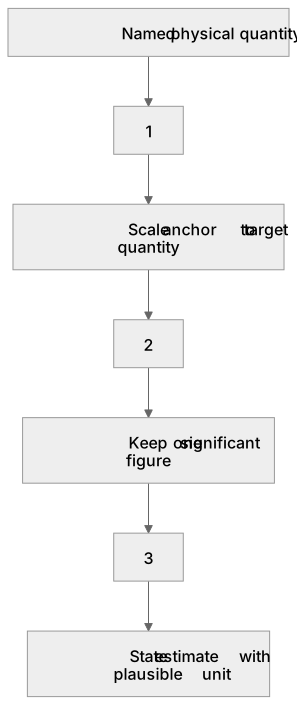
1Box 1
2Box 2
3Box 3
There is more to this lesson
The full lesson goes on to check your understanding and help you earn the marks. Create a free account to carry on, with your progress saved.
A week of Premium from your first lesson · Then the free plan continues · No card, no charge
Test your understanding of Physical quantities: (b) making estimates of physical quantities listed in this specification.
Active recall beats re-reading. Take an instant quiz now to test what you’ve learned and lock it into long-term memory.
A week of Premium from your first lesson · Then the free plan continues · No card, no charge