OCR · A-Level · Physics
Course version: H556 · Version from Sept 2015
Planetary motion: (e) geostationary orbit; uses of geostationary satellites.
A geostationary orbit is a circular orbit around Earth's equator with a period of one sidereal day (approximately 24 hours, or 86 164 s), so the satellite appears stationary above a fixed point on…
Checked against the OCR H556 specification (opens in a new tab) on .
- Point 5 of 5
- 3 key terms
Study notes
From the checked teaching notes for this specification point.
The idea
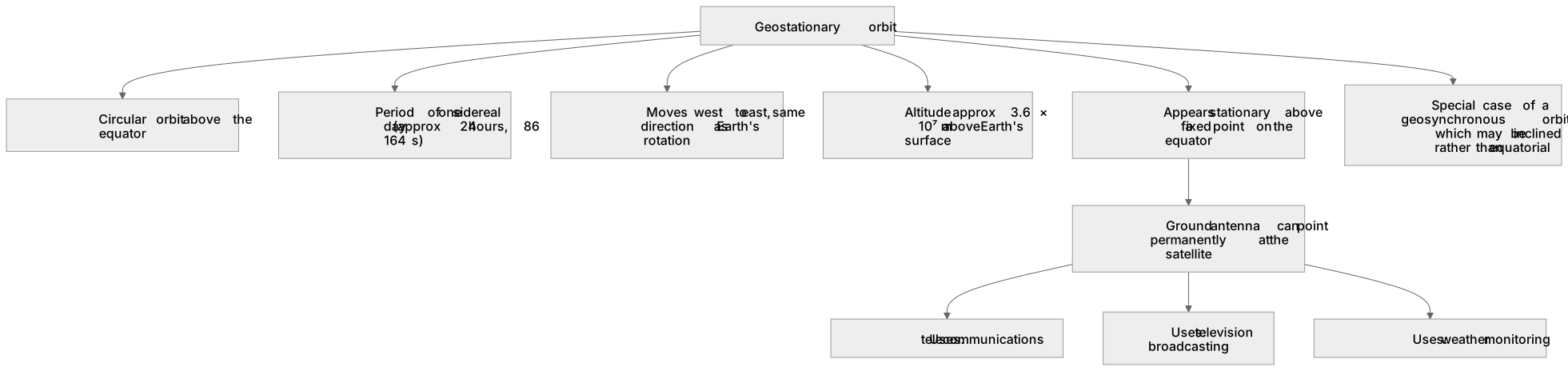
A geostationary orbit is a circular orbit around Earth's equator with a period of one sidereal day (approximately 24 hours, or 86 164 s), so the satellite appears stationary above a fixed point on the equator. It must orbit in the same direction as Earth's rotation (west to east) and at a specific altitude of approximately 3.6 × 10⁷ m above Earth's surface. Geostationary satellites are used for telecommunications, television broadcasting, and weather monitoring because their fixed position allows a ground antenna to point permanently at the satellite. For example, a satellite dish for satellite TV is aimed at a fixed point in the sky. The orbit is a special case of a geosynchronous orbit, which has a 24-hour period but may be inclined rather than equatorial.
What earns the marks
- Define a geostationary orbit as one with a period of one sidereal day (approx 24 hours) above the equator, moving west to east.
- State that the satellite appears stationary relative to a fixed point on Earth's surface.
- Give uses such as telecommunications, television broadcasting, and weather monitoring.
- Explain that the fixed position allows continuous coverage and fixed ground antennas.
- Distinguish geostationary from geosynchronous orbits (which may not be equatorial).
Common mistakes and how to put them right
Confusing geostationary with geosynchronous.
Put it right by noting geostationary must be equatorial and circular.
Thinking any satellite with a 24-hour period is geostationary.
Put it right by requiring it to be above the equator and moving west to east.
Stating GPS uses geostationary satellites.
Put it right by noting GPS uses medium Earth orbits, whereas geostationary is used for communications and TV.
Assuming geostationary satellites can be used for polar observations.
Put it right by noting they only view one region of Earth near the equator.
Exam tips
- Remember the period is one sidereal day (approximately 24 hours or 86 164 s) and the orbit is equatorial.
- Use the equation T² = (4π²/GM)r³ to calculate the orbital radius if needed.
- Link uses to the advantage of a fixed position relative to Earth, such as not needing to track the satellite with a moving dish.
Try the lesson
The start of the Planetary motion: (e) geostationary orbit; uses of geostationary satellites. lesson, made from checked teaching notes for this specification point.
Listen
A geostationary orbit is a circular orbit around Earth's equator with a period of one sidereal day (approximately 24 hours, or 86 164 s), so the satellite appears stationary above a fixed point on the equator. It must orbit in the same direction as Earth's rotation (west to east) and at a specific altitude of approximately 3.6 × 10⁷ m above Earth's surface. Geostationary satellites are used for telecommunications, television broadcasting, and weather monitoring because their fixed position allows a ground antenna to point permanently at the satellite. For example, a satellite dish for satellite TV is aimed at a fixed point in the sky. The orbit is a special case of a geosynchronous orbit, which has a 24-hour period but may be inclined rather than equatorial. A strong answer earns marks for these points. Define a geostationary orbit as one with a period of one sidereal day (approx 24 hours) above the equator, moving west to east. State that the satellite appears stationary relative to a fixed point on Earth's surface. Give uses such as telecommunications, television broadcasting, and weather monitoring. Explain that the fixed position allows continuous coverage and fixed ground antennas. A common slip: Confusing geostationary with geosynchronous. Instead, noting geostationary must be equatorial and circular. Exam tip: Remember the period is one sidereal day (approximately 24 hours or 86 164 s) and the orbit is equatorial.
See it
Key words
Say what each word means before you turn the card.
Geostationary orbit
Try answering aloud or in your head before turning the card.
Uses of geostationary satellites
Try answering aloud or in your head before turning the card.
Geosynchronous orbit
Try answering aloud or in your head before turning the card.
See every definition
- Geostationary orbit
- A circular orbit around Earth's equator with a period of one sidereal day, moving west to east at a specific altitude above Earth's surface.
- Uses of geostationary satellites
- Telecommunications, television broadcasting and weather monitoring, because their fixed position allows a ground antenna to point permanently at the satellite.
- Geosynchronous orbit
- An orbit with a 24-hour period that may be inclined rather than equatorial, of which the geostationary orbit is a special case.
Label the diagram
Some boxes have lost their names. Pick the right name for each number.
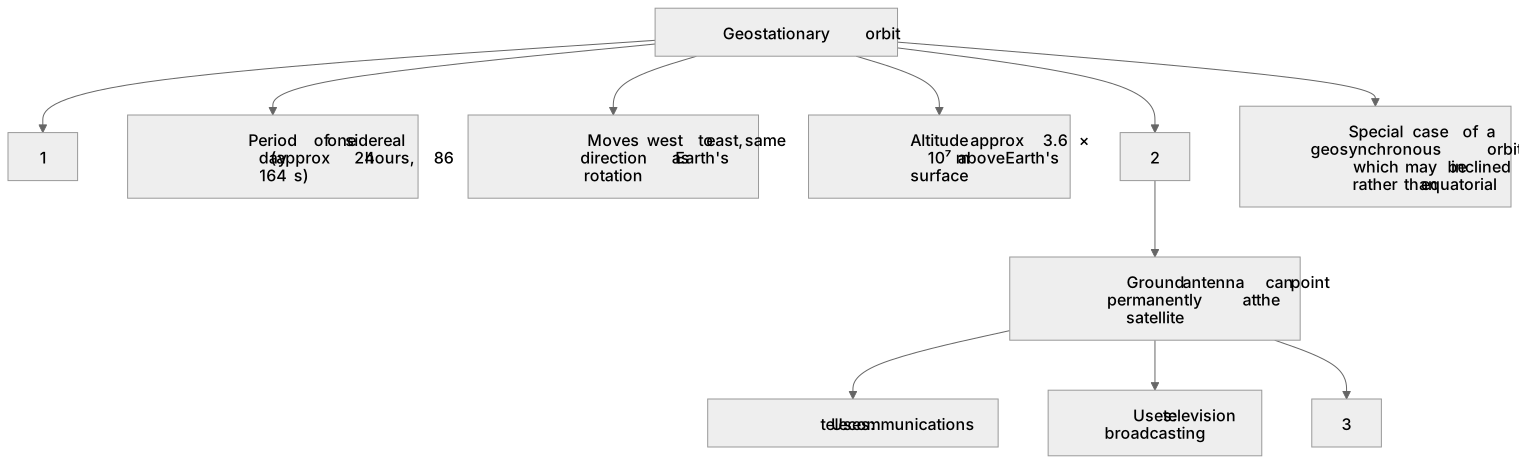
1Box 1
2Box 2
3Box 3
There is more to this lesson
The full lesson goes on to check your understanding and help you earn the marks. Create a free account to carry on, with your progress saved.
A week of Premium from your first lesson · Then the free plan continues · No card, no charge
Test your understanding of Planetary motion: (e) geostationary orbit; uses of geostationary satellites.
Active recall beats re-reading. Take an instant quiz now to test what you’ve learned and lock it into long-term memory.
A week of Premium from your first lesson · Then the free plan continues · No card, no charge