OCR · A-Level · Physics
Course version: H556 · Version from Sept 2015
(b) identification of variables that must be controlled, where appropriate
Full specification wording
Planning: (b) identification of variables that must be controlled, where appropriate
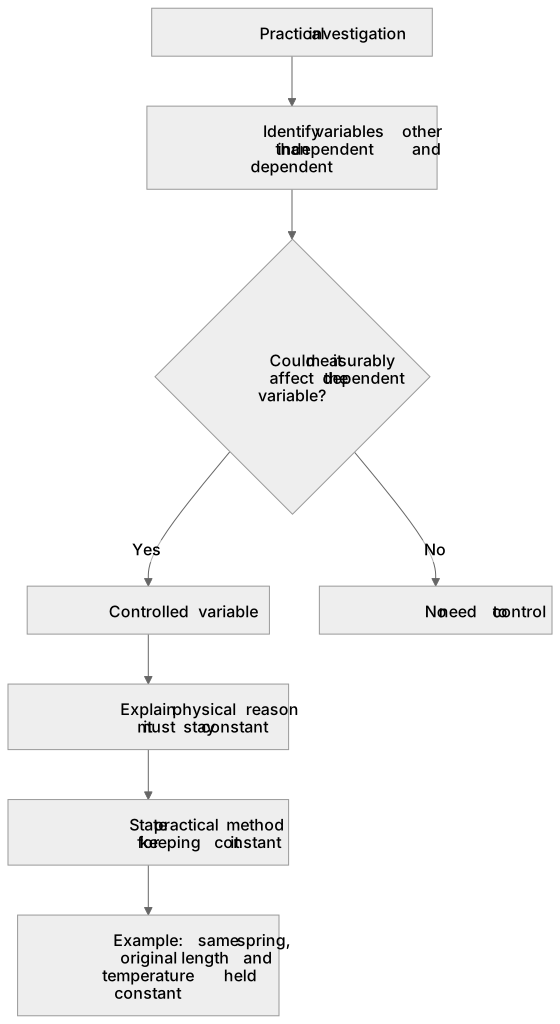
Controlled variables are the quantities, other than the independent and dependent variables, that could affect the result if they changed.
Checked against the OCR H556 specification (opens in a new tab) on .
Study notes
From the checked teaching notes for this specification point.
The idea
Controlled variables are the quantities, other than the independent and dependent variables, that could affect the result if they changed. In a practical investigation you identify them from the physics of the situation. For example, when testing how the extension of a spring depends on the load, the spring itself, its original length and the temperature should stay the same, because changing any of them would alter the extension for the same load. Not every variable needs controlling: if a quantity has no measurable effect on the outcome, controlling it wastes effort. The skill is to decide which variables matter, explain why, and state how each will be kept constant. A controlled variable is not the same as a zero or null result; it is a quantity deliberately held fixed.
What earns the marks
- Identifies variables, other than the independent and dependent variables, that could affect the measured outcome.
- Explains the physical reason why each identified variable must be held constant.
- Distinguishes variables that genuinely need control from those that do not affect the result.
- States a practical method for keeping each controlled variable constant.
Common mistakes and how to put them right
Confusing the independent variable with a controlled variable.
Put it right: The independent variable is deliberately changed, while controlled variables are held fixed.
Assuming every conceivable quantity must be controlled.
Put it right: Control only those that could measurably affect the dependent variable.
Naming a controlled variable without saying how it will be kept constant.
Put it right: Give the practical method, such as using the same spring each time.
Exam tips
- Read the practical context carefully and link each controlled variable to the physics of the measurement.
- For each controlled variable, add a short phrase explaining how it is kept constant.
- Reject variables that cannot plausibly affect the result, and be ready to say why they can be ignored.
Try the lesson
The start of the Planning: (b) identification of variables that must be controlled, where appropriate lesson, made from checked teaching notes for this specification point.
Listen
Controlled variables are the quantities, other than the independent and dependent variables, that could affect the result if they changed. In a practical investigation you identify them from the physics of the situation. For example, when testing how the extension of a spring depends on the load, the spring itself, its original length and the temperature should stay the same, because changing any of them would alter the extension for the same load. Not every variable needs controlling: if a quantity has no measurable effect on the outcome, controlling it wastes effort. The skill is to decide which variables matter, explain why, and state how each will be kept constant. A controlled variable is not the same as a zero or null result; it is a quantity deliberately held fixed. A strong answer earns marks for these points. Identifies variables, other than the independent and dependent variables, that could affect the measured outcome. Explains the physical reason why each identified variable must be held constant. Distinguishes variables that genuinely need control from those that do not affect the result. States a practical method for keeping each controlled variable constant. A common slip: Confusing the independent variable with a controlled variable. Instead, the independent variable is deliberately changed, while controlled variables are held fixed. Exam tip: Read the practical context carefully and link each controlled variable to the physics of the measurement.
See it
Watch it explained
What is the one idea the video explains? Say it in a sentence.
Read the described scene instead
Controlled variables are the quantities, other than the independent and dependent variables, that could affect the result if they changed. You don't pick them at random; you identify them from the physics of the practical situation. The independent variable is the one you deliberately change. The dependent variable is what you measure. Controlled variables are held fixed, and a controlled variable is not the same as a zero or null result. Take a spring test: how does extension depend on load? The spring itself, its original length and the temperature should stay the same, because changing any of them would alter the extension for the same load. Pause here and think about which of these you would control, and why. The skill is to decide which variables matter, explain why each must be held constant, and state how it will be kept constant. For instance, use the same spring each time. Not every variable needs controlling: if a quantity has no measurable effect, controlling it wastes effort. Three mistakes are common. Confusing the independent variable with a controlled one: the independent variable is deliberately changed, while controlled variables are held fixed. Assuming every conceivable quantity must be controlled: control only those that could measurably affect the dependent variable. And naming a controlled variable without saying how it will be kept constant. So, controlled variables are the quantities other than the independent and dependent variables that could affect the result. Identify them from the physics, explain why each matters, state how it is kept constant, and ignore those with no measurable effect.
Label the diagram
Some boxes have lost their names. Pick the right name for each number.
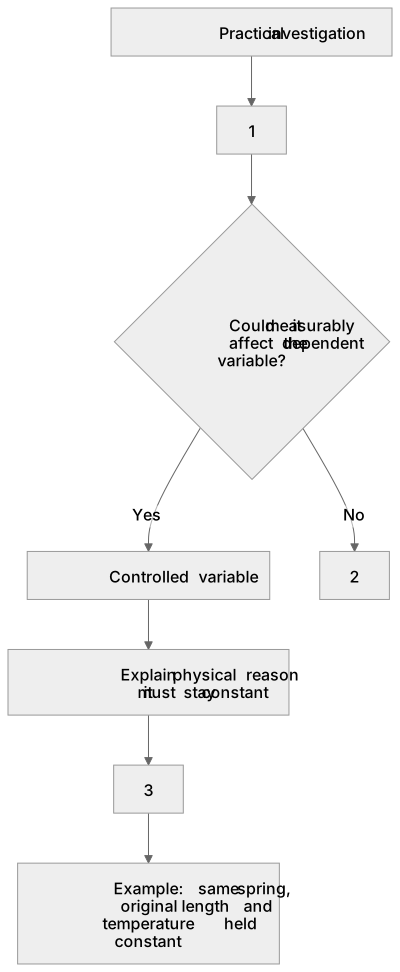
1Box 1
2Box 2
3Box 3
There is more to this lesson
The full lesson goes on to check your understanding and help you earn the marks. Create a free account to carry on, with your progress saved.
A week of Premium from your first lesson · Then the free plan continues · No card, no charge
Test your understanding of Planning: (b) identification of variables that must be controlled, where appropriate
Active recall beats re-reading. Take an instant quiz now to test what you’ve learned and lock it into long-term memory.
A week of Premium from your first lesson · Then the free plan continues · No card, no charge