OCR · A-Level · Physics
Course version: H556 · Version from Sept 2015
Point and spherical charges: (a) electric fields are due to charges
An electric field is a region in which a charged object experiences a force, and the field exists because charge is present.
Checked against the OCR H556 specification (opens in a new tab) on .
- Point 1 of 4
- 3 key terms
Study notes
From the checked teaching notes for this specification point.
The idea
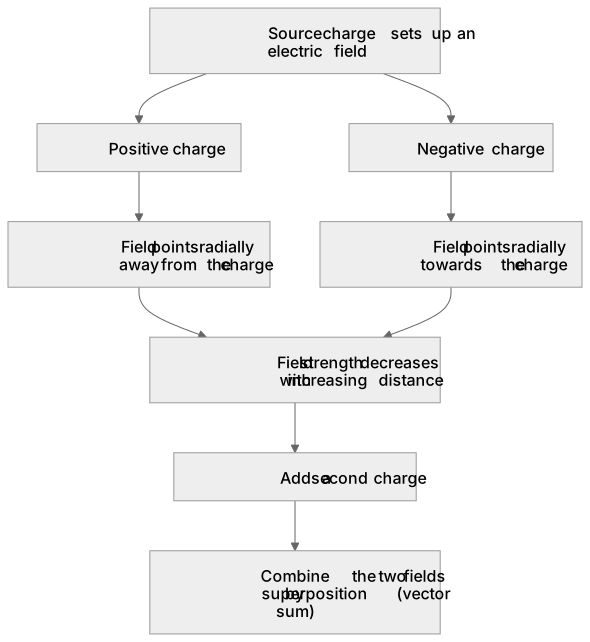
An electric field is a region in which a charged object experiences a force, and the field exists because charge is present. Charge is the source of the field: a positive charge sets up a field pointing radially away from it, while a negative charge sets up a field pointing radially towards it. Field strength falls with distance from the source charge, so the field is strongest close to the charge. A useful method is to sketch the field around a single isolated charge first, then add a second charge and combine the two fields by superposition. In this section you meet point and spherical charges, so treat the source as a point charge at the centre of a uniformly charged sphere.
What earns the marks
- Electric fields are produced by electric charge; without a source charge there is no field.
- The direction of the field depends on the sign of the source charge: away from positive, towards negative.
- Field strength decreases with increasing distance from the source charge.
- For a uniformly charged sphere the field outside can be modelled as that of a point charge at the centre.
- Superposition: the resultant field at a point is the vector sum of the fields due to each source charge.
Common mistakes and how to put them right
Thinking a field can exist without a source charge.
Put it right by identifying the charge that sets up the field.
Believing field lines point towards a positive charge.
Put it right by remembering field direction is the force on a positive test charge, so lines point away from positive and towards negative.
Assuming field strength is the same everywhere around a point charge.
Put it right by noting it falls with distance from the charge.
Treating electric field as a scalar.
Put it right by adding fields as vectors when more than one source charge is present.
Exam tips
- Read the stem carefully and identify the sign of each source charge before choosing an option.
- Eliminate options that describe field direction incorrectly for the given charge sign.
- Check whether the question asks about the field due to one charge or the resultant field due to several charges.
Try the lesson
The start of the Point and spherical charges: (a) electric fields are due to charges lesson, made from checked teaching notes for this specification point.
Listen
An electric field is a region in which a charged object experiences a force, and the field exists because charge is present. Charge is the source of the field: a positive charge sets up a field pointing radially away from it, while a negative charge sets up a field pointing radially towards it. Field strength falls with distance from the source charge, so the field is strongest close to the charge. A useful method is to sketch the field around a single isolated charge first, then add a second charge and combine the two fields by superposition. In this section you meet point and spherical charges, so treat the source as a point charge at the centre of a uniformly charged sphere. A strong answer earns marks for these points. Electric fields are produced by electric charge; without a source charge there is no field. The direction of the field depends on the sign of the source charge: away from positive, towards negative. Field strength decreases with increasing distance from the source charge. For a uniformly charged sphere the field outside can be modelled as that of a point charge at the centre. A common slip: Thinking a field can exist without a source charge. Instead, identifying the charge that sets up the field. Exam tip: Read the stem carefully and identify the sign of each source charge before choosing an option.
See it
Key words
Say what each word means before you turn the card.
Electric field
Try answering aloud or in your head before turning the card.
Direction of field relative to charge sign
Try answering aloud or in your head before turning the card.
Superposition of fields from multiple charges
Try answering aloud or in your head before turning the card.
See every definition
- Electric field
- A region in which a charged object experiences a force, existing because charge is present.
- Direction of field relative to charge sign
- The field points radially away from a positive charge and radially towards a negative charge.
- Superposition of fields from multiple charges
- The resultant field at a point is the vector sum of the fields due to each source charge.
Label the diagram
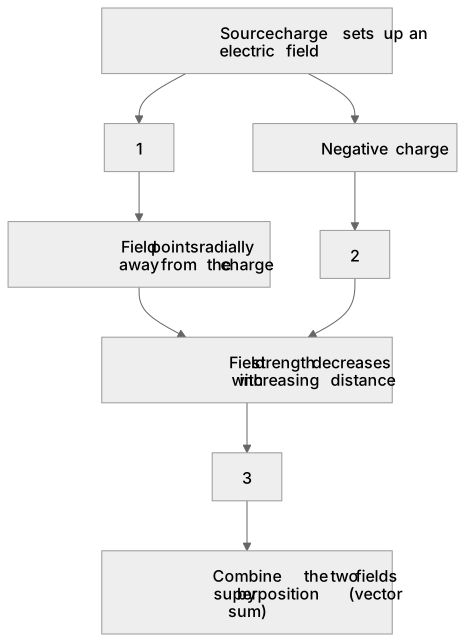
Some boxes have lost their names. Pick the right name for each number.
1Box 1
2Box 2
3Box 3
There is more to this lesson
The full lesson goes on to check your understanding and help you earn the marks. Create a free account to carry on, with your progress saved.
A week of Premium from your first lesson · Then the free plan continues · No card, no charge
Test your understanding of Point and spherical charges: (a) electric fields are due to charges
Active recall beats re-reading. Take an instant quiz now to test what you’ve learned and lock it into long-term memory.
A week of Premium from your first lesson · Then the free plan continues · No card, no charge