OCR · A-Level · Physics
Course version: H556 · Version from Sept 2015
Power: (a) the equations P = VI, P = I²R and P = V²/R
Electrical power is the rate of energy transfer in a component.
Checked against the OCR H556 specification (opens in a new tab) on .
- Point 4 of 6
- 4 key terms
Study notes
From the checked teaching notes for this specification point.
The idea
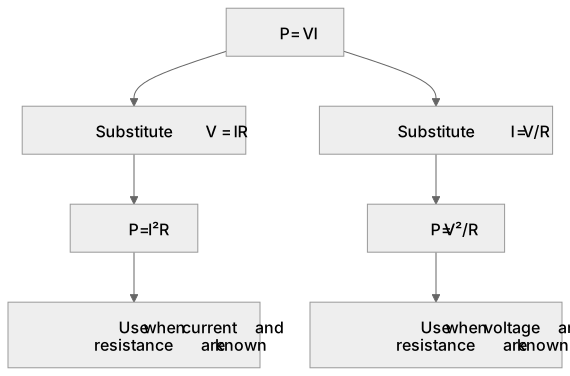
Electrical power is the rate of energy transfer in a component. Starting from P = VI, substitute V = IR to obtain P = I²R, or substitute I = V/R to obtain P = V²/R. Each form is useful when a different pair of quantities is known. For a 12 V lamp drawing 0.50 A, P = VI = 12 × 0.50 = 6.0 W; its resistance is 24 Ω, so P = I²R = 0.50² × 24 = 6.0 W and P = V²/R = 12² ÷ 24 = 6.0 W. Choose the form matching the data: use P = I²R when current and resistance are known, and P = V²/R when voltage and resistance are known. In multiple-choice questions, check units and significant figures before selecting an option.
What earns the marks
- States that P = VI gives power as the product of potential difference and current.
- Derives P = I²R by substituting V = IR into P = VI.
- Derives P = V²/R by substituting I = V/R into P = VI.
- Selects the appropriate form for the quantities given in a calculation.
- Applies correct units: watts for power, volts for potential difference, amperes for current and ohms for resistance.
Common mistakes and how to put them right
Squaring the wrong quantity.
Put it right: P = I²R, where only the current is squared.
Using P = V²/R when resistance is unknown.
Put it right: Use P = VI if current is known instead.
Forgetting to square the current before multiplying by resistance.
Put it right: Evaluate I² first, for example 0.50² = 0.25, then multiply by R.
Exam tips
- Write the chosen equation before substituting numbers so the examiner can follow your reasoning.
- Check that the final unit is the watt and that the magnitude is sensible for the component described.
- When two forms could be used, pick the one requiring the fewest rearrangements to reduce arithmetic slips.
Try the lesson
The start of the Power: (a) the equations P = VI, P = I²R and P = V²/R lesson, made from checked teaching notes for this specification point.
Listen
Electrical power is the rate of energy transfer in a component. Starting from P = VI, substitute V = IR to obtain P = I²R, or substitute I = V/R to obtain P = V²/R. Each form is useful when a different pair of quantities is known. For a 12 V lamp drawing 0.50 A, P = VI = 12 × 0.50 = 6.0 W; its resistance is 24 Ω, so P = I²R = 0.50² × 24 = 6.0 W and P = V²/R = 12² ÷ 24 = 6.0 W. Choose the form matching the data: use P = I²R when current and resistance are known, and P = V²/R when voltage and resistance are known. In multiple-choice questions, check units and significant figures before selecting an option. A strong answer earns marks for these points. States that P = VI gives power as the product of potential difference and current. Derives P = I²R by substituting V = IR into P = VI. Derives P = V²/R by substituting I = V/R into P = VI. Selects the appropriate form for the quantities given in a calculation. A common slip: Squaring the wrong quantity: the error is writing P = IR². Instead, P = I²R, where only the current is squared. Exam tip: Write the chosen equation before substituting numbers so the examiner can follow your reasoning.
See it
Key words
Say what each word means before you turn the card.
Electrical power
Try answering aloud or in your head before turning the card.
P = I²R
Try answering aloud or in your head before turning the card.
P = V²/R
Try answering aloud or in your head before turning the card.
Efficient equation form
Try answering aloud or in your head before turning the card.
See every definition
- Electrical power
- The rate of energy transfer in a component, given by P = VI.
- P = I²R
- Obtained by substituting V = IR into P = VI, and useful when current and resistance are known.
- P = V²/R
- Obtained by substituting I = V/R into P = VI, and useful when voltage and resistance are known.
- Efficient equation form
- The form matching the data, chosen to require the fewest rearrangements and reduce arithmetic slips.
Label the diagram
Some boxes have lost their names. Pick the right name for each number.
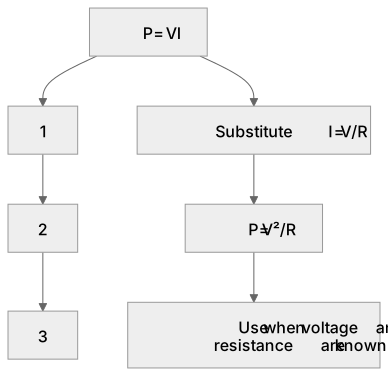
1Box 1
2Box 2
3Box 3
There is more to this lesson
The full lesson goes on to check your understanding and help you earn the marks. Create a free account to carry on, with your progress saved.
A week of Premium from your first lesson · Then the free plan continues · No card, no charge
Test your understanding of Power: (a) the equations P = VI, P = I²R and P = V²/R
Active recall beats re-reading. Take an instant quiz now to test what you’ve learned and lock it into long-term memory.
A week of Premium from your first lesson · Then the free plan continues · No card, no charge