OCR · A-Level · Physics
Course version: H556 · Version from Sept 2015
(a) independence of the vertical and horizontal motion of a projectile
Full specification wording
Projectile motion: (a) independence of the vertical and horizontal motion of a projectile
A projectile is any object moving freely under gravity alone, and its motion splits into two perpendicular components that do not affect each other.
Checked against the OCR H556 specification (opens in a new tab) on .
- Point 1 of 2
- 3 key terms
Study notes
From the checked teaching notes for this specification point.
The idea
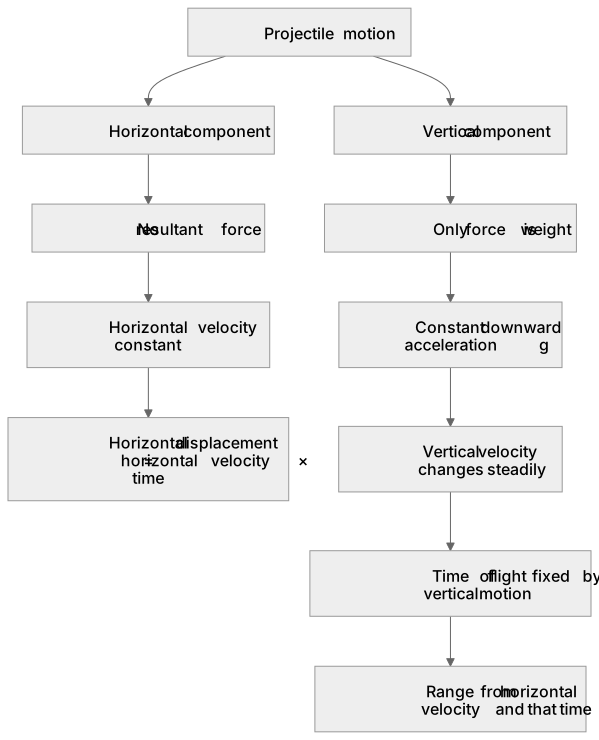
A projectile is any object moving freely under gravity alone, and its motion splits into two perpendicular components that do not affect each other. Horizontally there is no resultant force, so horizontal velocity stays constant and horizontal displacement is velocity × time. Vertically the only force is weight, giving constant downward acceleration g, so vertical velocity changes steadily and vertical displacement follows the constant-acceleration equations. Because the two directions are independent, the time of flight is fixed entirely by the vertical motion, while the horizontal range is fixed by the horizontal velocity and that same time.
For example: A ball rolled off a bench and one dropped vertically from the same height reach the floor together, because both have identical vertical motion.
What earns the marks
- Horizontal and vertical components of a projectile's motion are independent of each other.
- Horizontally there is no resultant force, so horizontal velocity is constant and horizontal displacement = horizontal velocity × time.
- Vertically the only force is weight, giving constant downward acceleration of magnitude g, so vertical velocity changes at a steady rate.
- The time of flight is determined solely by the vertical motion; the horizontal range follows from horizontal velocity and that time.
- A projectile released horizontally and one dropped from the same height land at the same time because their vertical motions are identical.
Common mistakes and how to put them right
Believing that a larger horizontal velocity makes a projectile fall more slowly.
Put it right: The horizontal and vertical motions are independent, so the vertical fall time is unchanged.
Treating horizontal velocity as decreasing during flight.
Put it right: With no horizontal resultant force it stays constant, and only the vertical velocity changes.
Assuming the vertical acceleration changes direction or magnitude during flight.
Put it right: Near the Earth's surface it stays constant at g downwards throughout.
Thinking the two components must be combined before the time of flight can be found.
Put it right: The vertical motion alone gives the time of flight.
Exam tips
- State explicitly that the two perpendicular components are independent before using any equation.
- Choose the vertical direction to find time of flight, then use that time with constant horizontal velocity to find range.
- Check the direction convention for g and keep signs consistent when substituting into constant-acceleration equations.
Try the lesson
The start of the Projectile motion: (a) independence of the vertical and horizontal motion of a projectile lesson, made from checked teaching notes for this specification point.
Listen
A projectile is any object moving freely under gravity alone, and its motion splits into two perpendicular components that do not affect each other. Horizontally there is no resultant force, so horizontal velocity stays constant and horizontal displacement is velocity × time. Vertically the only force is weight, giving constant downward acceleration g, so vertical velocity changes steadily and vertical displacement follows the constant-acceleration equations. Because the two directions are independent, the time of flight is fixed entirely by the vertical motion, while the horizontal range is fixed by the horizontal velocity and that same time. For example, a ball rolled off a bench and one dropped vertically from the same height reach the floor together, because both have identical vertical motion. A strong answer earns marks for these points. Horizontal and vertical components of a projectile's motion are independent of each other. Horizontally there is no resultant force, so horizontal velocity is constant and horizontal displacement = horizontal velocity × time. Vertically the only force is weight, giving constant downward acceleration of magnitude g, so vertical velocity changes at a steady rate. The time of flight is determined solely by the vertical motion; the horizontal range follows from horizontal velocity and that time. Exam tip: State explicitly that the two perpendicular components are independent before using any equation.
See it
Key words
Say what each word means before you turn the card.
Independence of perpendicular components of motion
Try answering aloud or in your head before turning the card.
Constant velocity when resultant force is zero
Try answering aloud or in your head before turning the card.
Constant acceleration under gravity
Try answering aloud or in your head before turning the card.
See every definition
- Independence of perpendicular components of motion
- The motion splits into two perpendicular components that do not affect each other, so the horizontal and vertical motions of a projectile are independent.
- Constant velocity when resultant force is zero
- Horizontally there is no resultant force, so horizontal velocity stays constant and horizontal displacement is velocity × time.
- Constant acceleration under gravity
- Vertically the only force is weight, giving constant downward acceleration g, so vertical velocity changes steadily.
Label the diagram
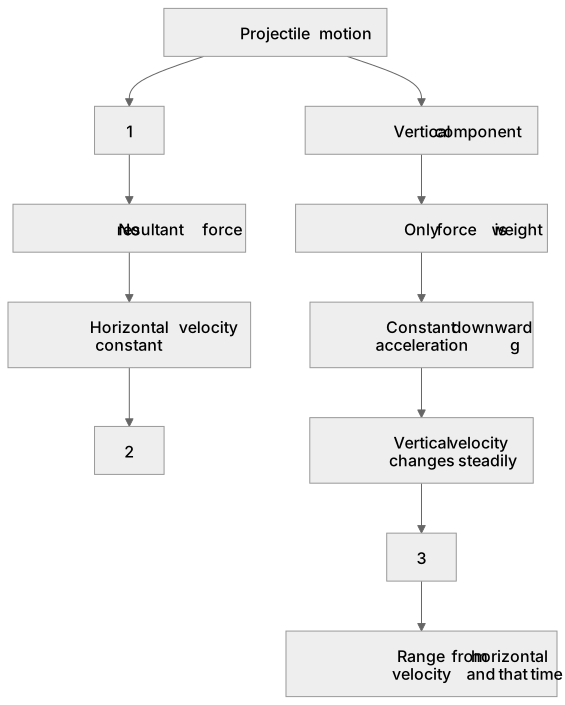
Some boxes have lost their names. Pick the right name for each number.
1Box 1
2Box 2
3Box 3
There is more to this lesson
The full lesson goes on to check your understanding and help you earn the marks. Create a free account to carry on, with your progress saved.
A week of Premium from your first lesson · Then the free plan continues · No card, no charge
Test your understanding of Projectile motion: (a) independence of the vertical and horizontal motion of a projectile
Active recall beats re-reading. Take an instant quiz now to test what you’ve learned and lock it into long-term memory.
A week of Premium from your first lesson · Then the free plan continues · No card, no charge