OCR · A-Level · Physics
Course version: H556 · Version from Sept 2015
Radioactivity: (a) radioactive decay; spontaneous and random nature of decay
Radioactive decay is the process by which an unstable nucleus emits radiation to become more stable.
Checked against the OCR H556 specification (opens in a new tab) on .
- Point 1 of 11
- 4 key terms
Study notes
From the checked teaching notes for this specification point.
The idea
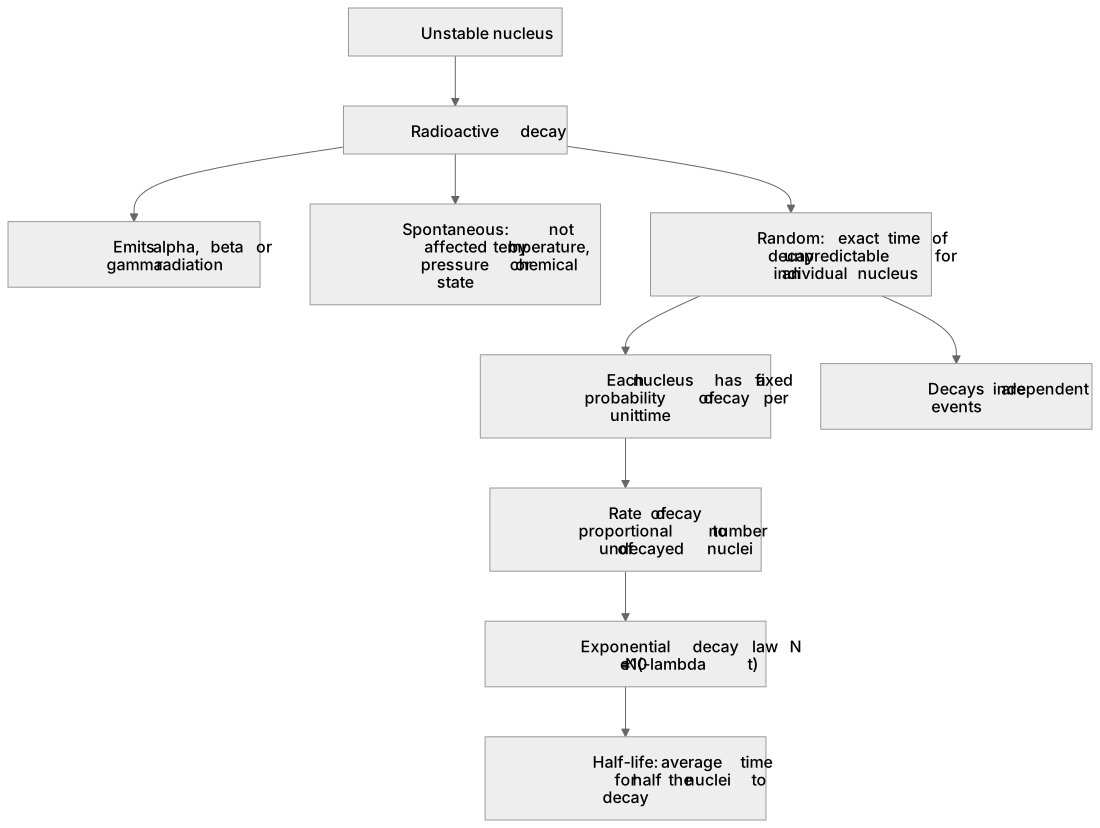
Radioactive decay is the process by which an unstable nucleus emits radiation to become more stable. It is spontaneous: the decay is not triggered by external factors such as temperature, pressure or chemical state, and cannot be predicted or controlled. It is random: for any given nucleus, we cannot know when it will decay, and in a sample, different nuclei decay at different times. The decay of one nucleus is independent of others. These properties are fundamental to understanding phenomena like exponential decay and half-life. For example, a single carbon-14 nucleus might decay in the next second or in thousands of years; we can only assign a probability. The rate of decay is proportional to the number of undecayed nuclei, leading to N = N₀e^(−λt).
What earns the marks
- Spontaneous: decay is not affected by external conditions such as temperature, pressure or chemical environment.
- Random: for an individual nucleus, the exact time of decay is unpredictable; each nucleus has a fixed probability of decay per unit time.
- Decay is a nuclear process; it involves changes in the nucleus, often emitting alpha, beta or gamma radiation.
- The rate of decay is proportional to the number of undecayed nuclei, N, giving the exponential decay law N = N₀e^(−λt).
- Half-life is the average time for half the nuclei in a sample to decay, and it is constant for a given isotope.
Common mistakes and how to put them right
Misunderstanding: thinking that decay can be sped up by heating or chemical reactions.
Put it right: Decay is spontaneous and unaffected by external conditions.
Misunderstanding: believing that after one half-life all nuclei have decayed.
Put it right: After one half-life, half of the original nuclei remain undecayed; decay continues exponentially.
Misunderstanding: assuming that the decay of one nucleus affects the timing of another.
Put it right: Decays are independent events; the decay of one nucleus does not influence others.
Misunderstanding: confusing random with unpredictable in the sense of having no pattern.
Put it right: While individual decays are random, large samples show statistical patterns such as exponential decay.
Exam tips
- Remember that 'spontaneous' means the decay is not caused by external factors, and 'random' means we cannot predict which nucleus decays next or when.
- In calculations, use the exponential decay equation N = N₀e^(−λt) and ensure you can rearrange it for λ or t.
- When explaining half-life, emphasise that it is an average time and that after each half-life the number of undecayed nuclei halves.
Try the lesson
The start of the Radioactivity: (a) radioactive decay; spontaneous and random nature of decay lesson, made from checked teaching notes for this specification point.
Listen
Radioactive decay is the process by which an unstable nucleus emits radiation to become more stable. It is spontaneous: the decay is not triggered by external factors such as temperature, pressure or chemical state, and cannot be predicted or controlled. It is random: for any given nucleus, we cannot know when it will decay, and in a sample, different nuclei decay at different times. The decay of one nucleus is independent of others. These properties are fundamental to understanding phenomena like exponential decay and half-life. For example, a single carbon-14 nucleus might decay in the next second or in thousands of years; we can only assign a probability. The rate of decay is proportional to the number of undecayed nuclei, leading to N = N₀e^(−λt). A strong answer earns marks for these points. Spontaneous: decay is not affected by external conditions such as temperature, pressure or chemical environment. Random: for an individual nucleus, the exact time of decay is unpredictable; each nucleus has a fixed probability of decay per unit time. Decay is a nuclear process; it involves changes in the nucleus, often emitting alpha, beta or gamma radiation. The rate of decay is proportional to the number of undecayed nuclei, N, giving the exponential decay law N = N₀e^(−λt). A common slip: Misunderstanding: thinking that decay can be sped up by heating or chemical reactions. Instead, decay is spontaneous and unaffected by external conditions. Exam tip: Remember that 'spontaneous' means the decay is not caused by external factors, and 'random' means we cannot predict which nucleus decays next or when.
See it
Key words
Say what each word means before you turn the card.
Spontaneity of radioactive decay
Try answering aloud or in your head before turning the card.
Randomness of radioactive decay
Try answering aloud or in your head before turning the card.
Exponential decay law
Try answering aloud or in your head before turning the card.
Half-life and its meaning
Try answering aloud or in your head before turning the card.
See every definition
- Spontaneity of radioactive decay
- The decay is not triggered by external factors such as temperature, pressure or chemical state, and cannot be predicted or controlled.
- Randomness of radioactive decay
- For any given nucleus, we cannot know when it will decay, and in a sample, different nuclei decay at different times.
- Exponential decay law
- The rate of decay is proportional to the number of undecayed nuclei, leading to N = N₀e^(−λt).
- Half-life and its meaning
- The average time for half the nuclei in a sample to decay, and it is constant for a given isotope.
Label the diagram
Some boxes have lost their names. Pick the right name for each number.
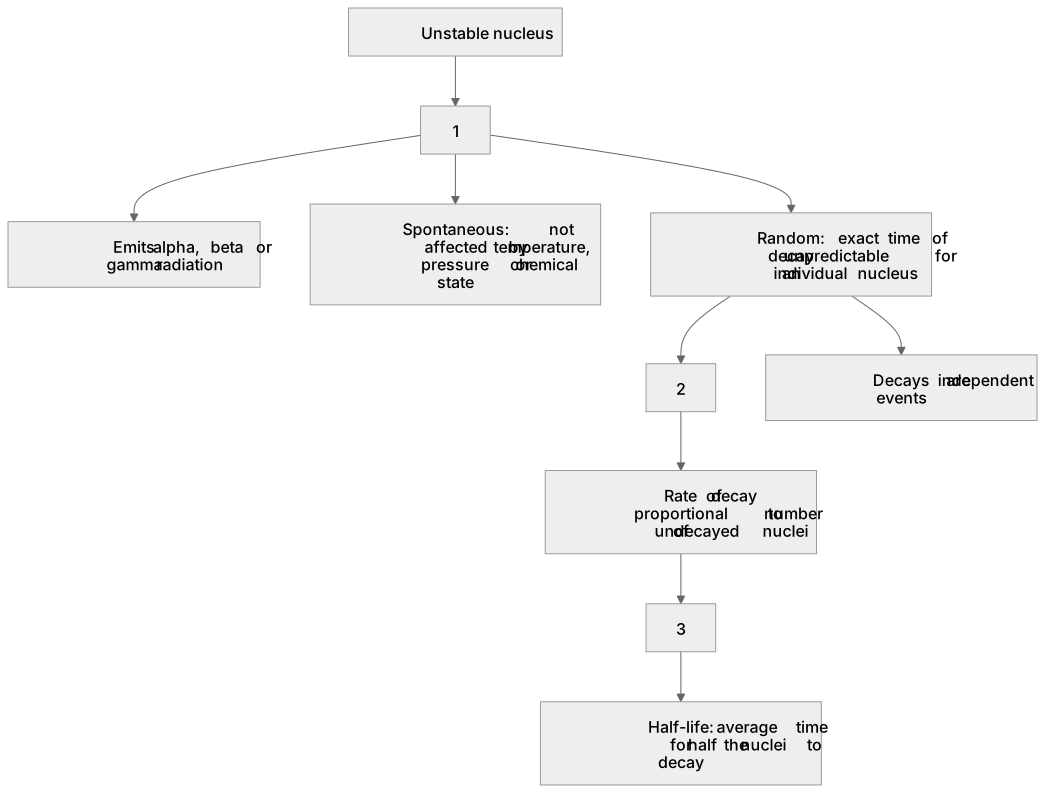
1Box 1
2Box 2
3Box 3
There is more to this lesson
The full lesson goes on to check your understanding and help you earn the marks. Create a free account to carry on, with your progress saved.
A week of Premium from your first lesson · Then the free plan continues · No card, no charge
Test your understanding of Radioactivity: (a) radioactive decay; spontaneous and random nature of decay
Active recall beats re-reading. Take an instant quiz now to test what you’ve learned and lock it into long-term memory.
A week of Premium from your first lesson · Then the free plan continues · No card, no charge