OCR · A-Level · Physics
Course version: H556 · Version from Sept 2015
(ii) techniques and procedures used to investigate the absorption of α…
Full specification wording
Radioactivity: (ii) techniques and procedures used to investigate the absorption of α -particles, β-particles and γ -rays by appropriate materials
To investigate absorption, set up a source, absorber and detector (e.g., Geiger-Müller tube) with a counter.
Checked against the OCR H556 specification (opens in a new tab) on .
- Point 3 of 11
- 4 key terms
Study notes
From the checked teaching notes for this specification point.
The idea
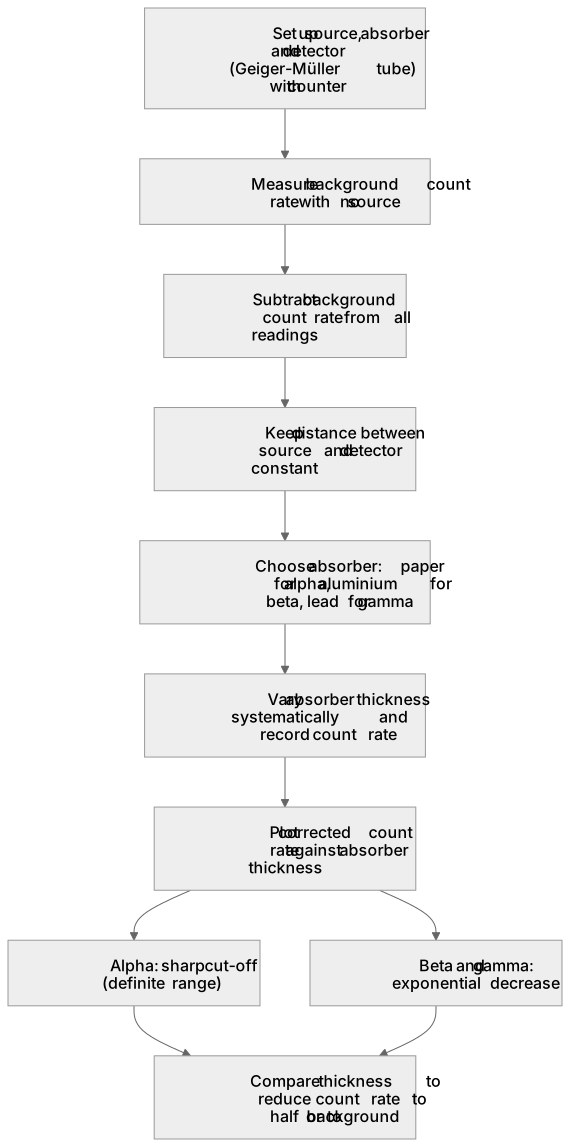
To investigate absorption, set up a source, absorber and detector (e.g., Geiger-Müller tube) with a counter. Measure background count rate first and subtract it from all readings. For alpha, use paper or thin card as absorber; for beta, use aluminium sheets of varying thickness; for gamma, use lead sheets. Vary absorber thickness systematically and record count rate. Plot corrected count rate against thickness. Alpha shows a sharp cut-off (definite range); beta and gamma show exponential decrease. Use tongs to handle sources, minimise exposure time, and keep source away from body. Ensure distance between source and detector is constant. This experiment allows comparison of penetration and absorption characteristics.
What earns the marks
- Set up source, absorber and detector (Geiger-Müller tube) with counter; measure background count rate and subtract from all readings.
- Use appropriate absorbers: paper for alpha, aluminium for beta, lead for gamma; vary thickness systematically.
- Keep distance between source and detector constant; use tongs and minimise exposure time for safety.
- Plot corrected count rate against absorber thickness; alpha shows a definite range, beta and gamma show exponential absorption.
- Compare the thickness required to reduce count rate to half or to background for each radiation type.
Common mistakes and how to put them right
Misunderstanding: forgetting to measure background radiation.
Put it right: Measure background count rate with no source and subtract it from all readings.
Misunderstanding: using the wrong absorber for a given radiation.
Put it right: Use paper for alpha, aluminium for beta, lead for gamma.
Misunderstanding: not keeping the source-detector distance constant.
Put it right: Fix the distance to ensure count rate changes are due only to absorber thickness.
Misunderstanding: assuming alpha absorption is exponential.
Put it right: Alpha particles have a definite range, so count rate drops sharply to background at a specific thickness.
Exam tips
- Describe the procedure step by step: background count, set distance, insert absorber, record count rate, repeat for different thicknesses.
- Mention safety precautions: use tongs, keep source away from body, minimise time near source.
- When analysing, plot a graph of corrected count rate against thickness and identify the shape for each radiation.
Try the lesson
The start of the Radioactivity: (ii) techniques and procedures used to investigate the absorption of α -particles, β-particles and γ -rays by appropriate materials lesson, made from checked teaching notes for this specification point.
Listen
To investigate absorption, set up a source, absorber and detector (e.g., Geiger-Müller tube) with a counter. Measure background count rate first and subtract it from all readings. For alpha, use paper or thin card as absorber; for beta, use aluminium sheets of varying thickness; for gamma, use lead sheets. Vary absorber thickness systematically and record count rate. Plot corrected count rate against thickness. Alpha shows a sharp cut-off (definite range); beta and gamma show exponential decrease. Use tongs to handle sources, minimise exposure time, and keep source away from body. Ensure distance between source and detector is constant. This experiment allows comparison of penetration and absorption characteristics. A strong answer earns marks for these points. Set up source, absorber and detector (Geiger-Müller tube) with counter; measure background count rate and subtract from all readings. Use appropriate absorbers: paper for alpha, aluminium for beta, lead for gamma; vary thickness systematically. Keep distance between source and detector constant; use tongs and minimise exposure time for safety. Plot corrected count rate against absorber thickness; alpha shows a definite range, beta and gamma show exponential absorption. A common slip: Misunderstanding: forgetting to measure background radiation. Instead, measure background count rate with no source and subtract it from all readings. Exam tip: Describe the procedure step by step: background count, set distance, insert absorber, record count rate, repeat for different thicknesses.
See it
Key words
Say what each word means before you turn the card.
Geiger-Müller tube
Try answering aloud or in your head before turning the card.
Background count rate
Try answering aloud or in your head before turning the card.
Absorber
Try answering aloud or in your head before turning the card.
Corrected count rate
Try answering aloud or in your head before turning the card.
See every definition
- Geiger-Müller tube
- A detector used with a counter to measure count rate when investigating absorption of α-particles, β-particles and γ-rays by appropriate materials.
- Background count rate
- A reading measured first with no source and subtracted from all readings in absorption studies.
- Absorber
- Material placed between source and detector, such as paper or thin card for alpha, aluminium sheets of varying thickness for beta, and lead sheets for gamma.
- Corrected count rate
- The count rate after background count rate has been subtracted, plotted against absorber thickness to show absorption.
Label the diagram
Some boxes have lost their names. Pick the right name for each number.
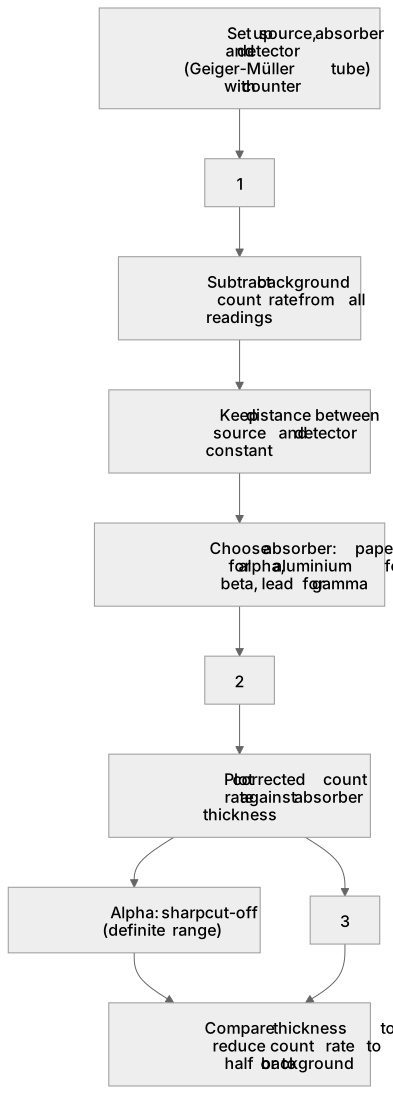
1Box 1
2Box 2
3Box 3
There is more to this lesson
The full lesson goes on to check your understanding and help you earn the marks. Create a free account to carry on, with your progress saved.
A week of Premium from your first lesson · Then the free plan continues · No card, no charge
Test your understanding of Radioactivity: (ii) techniques and procedures used to investigate the absorption of α -particles, β-particles and γ -rays by appropriate materials
Active recall beats re-reading. Take an instant quiz now to test what you’ve learned and lock it into long-term memory.
A week of Premium from your first lesson · Then the free plan continues · No card, no charge