OCR · A-Level · Physics
Course version: H556 · Version from Sept 2015
(d) light-dependent resistor (LDR); variation of resistance with light…
Full specification wording
Resistance: (d) light-dependent resistor (LDR); variation of resistance with light intensity.
A light-dependent resistor, or LDR, is a semiconductor component whose resistance decreases as light intensity increases.
Checked against the OCR H556 specification (opens in a new tab) on .
- Point 5 of 5
- 3 key terms
Study notes
From the checked teaching notes for this specification point.
The idea
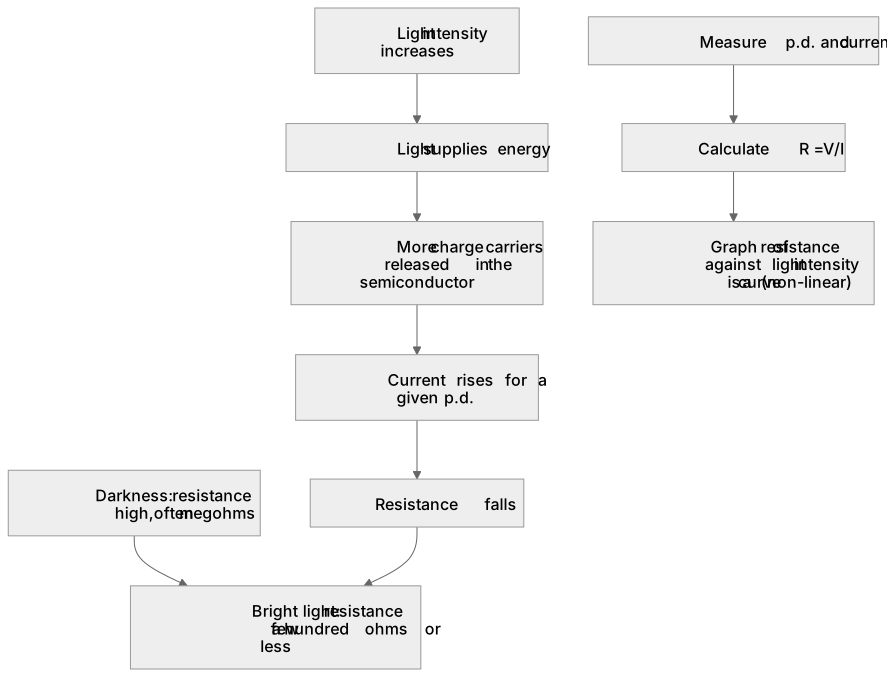
A light-dependent resistor, or LDR, is a semiconductor component whose resistance decreases as light intensity increases. In darkness its resistance is high, often megohms; in bright light it falls to a few hundred ohms or less. The light supplies energy that releases more charge carriers, so the current for a given p.d. rises and resistance falls. You can investigate this by placing an LDR in a circuit with an ammeter and voltmeter, varying the distance from a lamp or using different light intensities, and calculating resistance from V/I. The relationship is non-linear, so a graph of resistance against light intensity is a curve.
What earns the marks
- LDR resistance decreases as light intensity increases.
- In darkness the resistance is high; in bright light it is much lower.
- Light energy releases more charge carriers in the semiconductor, increasing current for a given p.d.
- Resistance is calculated from R = V/I using measured p.d. and current.
- The variation of resistance with light intensity is non-linear.
Common mistakes and how to put them right
Saying LDR resistance increases with light intensity.
Put it right: Resistance decreases as light intensity increases.
Treating the LDR as ohmic with constant resistance.
Put it right: Its resistance changes with light intensity, so it is non-ohmic.
Assuming a directly proportional relationship between resistance and light intensity.
Put it right: The graph is a curve, not a straight line.
Exam tips
- State the direction of change clearly: more light means less resistance.
- Use the equation R = V/I when calculating resistance from measurements.
- Describe the graph as a curve showing a non-linear decrease.
Try the lesson
The start of the Resistance: (d) light-dependent resistor (LDR); variation of resistance with light intensity. lesson, made from checked teaching notes for this specification point.
Listen
A light-dependent resistor, or LDR, is a semiconductor component whose resistance decreases as light intensity increases. In darkness its resistance is high, often megohms; in bright light it falls to a few hundred ohms or less. The light supplies energy that releases more charge carriers, so the current for a given p.d. rises and resistance falls. You can investigate this by placing an LDR in a circuit with an ammeter and voltmeter, varying the distance from a lamp or using different light intensities, and calculating resistance from V/I. The relationship is non-linear, so a graph of resistance against light intensity is a curve. A strong answer earns marks for these points. LDR resistance decreases as light intensity increases. In darkness the resistance is high; in bright light it is much lower. Light energy releases more charge carriers in the semiconductor, increasing current for a given p.d. Resistance is calculated from R = V/I using measured p.d. and current. A common slip: Saying LDR resistance increases with light intensity. Instead, resistance decreases as light intensity increases. Exam tip: State the direction of change clearly: more light means less resistance.
See it
Key words
Say what each word means before you turn the card.
Light intensity as a variable
Try answering aloud or in your head before turning the card.
Non-ohmic behaviour
Try answering aloud or in your head before turning the card.
Practical measurement of resistance
Try answering aloud or in your head before turning the card.
See every definition
- Light intensity as a variable
- It can be varied by changing the distance from a lamp or by using different light intensities when investigating an LDR.
- Non-ohmic behaviour
- The resistance changes with light intensity, so the LDR is not ohmic with constant resistance.
- Practical measurement of resistance
- Place an LDR in a circuit with an ammeter and voltmeter and calculate resistance from V/I.
Label the diagram
Some boxes have lost their names. Pick the right name for each number.
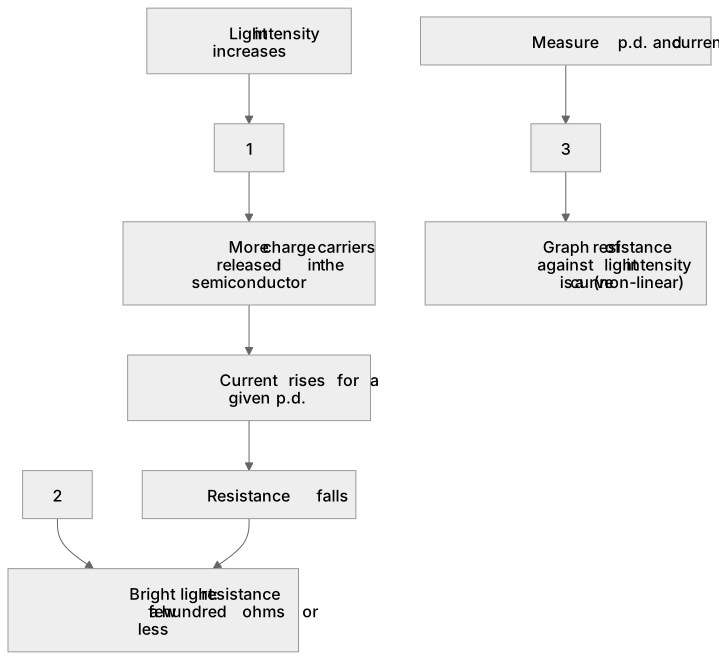
1Box 1
2Box 2
3Box 3
There is more to this lesson
The full lesson goes on to check your understanding and help you earn the marks. Create a free account to carry on, with your progress saved.
A week of Premium from your first lesson · Then the free plan continues · No card, no charge
Test your understanding of Resistance: (d) light-dependent resistor (LDR); variation of resistance with light intensity.
Active recall beats re-reading. Take an instant quiz now to test what you’ve learned and lock it into long-term memory.
A week of Premium from your first lesson · Then the free plan continues · No card, no charge