OCR · A-Level · Physics
Course version: H556 · Version from Sept 2015
(b) the variation of resistivity of metals and semiconductors with…
Full specification wording
Resistivity: (b) the variation of resistivity of metals and semiconductors with temperature
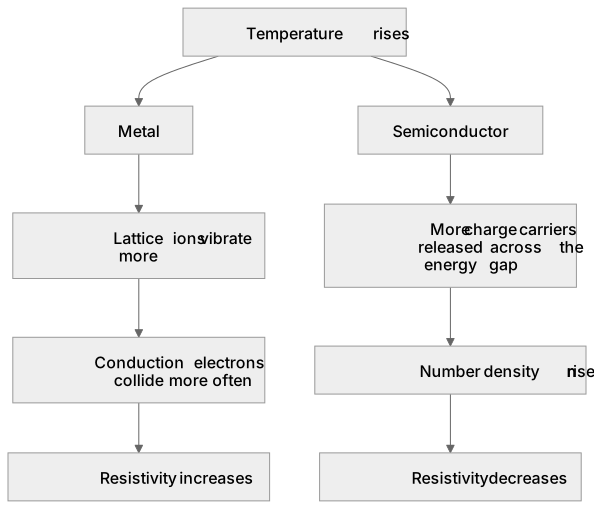
In a metal, increasing temperature makes the lattice ions vibrate more, so conduction electrons collide more often and resistivity increases.
Checked against the OCR H556 specification (opens in a new tab) on .
- Point 3 of 4
- 4 key terms
Study notes
From the checked teaching notes for this specification point.
The idea
In a metal, increasing temperature makes the lattice ions vibrate more, so conduction electrons collide more often and resistivity increases. Over a limited range near room temperature the rise is roughly linear, so ρ ≈ ρ₀(1 + αΔT). In a semiconductor, increasing temperature releases more charge carriers (electrons and holes) across the small energy gap, so the number density n rises sharply and resistivity falls. This is a negative temperature coefficient of resistivity. So the same temperature change has opposite effects: metals become worse conductors, semiconductors become better conductors. In multiple-choice questions you may be asked to identify a graph shape or to explain the microscopic reason.
What earns the marks
- In metals, resistivity increases as temperature rises.
- The cause is increased lattice vibration, which increases the rate of collisions between conduction electrons and ions.
- The number density of charge carriers in a metal is essentially unchanged by temperature.
- In semiconductors, resistivity decreases as temperature rises.
- The cause is the release of more charge carriers across the energy gap, increasing the number density n.
- A graph of ρ against T has a positive gradient for a metal and a negative gradient for a semiconductor.
Common mistakes and how to put them right
Saying metals and semiconductors both increase in resistivity with temperature.
Put it right: Metals increase, semiconductors decrease.
Explaining the metal effect by saying more electrons are released.
Put it right: The number of carriers is nearly constant; it is the collision rate that rises.
Explaining the semiconductor effect by saying ions vibrate less.
Put it right: The dominant effect is the increase in the number of charge carriers.
Assuming the relationship is linear for a semiconductor.
Put it right: The fall is non-linear and steep, often shown as a curve.
Exam tips
- Link each trend to the microscopic cause: collision rate for metals, carrier number for semiconductors.
- Sketch or read the graph carefully: positive gradient for a metal, negative for a semiconductor.
- Use the phrase 'number density of charge carriers' when discussing semiconductors.
- Remember that resistivity, not just resistance, is being described; keep the specimen dimensions fixed.
Try the lesson
The start of the Resistivity: (b) the variation of resistivity of metals and semiconductors with temperature lesson, made from checked teaching notes for this specification point.
Listen
In a metal, increasing temperature makes the lattice ions vibrate more, so conduction electrons collide more often and resistivity increases. Over a limited range near room temperature the rise is roughly linear, so ρ ≈ ρ₀(1 + αΔT). In a semiconductor, increasing temperature releases more charge carriers (electrons and holes) across the small energy gap, so the number density n rises sharply and resistivity falls. This is a negative temperature coefficient of resistivity. So the same temperature change has opposite effects: metals become worse conductors, semiconductors become better conductors. In multiple-choice questions you may be asked to identify a graph shape or to explain the microscopic reason. A strong answer earns marks for these points. In metals, resistivity increases as temperature rises. The cause is increased lattice vibration, which increases the rate of collisions between conduction electrons and ions. The number density of charge carriers in a metal is essentially unchanged by temperature. In semiconductors, resistivity decreases as temperature rises. A common slip: Saying metals and semiconductors both increase in resistivity with temperature. Instead, metals increase, semiconductors decrease. Exam tip: Link each trend to the microscopic cause: collision rate for metals, carrier number for semiconductors.
See it
Key words
Say what each word means before you turn the card.
Temperature dependence of resistivity
Try answering aloud or in your head before turning the card.
Microscopic model of conduction in metals
Try answering aloud or in your head before turning the card.
Charge-carrier release in semiconductors
Try answering aloud or in your head before turning the card.
Graphical interpretation of ρ against T
Try answering aloud or in your head before turning the card.
See every definition
- Temperature dependence of resistivity
- In a metal, increasing temperature makes the lattice ions vibrate more, so conduction electrons collide more often and resistivity increases; in a semiconductor, increasing temperature releases more charge carriers, so resistivity falls.
- Microscopic model of conduction in metals
- Increased lattice vibration increases the rate of collisions between conduction electrons and ions, while the number density of charge carriers is essentially unchanged by temperature.
- Charge-carrier release in semiconductors
- Increasing temperature releases more charge carriers (electrons and holes) across the small energy gap, so the number density n rises sharply.
- Graphical interpretation of ρ against T
- A graph of ρ against T has a positive gradient for a metal and a negative gradient for a semiconductor, with the semiconductor fall being non-linear and steep, often shown as a curve.
Label the diagram
Some boxes have lost their names. Pick the right name for each number.
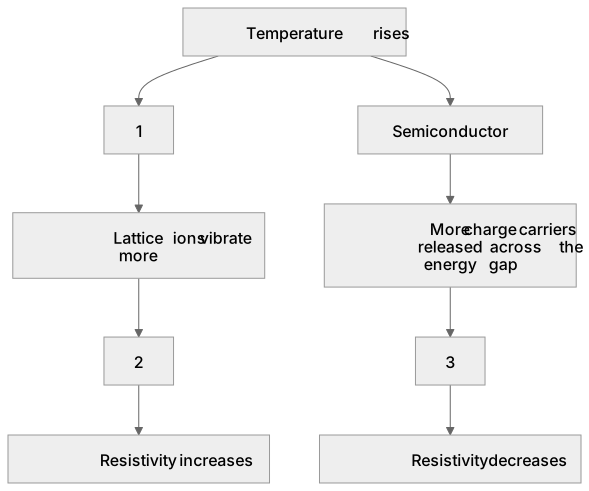
1Box 1
2Box 2
3Box 3
There is more to this lesson
The full lesson goes on to check your understanding and help you earn the marks. Create a free account to carry on, with your progress saved.
A week of Premium from your first lesson · Then the free plan continues · No card, no charge
Test your understanding of Resistivity: (b) the variation of resistivity of metals and semiconductors with temperature
Active recall beats re-reading. Take an instant quiz now to test what you’ve learned and lock it into long-term memory.
A week of Premium from your first lesson · Then the free plan continues · No card, no charge